
Mindmap
Introduction to quantitative research
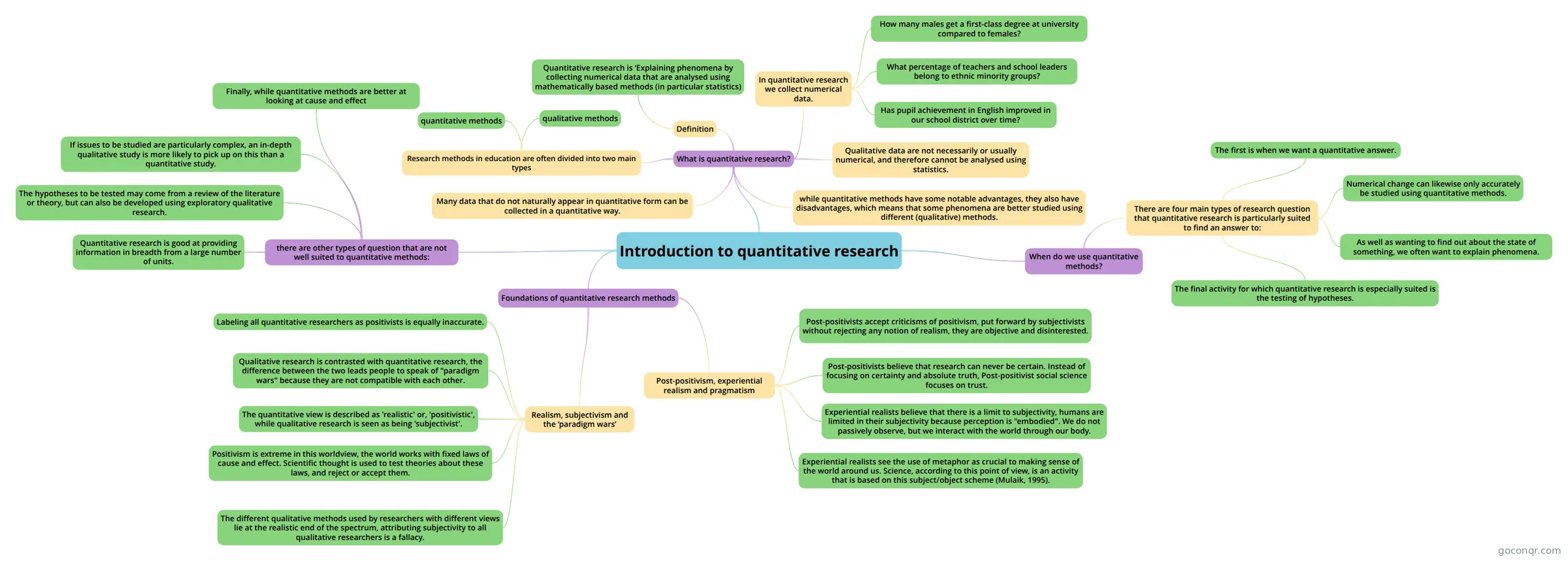
Mind map: Introduction to quantitative research
Inhalt der Mindmap
Introduction to quantitative research
What is quantitative research?
- Research methods in education are often divided into two main types
- quantitative methods
- qualitative methods
- Definition
- Quantitative research is ‘Explaining phenomena by collecting numerical data that are analysed using mathematically based methods (in particular statistics)
- In quantitative research we collect numerical data.
- How many males get a first-class degree at university compared to females?
- What percentage of teachers and school leaders belong to ethnic minority groups?
- Has pupil achievement in English improved in our school district over time?
- Qualitative data are not necessarily or usually numerical, and therefore cannot be analysed using statistics.
- Many data that do not naturally appear in quantitative form can be collected in a quantitative way.
- while quantitative methods have some notable advantages, they also have disadvantages, which means that some phenomena are better studied using different (qualitative) methods.
- Research methods in education are often divided into two main types
Foundations of quantitative research methods
- Realism, subjectivism and the ‘paradigm wars’
- Qualitative research is contrasted with quantitative research, the difference between the two leads people to speak of "paradigm wars" because they are not compatible with each other.
- The quantitative view is described as 'realistic' or, 'positivistic', while qualitative research is seen as being 'subjectivist'.
- Positivism is extreme in this worldview, the world works with fixed laws of cause and effect. Scientific thought is used to test theories about these laws, and reject or accept them.
- The different qualitative methods used by researchers with different views lie at the realistic end of the spectrum, attributing subjectivity to all qualitative researchers is a fallacy.
- Labeling all quantitative researchers as positivists is equally inaccurate.
- Post-positivism, experiential realism and pragmatism
- Post-positivists accept criticisms of positivism, put forward by subjectivists without rejecting any notion of realism, they are objective and disinterested.
- Post-positivists believe that research can never be certain. Instead of focusing on certainty and absolute truth, Post-positivist social science focuses on trust.
- Experiential realists believe that there is a limit to subjectivity, humans are limited in their subjectivity because perception is "embodied". We do not passively observe, but we interact with the world through our body.
- Experiential realists see the use of metaphor as crucial to making sense of the world around us. Science, according to this point of view, is an activity that is based on this subject/object scheme (Mulaik, 1995).
- Realism, subjectivism and the ‘paradigm wars’
When do we use quantitative methods?
- There are four main types of research question that quantitative research is particularly suited to find an answer to:
- The first is when we want a quantitative answer.
- Numerical change can likewise only accurately be studied using quantitative methods.
- As well as wanting to find out about the state of something, we often want to explain phenomena.
- The final activity for which quantitative research is especially suited is the testing of hypotheses.
- There are four main types of research question that quantitative research is particularly suited to find an answer to:
there are other types of question that are not well suited to quantitative methods:
- Quantitative research is good at providing information in breadth from a large number of units.
- The hypotheses to be tested may come from a review of the literature or theory, but can also be developed using exploratory qualitative research.
- If issues to be studied are particularly complex, an in-depth qualitative study is more likely to pick up on this than a quantitative study.
- Finally, while quantitative methods are better at looking at cause and effect
Informationen
- Beschreibung
- Mindmap am Introduction to quantitative research, erstellt von Joselyn Bedón am 20/04/2022.
- Erstellt von
- Joselyn Bedón
- Aufrufe
- 8
- Bewertung