
Mindmap
Assessing Reading
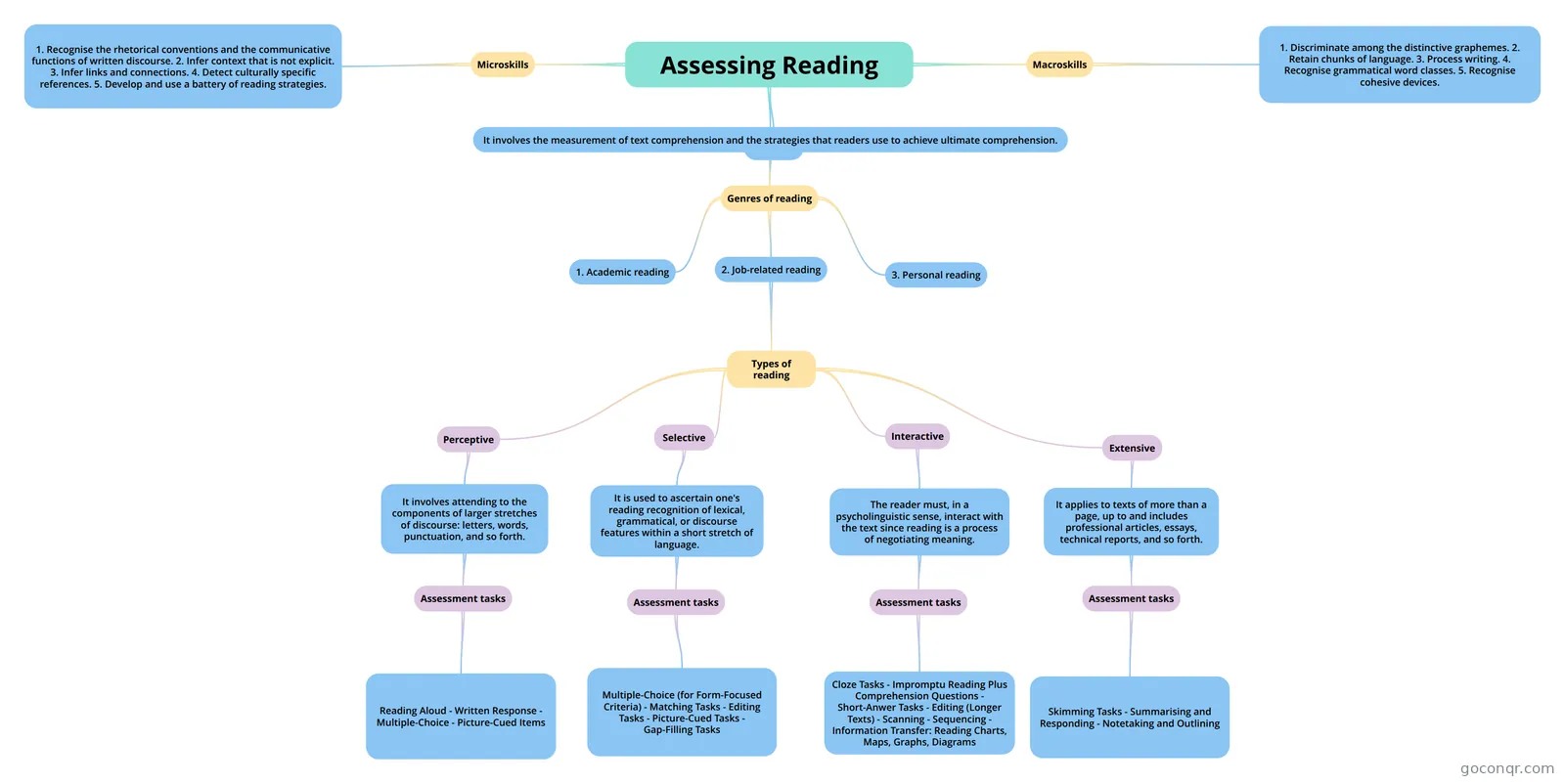
Mind map: Assessing Reading
Inhalt der Mindmap
Assessing Reading
It involves the measurement of text comprehension and the strategies that readers use to achieve ultimate comprehension.
- Genres of reading
- 2. Job-related reading
- Types of reading
- Selective
- It is used to ascertain one's reading recognition of lexical, grammatical, or discourse features within a short stretch of language.
- Assessment tasks
- Multiple-Choice (for Form-Focused Criteria) - Matching Tasks - Editing Tasks - Picture-Cued Tasks - Gap-Filling Tasks
- Assessment tasks
- It is used to ascertain one's reading recognition of lexical, grammatical, or discourse features within a short stretch of language.
- Interactive
- The reader must, in a psycholinguistic sense, interact with the text since reading is a process of negotiating meaning.
- Assessment tasks
- Cloze Tasks - Impromptu Reading Plus Comprehension Questions - Short-Anwer Tasks - Editing (Longer Texts) - Scanning - Sequencing - Information Transfer: Reading Charts, Maps, Graphs, Diagrams
- Assessment tasks
- The reader must, in a psycholinguistic sense, interact with the text since reading is a process of negotiating meaning.
- Perceptive
- It involves attending to the components of larger stretches of discourse: letters, words, punctuation, and so forth.
- Assessment tasks
- Reading Aloud - Written Response - Multiple-Choice - Picture-Cued Items
- Assessment tasks
- It involves attending to the components of larger stretches of discourse: letters, words, punctuation, and so forth.
- Extensive
- It applies to texts of more than a page, up to and includes professional articles, essays, technical reports, and so forth.
- Assessment tasks
- Skimming Tasks - Summarising and Responding - Notetaking and Outlining
- Assessment tasks
- It applies to texts of more than a page, up to and includes professional articles, essays, technical reports, and so forth.
- Selective
- Types of reading
- 3. Personal reading
- 1. Academic reading
- 2. Job-related reading
- Genres of reading
Macroskills
- 1. Discriminate among the distinctive graphemes. 2. Retain chunks of language. 3. Process writing. 4. Recognise grammatical word classes. 5. Recognise cohesive devices.
Microskills
- 1. Recognise the rhetorical conventions and the communicative functions of written discourse. 2. Infer context that is not explicit. 3. Infer links and connections. 4. Detect culturally specific references. 5. Develop and use a battery of reading strategies.