
Mindmap
Plant & Planetary Evolution
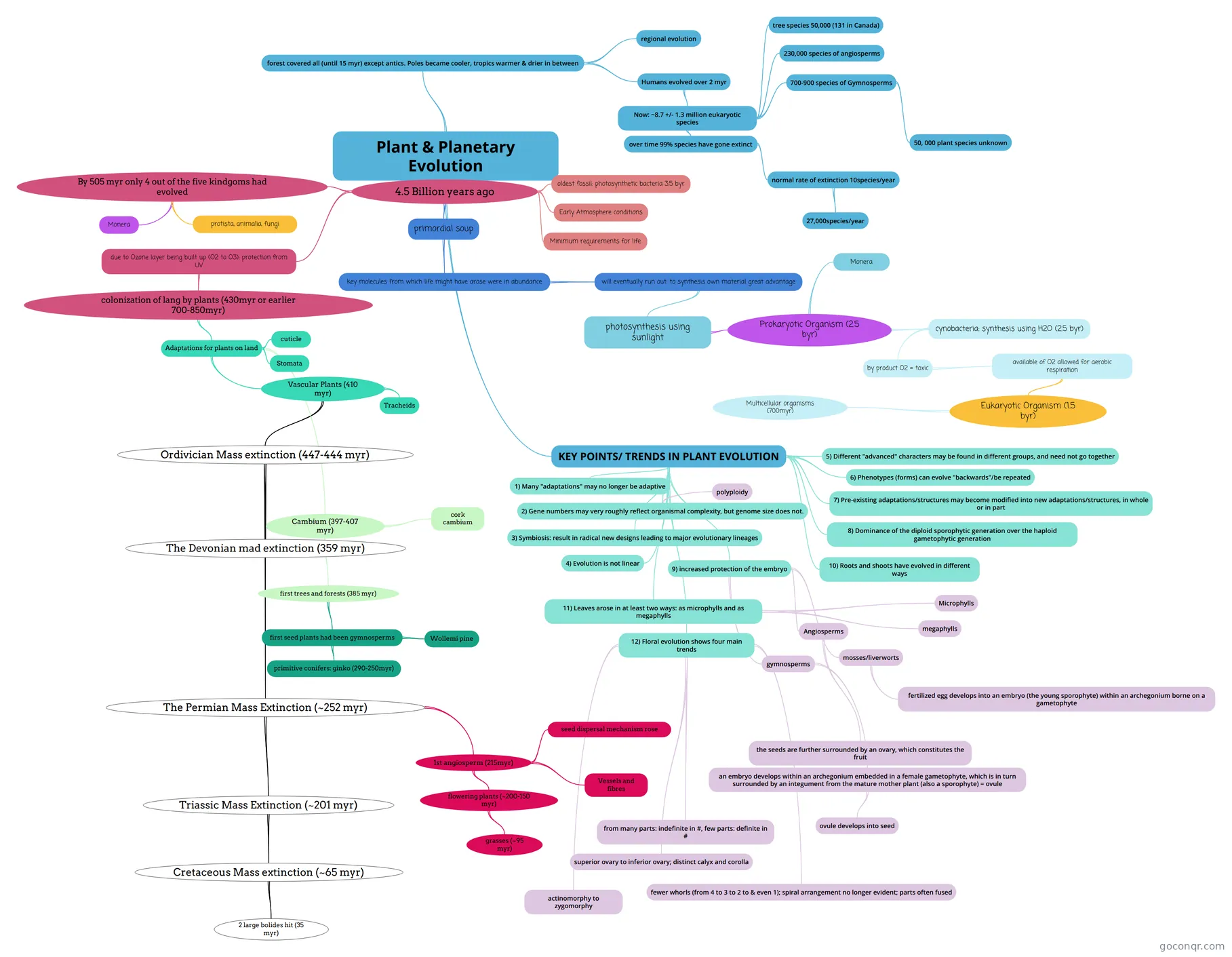
Mind map: Plant and planetary evolution
Inhalt der Mindmap
Plant & Planetary Evolution
4.5 Billion years ago
- Early Atmosphere conditions
- mostly N2 -same CO2 higher (10-30%) -now 0.04% H2 large amounts initially, than dropped H2S, NH3, Ch4 present little to no oxygen -now 21%
- oldest fossil: photosynthetic bacteria 3.5 byr
- Minimum requirements for life
- Organic molecule that replicate Variation selection: driving evolution
- primordial soup
- key molecules from which life might have arose were in abundance
- will eventually run out: to synthesis own material great advantage
- photosynthesis using sunlight
- Prokaryotic Organism (2.5 byr)
- Unicellular organism that lacks a a nuculeus and membrane bound organelles
- cynobacteria: synthesis using H2O (2.5 byr)
- by product O2 = toxic
- available of O2 allowed for aerobic respiration
- Eukaryotic Organism (1.5 byr)
- have cells with uncle & other organelles, such as chloroplast & mitochondria !!sexual reproductive organelles!!
- Multicellular organisms (700myr)
- Eukaryotic Organism (1.5 byr)
- available of O2 allowed for aerobic respiration
- by product O2 = toxic
- Monera
- Prokaryotic Organism (2.5 byr)
- photosynthesis using sunlight
- will eventually run out: to synthesis own material great advantage
- key molecules from which life might have arose were in abundance
- By 505 myr only 4 out of the five kindgoms had evolved
- protista, animalia, fungi
- Monera
- due to Ozone layer being built up (O2 to O3): protection from UV
- build up O2 via photosynthesis over time (1.5byr) but due to forming of Fe3O2 to reduce gases from volcanoes, all the Fe needed to used up before O2 could be added to the atmosphere to produce O3:ozone.
- colonization of lang by plants (430myr or earlier 700-850myr)
- took time, hard to live on land. extreme T change water not always available on land: seeds need dormancy mech. to suspend activity. sperm can't swim on land: need pollen (wind dispersal instead) not dense: plants need support need to retain H2O
- Adaptations for plants on land
- cuticle
- Waxy layer that coats leaves & young stems, help to retain water, but water loss cannot be avoided entirely
- Stomata
- Microscopic holes in leaves that are capable of opening & closing in a matter of seconds
- Vascular Plants (410 myr)
- Plants with vascular transport systems: veins
- Tracheids
- hollow non-living cells with thick, hard walls
- Ordivician Mass extinction (447-444 myr)
- due to cooling 86% of species lost
- The Permian Mass Extinction (~252 myr)
- Abrupt 96% species lost -the great dying volcanic erruption (in siberia) resulting in acidification and warming from released CO2, SO2, CH4 into the atmosphere
- 1st angiosperm (215myr)
- gymnosperms continued to dominate until 110 myr ago.
- seed dispersal mechanism rose
- due to angios having fruit/ covered seeds and complicated flowers
- Vessels and fibres
- more elaborate water transport systems vessels: transport -more open for H2O to enter fibers:support
- flowering plants (~200-150 myr)
- grasses (~95 myr)
- Triassic Mass Extinction (~201 myr)
- 80% specie loss : overtime methane gas
- Cretaceous Mass extinction (~65 myr)
- K-T abrupt: bolide impact in mexico the dust caused a short but intense winter. CO2 was also released for the winter was followed by a greenhouse warming effect. destroyed the dinosaurs, plants recovered by seeds and spores
- 2 large bolides hit (35 myr)
- siberia & NE cost of N.A. may have caused another round of extinction
- The Devonian mad extinction (359 myr)
- cooling ~75% species lost
- Cambium (397-407 myr)
- layer of cells just under the bark that produces the highly organized vascular tissue we call wood.
- true trees & other woody plants
- cork cambium
- Bark: needed to protect the stems of large lived plants
- first trees and forests (385 myr)
- Plants had become abundant and diverse include club moses, horsetails, ferns, pro gymnosperms (i.e. archaeopteris) and first seed-bearing plants
- first seed plants had been gymnosperms
- included cycads and seed "ferns" some seed ferns and primitive conifers were tall trees
- Wollemi pine
- small tree found in australia in 1994, thought to have been extinct 150 my ago!
- primitive conifers: ginko (290-250myr)
- cuticle
- Early Atmosphere conditions
forest covered all (until 15 myr) except antics. Poles became cooler, tropics warmer & drier in between
- regional evolution
- Humans evolved over 2 myr
- Now: ~8.7 +/- 1.3 million eukaryotic species
- over time 99% species have gone extinct
- normal rate of extinction 10species/year
- 27,000species/year
- normal rate of extinction 10species/year
- 230,000 species of angiosperms
- 700-900 species of Gymnosperms
- 50, 000 plant species unknown
- tree species 50,000 (131 in Canada)
- over time 99% species have gone extinct
- Now: ~8.7 +/- 1.3 million eukaryotic species
KEY POINTS/ TRENDS IN PLANT EVOLUTION
- 1) Many "adaptations" may no longer be adaptive
- ie, a plant might be dispersed by a extinct species or dandelion producing pollen, however are actually asexual.
- 2) Gene numbers may very roughly reflect organismal complexity, but genome size does not.
- some plant genomes are absolutely huge, containing a lot of genetic material that does not correspond to genes.
- polyploidy
- containing more than two sets of chromosomes -doesn't aid in functionality redundancy: can promote reproduction isolation and speciation
- 3) Symbiosis: result in radical new designs leading to major evolutionary lineages
- ie chloroplast & mitochondira originated from bacterial cells living symbiotically inside single-celled eukaryotic cells.
- 4) Evolution is not linear
- lacks direction full of branches that split apart and can come back together
- 5) Different "advanced" characters may be found in different groups, and need not go together
- i.e. a species may be "primitive" in one respect, but highly evolved in another).
- 6) Phenotypes (forms) can evolve "backwards"/be repeated
- An example of simplification is seen in parasitic plants that “steal” that live partially inside other plants or use mycorrhizal fungi to steal food from them. may be able to do photosynthesis but lack leaves (cause they don't need them) also C4 photo differs from C3 photo
- 7) Pre-existing adaptations/structures may become modified into new adaptations/structures, in whole or in part
- many flowers parts are modified leaves
- 8) Dominance of the diploid sporophytic generation over the haploid gametophytic generation
- alteration of generations: haploid/diplod
- 9) increased protection of the embryo
- green algae charophytes to mosses & ferns to primitive seed plants to angiosperms
- mosses/liverworts
- fertilized egg develops into an embryo (the young sporophyte) within an archegonium borne on a gametophyte
- gymnosperms
- an embryo develops within an archegonium embedded in a female gametophyte, which is in turn surrounded by an integument from the mature mother plant (also a sporophyte) = ovule
- ovule develops into seed
- an embryo develops within an archegonium embedded in a female gametophyte, which is in turn surrounded by an integument from the mature mother plant (also a sporophyte) = ovule
- Angiosperms
- the seeds are further surrounded by an ovary, which constitutes the fruit
- 10) Roots and shoots have evolved in different ways
- roots have remained structurally "primitive" relative to shoots
- 11) Leaves arose in at least two ways: as microphylls and as megaphylls
- Microphylls
- are small and primitive and have only one vein originated from superficial outgrowths from the stem or epidermis
- megaphylls
- usually bigger and seem to have evolved from branch systems that were flattened and then became fused or webbed to result in the leaf blade
- Microphylls
- 12) Floral evolution shows four main trends
- from many parts: indefinite in #, few parts: definite in #
- fewer whorls (from 4 to 3 to 2 to & even 1); spiral arrangement no longer evident; parts often fused
- superior ovary to inferior ovary; distinct calyx and corolla
- inferior: more advanced/protected
- actinomorphy to zygomorphy
- 1: always symmetrical 2: can only cut one way
- 1) Many "adaptations" may no longer be adaptive
Informationen
- Beschreibung
- Midterm FRST 200 Mindmap am Plant & Planetary Evolution, erstellt von dsaele am 08/10/2015.
- Erstellt von
- dsaele
- Aufrufe
- 1
- Bewertung