
Mindmap
English Syntax
Inhalt der Mindmap
English Syntax
Week 1; UNIT 1: SYNTAX AND LEXICAL ITEMS
- Word classes and their criteria
- Morphological criterion
- Formation of words and their changes through the use of affixes, prefixes, and suffixes, as well as morphemes. morphemes.
- Semantic criterion
- meaning of words and their correct use
- Syntactic criterion
- how words come together to form coherent.
- Morphological criterion
- Grammar
- System of rules allow interpret words clauses, phrases, and sentences.
- Syntax
- Defines the order of words, clauses and phrases in order to form precise sentences. form precise sentences.
- Word classes according to the Syntactic Criterion (Position)
- Lexical words
- nouns, verbs, adjectives, and adverbs.
- Function words
- determiners, conjunctions, prepositions, auxiliaries.
- Lexical words
- Structure (Internal Syntax) words are put together to form sentences.
- Luisa is a nice girl: Noun + verb + determiner + adjective + noun
- Function (External Syntax) relation of each constituent within a sentence.
- Luisa is a nice girl Subject + verb + object (Predicate)
- Morpho-Syntactic Criterion
- complement and verb must agree in person and number in order to be coherent.
- DERIVATIONAL AFFIXES
- derivation of words.
- Word classes and their criteria
Week 3: UNIT 2. SUBJECT, COMPLEMENTS AND SUBCATEGORIZATION RESTRICTIONS.
- Subject
- Types of Subjects.
- Proper nouns, Pronouns,Article , common noun, A plural common noun,A singular common noun or abstract nouns, A numeral + a common noun, An article + a numeral + a common noun,A clause
- Complements
- Subject complements
- usually preceded by a linking verb (predicate) which connects the subject with the complement.
- My mother is a doctor/beautiful Noun + copula verb (predicate) + subject complement
- can be other nouns, pronouns, or adjectives, which rename or define in some way the subject
- usually preceded by a linking verb (predicate) which connects the subject with the complement.
- Subject complements
- word or string of words that are coherent and possess a definite structure.
- Complement configuration of Nouns
- No complement: use of a single noun, can be accompanied by articles, determiners, or numerals) as subject. Examples: The book is on the desk (BOOK: N)
- Prepositional Phrases : They contain a preposition (of, in, …) to connect the main noun with its complement. Examples: The king of Spain is very nice (KING: N + PP.)
- Infinitival phrases :as complements of nouns: They use infinitives (to + verb) to complementize the noun. Example Her ability to paint is amazing (ABILITY: N + Inf.P.)
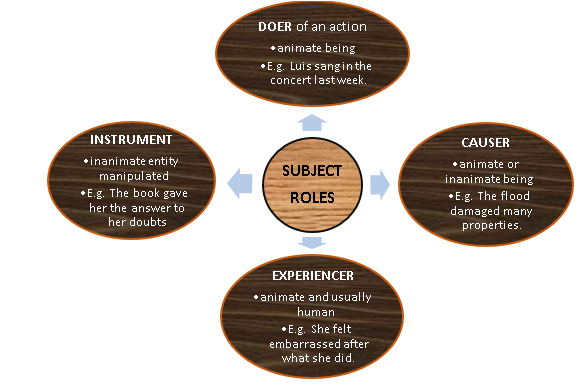
- Subject Roles
- Types
- Types of Subjects.
- Subject
Week 4 UNIT 2. SUBJECT, COMPLEMENTS AND SUBCATEGORIZATION RESTRICTIONS.
- Object complement
- These are the elements that modify or complement the object. It can be a noun or adjective or any structure acting as a noun or adjective. Example: My mom made me happy. (happy modifies/complements the object me)
- Adjectives complement
- Adjective alone: It can be alone with no complement Example: Nicole is nice.
- Prenominal adjectives: this refers to a NP or PP This is a beautiful house ( house modifies/ complements the adjective beautiful)
- Adjective followed by Prepositional phrase: works as the complement of the adjective it modifies. Jorge is angry with his wife.
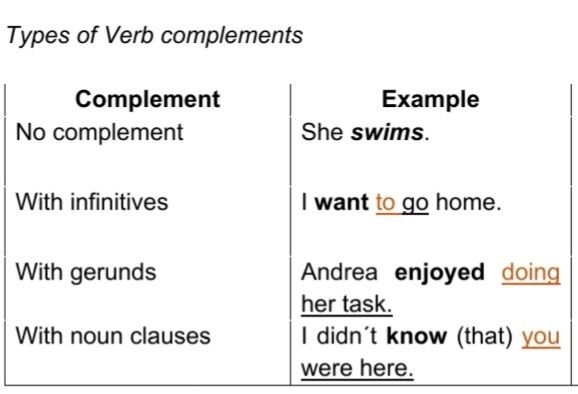
- Verbs complements
- refers are those constituents that are needed to make a syntactic construction comprehensible.
- Types of verb complements
- Set of general subcategorization restrictions of verbs.
- Intransitive verbs, Intransitive locative prepositional verbs, Transitive verb, Transitive prepositional verb,Ditransitive verb, Copula and Linking verb
- Object complement
Week 5 UNIT 3: SYNTACTIC LINKAGE ACCORDING TO THE GRAMMATICAL FUNCTIONS.
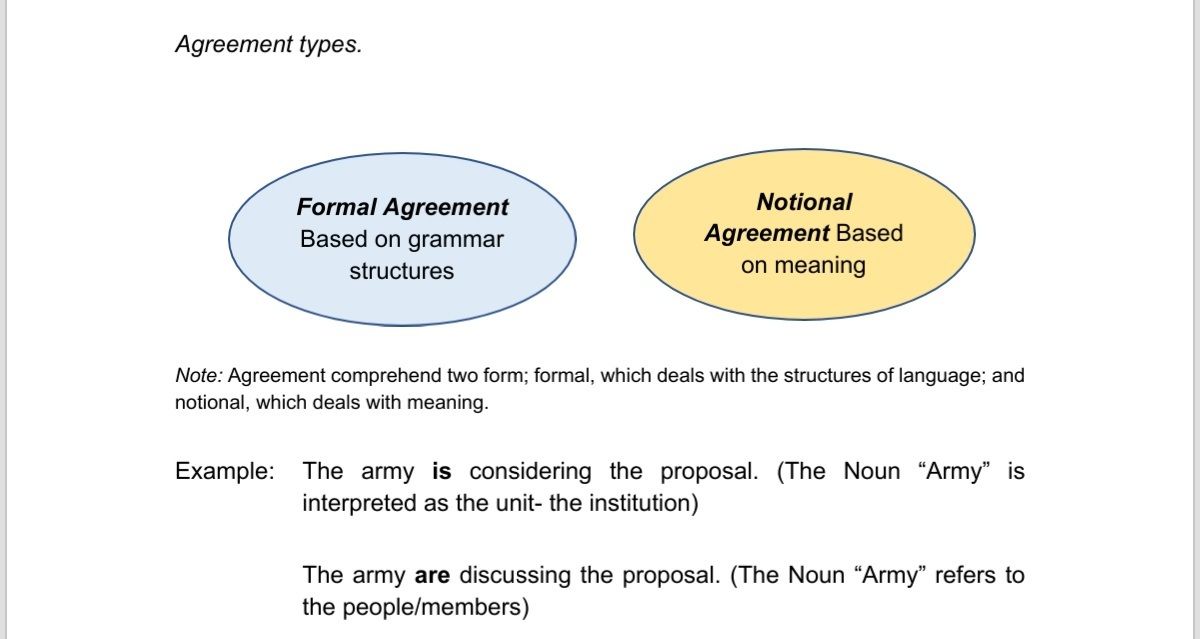
- Agreement
- it means the relationship between the different elements of a sentence or phrase
- Relations of agreement
- Subject-Verb Agreement and Subject Pronouns
- It relates to number agreement singular or plural.
- Subject-Verb Agreement and Subject Pronouns
- Types
- Rules of agreement.
- If the subject is singular, the verb must be singular too
- If the subject is plural, the verb must also be plural.
- When there is one subject and more than one verb, the verbs throughout the sentence must agree with the subject
- When two or more singular nouns or pronouns are connected by "or" or "nor," use a singular verb.
- Subjects and Objects
- Syntactic Linkage
- phrases or clauses are linked to form coherent structures and provide meaning.
- Agreement
Week 6:UNIT 3: SYNTACTIC LINKAGE ACCORDING TO THE GRAMMATICAL FUNCTIONS.
- Government refers to the relation between a word and its dependents.
- Case refers to the grammatical relationship of nouns and pronouns with other words in a sentence.
- three main case distinctions
- Nominative case: refers to the Nouns or pronouns used as subjects (E. g: Michael lost his watch) and for a subject complement. (E. g: Michael is a teacher).
- Genitive Case: use apostrophes ´s, s,
- Accusative and Dative Case: This Case refers to the use of Objective nouns or pronouns that receive the action in the sentence.
- -Direct Object -Indirect Object (also known as Dative) - Oblique Object
Week 2; UNIT 1 SYNTAX AND LEXICAL ITEMS
- Heads
- element on which the sentence is centered.
- Types of phrases
- Adv.P. Adverb Phrase E.g. Too slowly
- Adj.P. Adjective Phrase E.g. Very tall
- VP Verb phrase E.g: Watch TV
- NP Noun phrase E.g. A nice table
- Modifiers
- create coherent communication.
- COMPLEMENTS
- Obligatory
- Provide meaning to the sentence
- ADJUNCTS
- Optional
- Provide further details to the clause.
- Heads
Week 7; UNIT 3: SYNTACTIC LINKAGE ACCORDING TO THE GRAMMATICAL FUNCTIONS.
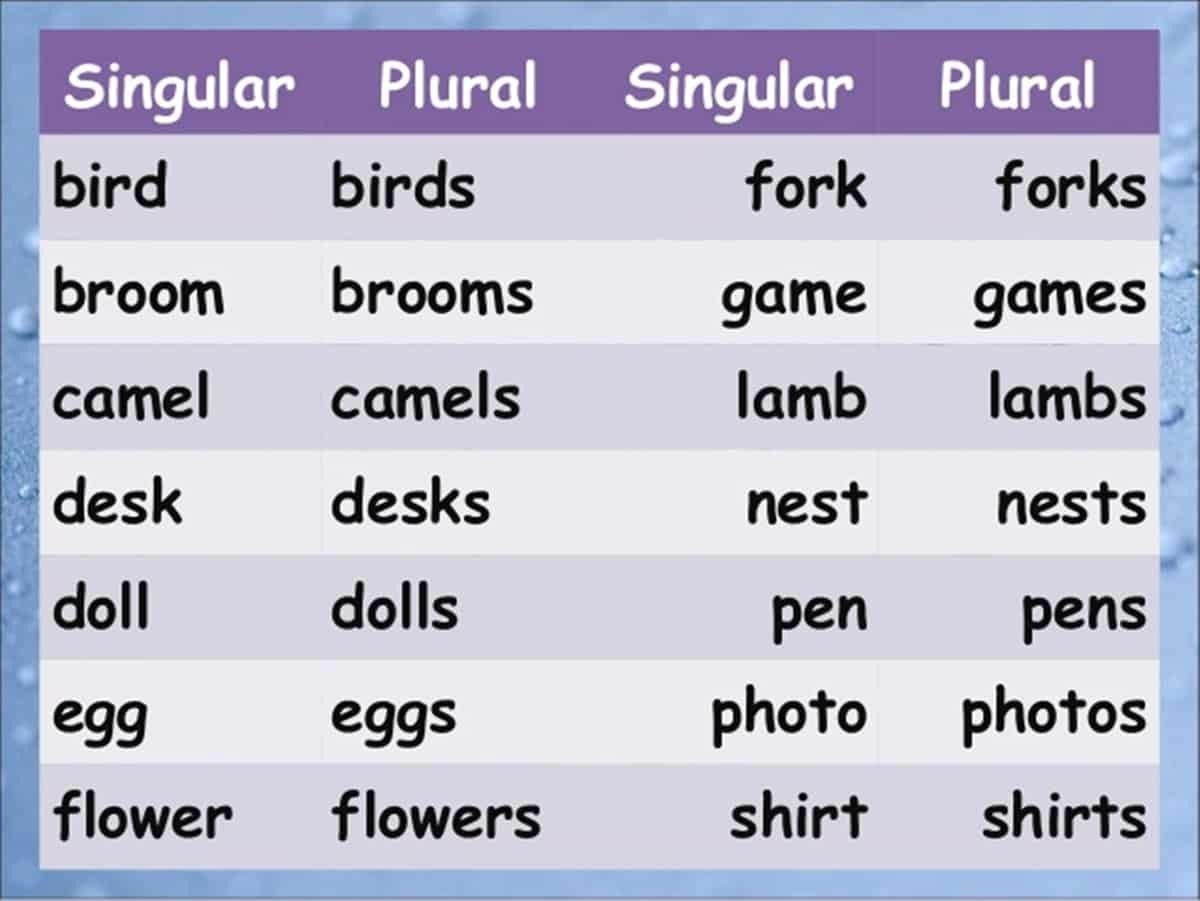
- Number
- Singular and plural
- Example
- Nouns, pronouns, adjectives, and verbs.
- Example: I have to fix those chairs over there.
- Singular and plural
- Person
- Second person: you
- Third person: He, She, it, they.
- relationship between the subject and its verb
- First person: I/we
- Examples: I will do it myself.
- Example: Antonio is selling his house.
- Gender
- nouns, pronouns, articles, or adjectives are defined as masculine, feminine, or neutral adjectives are not restricted to gender and number.
- Carmen has two beautiful children.
- They are a boy and a girl.
- nouns, pronouns, articles, or adjectives are defined as masculine, feminine, or neutral adjectives are not restricted to gender and number.
- Number
Bilder und Dateien der Mindmap
Informationen
- Beschreibung
- Mindmap am English Syntax, erstellt von Michelle Masache am 23/11/2022.
- Erstellt von
- Michelle Masache · Nov 2022
- Aktualisiert
- 24 Nov 2022
- Aufrufe
- 8
- Bewertung