
Syntax and Grammar
328 resources created by 260 users
This Syntax and Grammar page on GoConqr gathers community-made mind maps, flashcards, quizzes, flowcharts and notes, from phrase structure and constituent tests to word classes, subordination and Chomsky's Y-model. It's built for university students and professional candidates revising a topic or filling gaps, and for teachers after ready-made material. There are over 300 resources here, including more than 240 mind maps, over 30 flashcard decks and 7 quizzes. Pick a starting point, try a quiz to find your gaps, then make your own set.
Select topic
- Grammatical Terminology15
- Types of Grammar26
- Generative and Transformational Grammar16
- Parts of Speech and Word Classes31
- Morphology and Word Formation9
- Types of Verbs5
- Modality6
- Phrases and Phrase Types16
- Constituency and Syntax Trees24
- Sentence Structure and Grammatical Functions16
- Clauses and Complex Sentences16
- Adverbials6
- Grammar and Discourse5
Top Syntax and Grammar resources
-
45 cards12.) Syntax 2 Syntactic function vs. form What is the difference between syntactic function and syntactic form? defined by?
-
34 cardsGiU Topic 2 - Terminology
-
Mind map PHRASE STRUCTURE GRAMMAR Mind map that explains phrasal structure and verb complementation in English grammar
-
Flowchart Subordination I: Adjunct clauses
-
9 cardsSemantic, Morphologic & Syntactic Criteria for Descriptions
-
42 cardsEnglish terms AS Noun that is a name
-
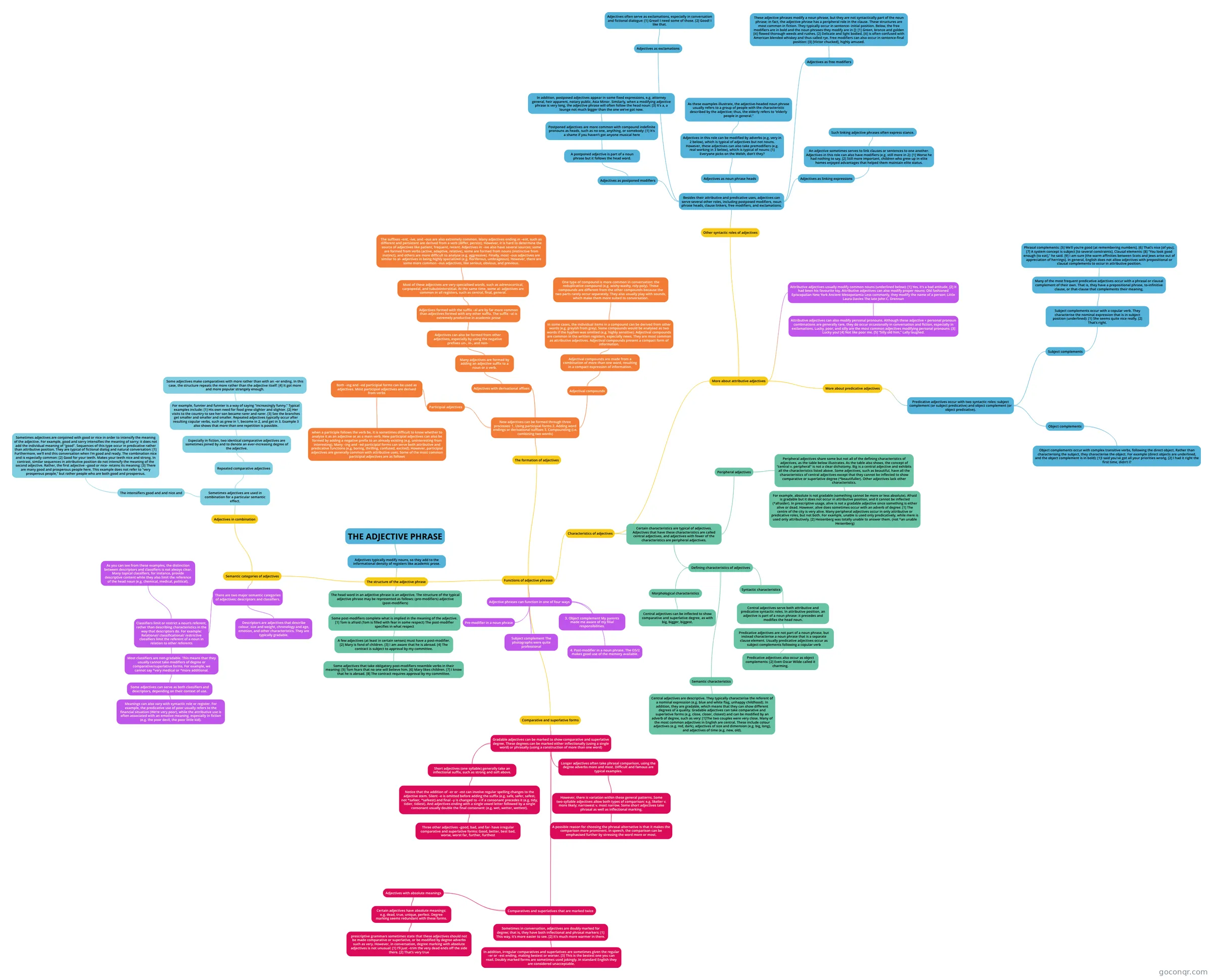 Mind map THE ADJECTIVE PHRASE
-
49 cardsGiU Topic 4 - Terminology
Quizzes
-
38 questionsLing Ch 9 Syntax is the study of how...
-
20 questionsUNIT 3 - MOCK TEST 1 FOR UNITS 1, 2 & 3 The following is NOT a type of verbal complementation:
-
19 questionsSyntax Quiz Syntax is the study/rule of how sentences are formed.
-
20 questionssyntax
-
15 questionsDiscourse Analysis: Self-evaluation Unit 4 Functionalism relies on...
-
9 questionsUntitled 1. What do the two sentences “The boy is sleeping.” and “Is the boy sleeping?” have in common?
-
6 questionsSome properties of language organs Which kind of recursive devices can be found in the sentences above?
Mind maps
See all 259 mind maps-
PHRASE STRUCTURE GRAMMAR Mind map that explains phrasal structure and verb complementation in English grammar
-
THE ADJECTIVE PHRASE
-
WORDS AND WORD CLASSES MIND MAP COPIA
-
Clause elements COPIA
-
Grammatical categories and word classes
-
Parts of speech (Word classes)
-
English Syntax
-
Phrasal structure and verb complementation
Flashcards
See all 34 flashcards-
45 cards12.) Syntax 2 Syntactic function vs. form What is the difference between syntactic function and syntactic form? defined by?
-
34 cardsGiU Topic 2 - Terminology
-
9 cardsSemantic, Morphologic & Syntactic Criteria for Descriptions
-
42 cardsEnglish terms AS Noun that is a name
-
49 cardsGiU Topic 4 - Terminology
-
91 cardsSpring workshop material
-
44 cards11.) Syntax 1 What is syntax?
-
35 cardsVocabulary Ch.1
Flowcharts
See all 17 flowchartsNotes
-
Intro to lingu Syntax Syntax is the component of grammar that deals with how words are combined into phrases and sentences. Lexical Categories(“parts of speech”) Distribution criteria The criteria we use for deter...
-
Understanding Sentences The linguistic theory of Chomsky Based on two related ideas:(1) relations between the language and the brain(2) a technical description of the structure of languageLanguage is a special feature that is innate, species...
-
Grammar and Syntax Phrases; one or more words that function as a unit in a sentence. Usually contains a head word accompanied by modifiers (describe/give more info about the head word. There are pre modifiers and post modifiers. N...
-
syntax SYNTAX Is the way words and clauses are arranged to form sentences. Structures of sentences:SIMPLE: one independent clause; The ...
-
GENERATIVE SYNTAX - created from Mind Map CONSTITUENCY TREES THETA THEORY COMPLEMENTIZER PHRASE (CP)
-
Untitled - What are endocentric and exocentric phrases and which kind of phrases belongs to which class? Give examples.Answer: Endocentric: It has the head. Having the center in itself. The phrases that belong to it, verb, nou...
-
GRAMMATICAL CATEGORIES GRAMMATICAL CATEGORIESGrammatical morpheme may be either free roots(function words) or bound affixes (inflectional affixes).Chapter 4 shows the distinction between lexical and grammatical morphemes.Latin/Greek - synth...
-
TENSE
Slides
Topics in Syntax and Grammar
More Linguistics and philology topics
About Syntax and Grammar
GoConqr OriginalWhat this unit covers
The resources here work through how words combine into phrases and sentences. The mind map PHRASE STRUCTURE GRAMMAR sits at the top of the page and deals with immediate constituent analysis, diagramming, hierarchical structure and the generative approach. Other maps cover the noun phrase, the adjective phrase, word classes and grammatical categories.
Where to start
Begin with the overview material, then move to the terminology decks.
- Read the mind map PHRASE STRUCTURE GRAMMAR for the big picture.
- Work through the notes Intro to lingu, which explain syntax, lexical categories and distribution criteria.
- Use the flashcard deck GiU Topic 2 - Terminology to learn constituent, substitution, movement and coordination.
- Move on to GiU Topic 4 - Terminology for noun phrases, pronouns and their subcategories.
Function, form and clauses
The deck on syntactic function versus form uses the example sentence about the woman eating the apple to separate what a phrase does from what it is. The flowchart Subordination I: Adjunct clauses then shows how circumstantial clauses add detail to a main clause verb. Three small flowcharts break down sample sentences with relative and adverbial clauses, which is handy for practising analysis by eye.
Using quizzes and maps together
Read a map, then test yourself. The Syntax Quiz is a quick check on the basics, and the flowchart Diagram Tree gives you a model to compare with your own drawings. If a quiz shows a weak spot, go back to the matching map or deck and read it again. Teachers can use the maps and flowcharts as ready-made starting points for sessions.
Where it fits
This unit belongs to the Sound and Structure strand of Linguistics and philology. It sits alongside material on morphology, and the page lists a flowchart on that too. Most of what is here is aimed at university level.
Open a resource that matches where you are now, and when you are ready, build a map or deck of your own.
Frequently asked questions
Which resource should I open first?
Start with the mind map PHRASE STRUCTURE GRAMMAR. It introduces constituents, diagramming and hierarchical structure in one place. After that, the notes Intro to lingu explain the basic terms, and the terminology flashcard decks help you memorise them.
What do the mind maps cover?
There are over 240 of them. They range from phrase structure grammar and the noun phrase to the adjective phrase, verbs, word classes, grammatical categories and modality. Several are simply titled Syntax or Grammar, so scan a few to find the one that matches your course.
Are the resources free to use?
Yes. Every resource listed here is free to open, study and take, with no account needed. They were made by GoConqr users, not by GoConqr itself, so it is worth checking that a resource suits your course before relying on it.
Who are these resources for?
Almost all of them are university level, so they suit university students and professional candidates. Teachers can also use them as ready-made material. A few resources mention A-level English Language, but the page is mainly for higher study.
How many quizzes are there?
There are over 5 quizzes on this page, alongside flashcards, flowcharts and notes. They include the Syntax Quiz and a quiz on some properties of language organs. Use them after reading a map to see which topics need another look.
What if I cannot find the topic I need?
Try the related titles first, as syntax material also appears under Grammar, Word Classes and Parts of speech. If nothing fits, a free account lets you make your own quizzes, mind maps, flashcards and notes for that topic.