
Mindmap
TEACHING THIRD LANGUAGES. Ulrike Jessner
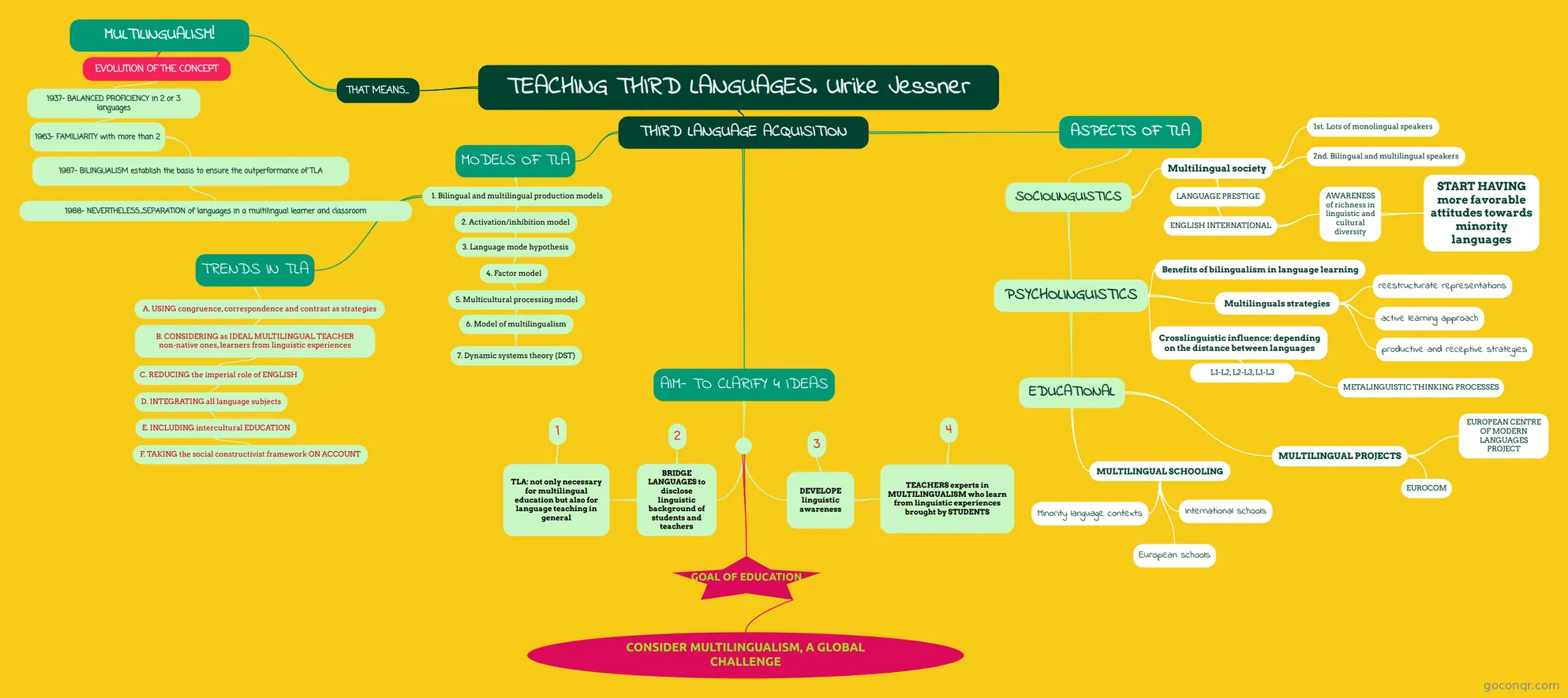
Mind map: Teaching third languages Ulrike Jessner
Inhalt der Mindmap
TEACHING THIRD LANGUAGES. Ulrike Jessner
THIRD LANGUAGE ACQUISITION
- AIM- TO CLARIFY 4 IDEAS
- GOAL OF EDUCATION
- CONSIDER MULTILINGUALISM, A GLOBAL CHALLENGE
- DEVELOPE linguistic awareness
- TEACHERS experts in MULTILINGUALISM who learn from linguistic experiences brought by STUDENTS
- 4
- 3
- TEACHERS experts in MULTILINGUALISM who learn from linguistic experiences brought by STUDENTS
- BRIDGE LANGUAGES to disclose linguistic background of students and teachers
- TLA: not only necessary for multilingual education but also for language teaching in general
- 1
- 2
- TLA: not only necessary for multilingual education but also for language teaching in general
- GOAL OF EDUCATION
- ASPECTS OF TLA
- SOCIOLINGUISTICS
- PSYCHOLINGUISTICS
- EDUCATIONAL
- MULTILINGUAL PROJECTS
- EUROPEAN CENTRE OF MODERN LANGUAGES PROJECT
- Languages awareness. Learning/Teaching in all languages
- EUROCOM
- 1. RECEPTIVE SKILLS 2. Transfer: between familiar languages (same origin) 3. Solid linguistic BASIS
- EUROPEAN CENTRE OF MODERN LANGUAGES PROJECT
- MULTILINGUAL SCHOOLING
- Minority language contexts
- L1, L2 and L3, instructed them all in different grade.
- European schools
- 1st GRADE : L2 2nd GRADE: L3 3rd GRADE: foreign pupils' languages 4t GRADE L4
- International schools
- L2 ENGLISH 1st GRADE: L3 IN ALL GRADES foreign language lessons
- Minority language contexts
- MULTILINGUAL PROJECTS
- Benefits of bilingualism in language learning
- Multilinguals strategies
- reestructurate representations
- active learning approach
- productive and receptive strategies
- Crosslinguistic influence: depending on the distance between languages
- L1-L2, L2-L3, L1-L3
- METALINGUISTIC THINKING PROCESSES
- L1-L2, L2-L3, L1-L3
- EDUCATIONAL
- Multilingual society
- 1st. Lots of monolingual speakers
- 2nd. Bilingual and multilingual speakers
- LANGUAGE PRESTIGE
- ENGLISH INTERNATIONAL
- AWARENESS of richness in linguistic and cultural diversity
- START HAVING more favorable attitudes towards minority languages
- AWARENESS of richness in linguistic and cultural diversity
- ENGLISH INTERNATIONAL
- PSYCHOLINGUISTICS
- SOCIOLINGUISTICS
- MODELS OF TLA
- 1. Bilingual and multilingual production models
- INFORMATION STORES: -conceptualizer - formulator - articulator
- TRENDS IN TLA
- A. USING congruence, correspondence and contrast as strategies
- B. CONSIDERING as IDEAL MULTILINGUAL TEACHER non-native ones, learners from linguistic experiences
- C. REDUCING the imperial role of ENGLISH
- D. INTEGRATING all language subjects
- E. INCLUDING intercultural EDUCATION
- F. TAKING the social constructivist framework ON ACCOUNT
- E. INCLUDING intercultural EDUCATION
- D. INTEGRATING all language subjects
- C. REDUCING the imperial role of ENGLISH
- B. CONSIDERING as IDEAL MULTILINGUAL TEACHER non-native ones, learners from linguistic experiences
- A. USING congruence, correspondence and contrast as strategies
- 2. Activation/inhibition model
- Levels of activation: -ACTIVE: language selected - DORMANT: language stored in longterm memory
- 3. Language mode hypothesis
- Speech variability depends on: participants, degree of formality, socio-economic status, message's form, mode of interaction...
- 4. Factor model
- Factors: neuropsychological, sociocultural, emotional, cognitive, linguistic, ESPECIFIC FACTOR (unique in each speaker)
- 5. Multicultural processing model
- Previously learned languages used as BRIDGE LANGUAGE. Spontaneous grammar with corresponding features between the languages. METACOGNITIVE STRATEGIES
- 6. Model of multilingualism
- TLA-Multilingualism-Multilinguality (influenced by social environment)
- 7. Dynamic systems theory (DST)
- Different multilingual systems commanded by the same speaker. MULTILINGUAL PROFICIENCY
- 1. Bilingual and multilingual production models
- AIM- TO CLARIFY 4 IDEAS
THAT MEANS...
- MULTILINGUALISM!
- EVOLUTION OF THE CONCEPT
- 1937- BALANCED PROFICIENCY in 2 or 3 languages
- 1963- FAMILIARITY with more than 2
- 1987- BILINGUALISM establish the basis to ensure the outperformance of TLA
- 1988- NEVERTHELESS...SEPARATION of languages in a multilingual learner and classroom
- 1987- BILINGUALISM establish the basis to ensure the outperformance of TLA
- 1963- FAMILIARITY with more than 2
- 1937- BALANCED PROFICIENCY in 2 or 3 languages
- EVOLUTION OF THE CONCEPT
- MULTILINGUALISM!