
Mindmap
Thermodynamics Unit
Inhalt der Mindmap
Thermodynamics Unit
Energy
- Can be TRANSFERED
- HEAT
- Change in system's energy ΔE = q + W
- System
- ex) a solution of HCL and another of NaOH were mixed together in a beaker with a stir rod
- Solution Chem: only the HCl and NaOH melecules (H+, OH-)
- ex) a solution of HCL and another of NaOH were mixed together in a beaker with a stir rod
- Surrounds
- EVERYTHING ELSE
- What Causes Chemical Rxns?
- Free Energy ("nature of reactants")
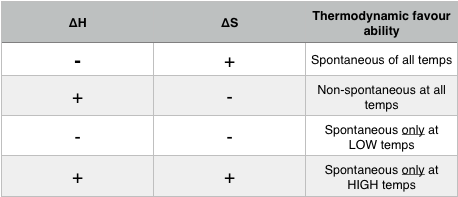
- ΔG = ΔH - TΔS
- ΔG: the max amount of energy that can be used to do work
- ΔH: energy transferred as heat
- TΔS: energy used to create disorder
- - : thermodynamically favoured (spontaneous)
- + : NOT thermodynamically favoured
- Calculate
- #1: Calculate ΔH from calorimtry OR Hess's OR ΔHf; then calculate ΔS using entropy values; and then plug in to find ΔG at a certain temp
- #2: Calculate ΔG using ΔGfº values
- (ΔG = ΣnΔGº (products)−ΣnΔGº (reactants))
- ΔG = ΔH - TΔS
- Entropy Δs: measure of disorder *more random wanted*
- 2nd law: Entropy of Universe is always increasing
- ΔS = S(products) - S(reactants)
- ΔSrxn = ΣnSº(products) - ΣnSº(reactants)
- Positive value is WANTED
- Enthalpy
- 1st Law of Thermodynamics: cannot be created or destroyed
- EXO
- ΔH = q = -
- ENDO
- ΔH = q = +
- EXO
- can be calculated 4 ways
- #3 Hess's Law
- if a rxn is carried in 1 or several steps, the overall change in enthalpy is equal to the sum of the enthalpy changes for each step
- #2 Calorimeter
- Heat transfer cannot be directly measured
- Heat Capacity [kJ/K (or Cº)]
- Specific heat capacity: amount of heat needed to raise the temperature of 1 kg of a substance by 1 k [kJ/kg•K (or Cº)]
- ΔH rxn vs Δq rxn [ΔH = Δq/n]
- total amount of heat lost or gained by a rxn
- Using stoichiometry
- ΔH rxn vs Δq rxn [ΔH = Δq/n]
- Specific heat capacity: amount of heat needed to raise the temperature of 1 kg of a substance by 1 k [kJ/kg•K (or Cº)]
- Heat Capacity [kJ/K (or Cº)]
- Heat transfer cannot be directly measured
- #1 Bond of Enthalpies
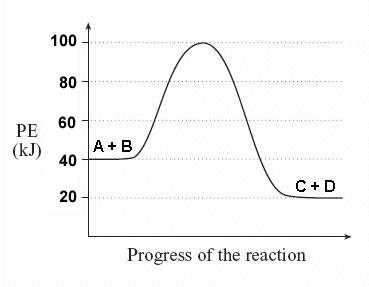
- Break bonds NEED energy
- For the image: A + B need energy to break up; C + D release energy when formed
- Form bonds REALEASE energy
- ΔH = ΣnBE - ΣnBE
- Σ = sum
- n = # of moles
- BE = bond energy *from exp't* values must be given
- ΔH = ΣnBE - ΣnBE
- Break bonds NEED energy
- #4 Enthalpy of Formation
- An arbitrary value that indicates how much heat would be lost/gained from experimental states
- ΔHº rxn=ΣnΔHºf (products)−ΣnΔHºf (Reactants)
- n: mol
- Most "Hº"'s will be given
- ΔHº rxn=ΣnΔHºf (products)−ΣnΔHºf (Reactants)
- An arbitrary value that indicates how much heat would be lost/gained from experimental states
- #3 Hess's Law
- 1st Law of Thermodynamics: cannot be created or destroyed
- Free Energy ("nature of reactants")
- q (+): heat transferred IN
- q (-): heat transferred OUT
- w (+): work done ON the system
- w (-): work done BY the system
- ΔE is change in PE and KE of particles in a system
- System
- Change in system's energy ΔE = q + W
- WORK W = -PΔV
- HEAT
- PE
- KE
- Temperature
- Conversions
- C = K - 273
- C = (5/9)(Fº - 32)
- a measure of the average KE of particles in a system
- If KE doubles, the temp doubles as well
- Conversions
- Temperature
- CANNOT BE CREATED OR DESTROYED
- Can be TRANSFERED
Bilder und Dateien der Mindmap
Informationen
- Beschreibung
- Thermodynamics in AP Chemistry
- Erstellt von
- Rachel Todd
- Aufrufe
- 445
- Tags
- Bewertung