
Mindmap
English Language Learning—An SLA-based Approach (Jörg-U. Keßler)
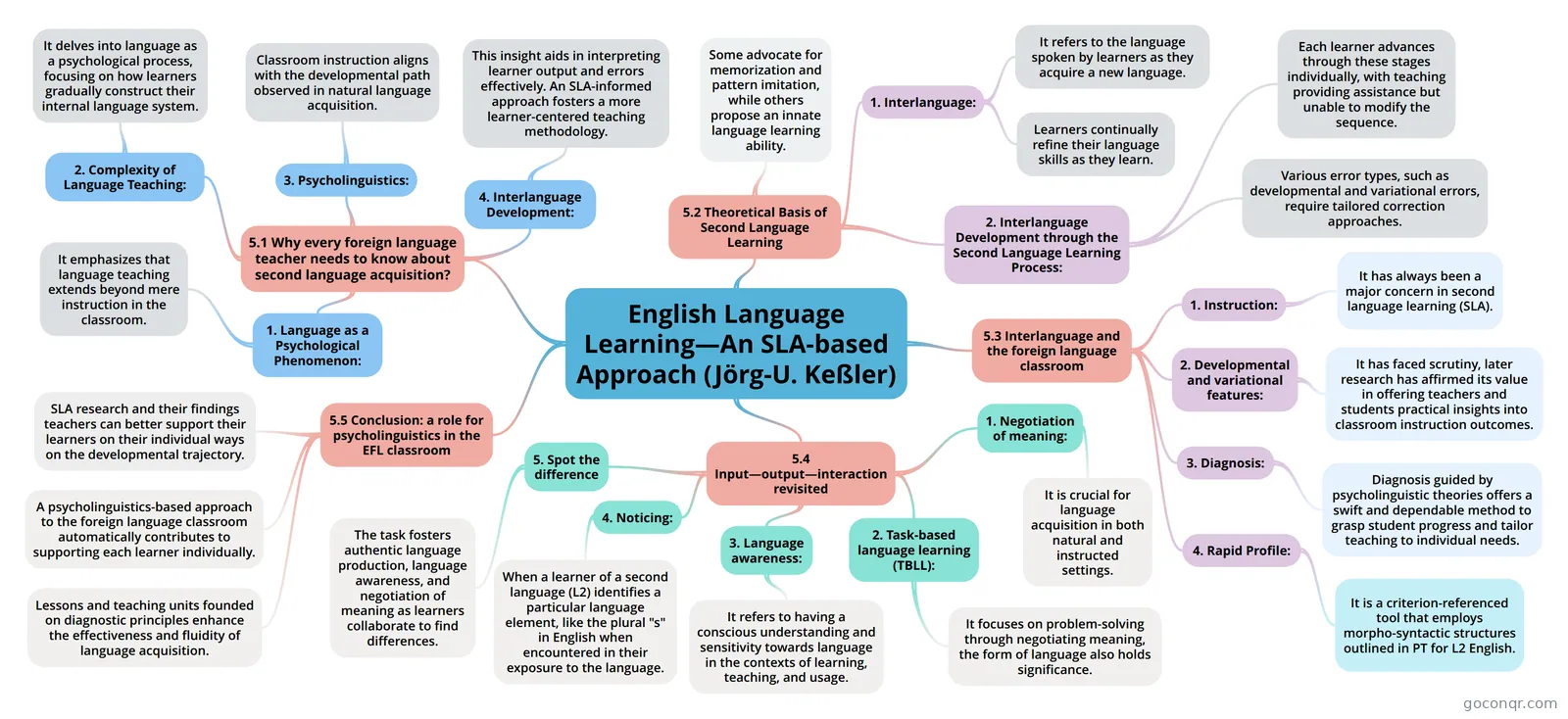
Mind map: English language learning SLA-based approach
Inhalt der Mindmap
English Language Learning—An SLA-based Approach (Jörg-U. Keßler)
5.1 Why every foreign language teacher needs to know about second language acquisition?
- 2. Complexity of Language Teaching:
- It delves into language as a psychological process, focusing on how learners gradually construct their internal language system.
- 1. Language as a Psychological Phenomenon:
- It emphasizes that language teaching extends beyond mere instruction in the classroom.
- 3. Psycholinguistics:
- Classroom instruction aligns with the developmental path observed in natural language acquisition.
- 4. Interlanguage Development:
- This insight aids in interpreting learner output and errors effectively. An SLA-informed approach fosters a more learner-centered teaching methodology.
- 2. Complexity of Language Teaching:
5.2 Theoretical Basis of Second Language Learning
- Some advocate for memorization and pattern imitation, while others propose an innate language learning ability.
- 1. Interlanguage:
- It refers to the language spoken by learners as they acquire a new language.
- Learners continually refine their language skills as they learn.
- 2. Interlanguage Development through the Second Language Learning Process:
- Each learner advances through these stages individually, with teaching providing assistance but unable to modify the sequence.
- Various error types, such as developmental and variational errors, require tailored correction approaches.
5.3 Interlanguage and the foreign language classroom
- 1. Instruction:
- It has always been a major concern in second language learning (SLA).
- 2. Developmental and variational features:
- It has faced scrutiny, later research has affirmed its value in offering teachers and students practical insights into classroom instruction outcomes.
- 3. Diagnosis:
- Diagnosis guided by psycholinguistic theories offers a swift and dependable method to grasp student progress and tailor teaching to individual needs.
- 4. Rapid Profile:
- It is a criterion-referenced tool that employs morpho-syntactic structures outlined in PT for L2 English.
- 1. Instruction:
5.4 Input—output—interaction revisited
- 1. Negotiation of meaning:
- It is crucial for language acquisition in both natural and instructed settings.
- 2. Task-based language learning (TBLL):
- It focuses on problem-solving through negotiating meaning, the form of language also holds significance.
- 3. Language awareness:
- It refers to having a conscious understanding and sensitivity towards language in the contexts of learning, teaching, and usage.
- 4. Noticing:
- When a learner of a second language (L2) identifies a particular language element, like the plural "s" in English when encountered in their exposure to the language.
- 5. Spot the difference
- The task fosters authentic language production, language awareness, and negotiation of meaning as learners collaborate to find differences.
- 1. Negotiation of meaning:
5.5 Conclusion: a role for psycholinguistics in the EFL classroom
- SLA research and their findings teachers can better support their learners on their individual ways on the developmental trajectory.
- A psycholinguistics-based approach to the foreign language classroom automatically contributes to supporting each learner individually.
- Lessons and teaching units founded on diagnostic principles enhance the effectiveness and fluidity of language acquisition.
Informationen
- Beschreibung
- Mindmap am English Language Learning—An SLA-based Approach (Jörg-U. Keßler), erstellt von Jhusany Viteri am 16/05/2024.
- Erstellt von
- Jhusany Viteri
- Aufrufe
- 4
- Bewertung