
Mindmap
Classification and evolution
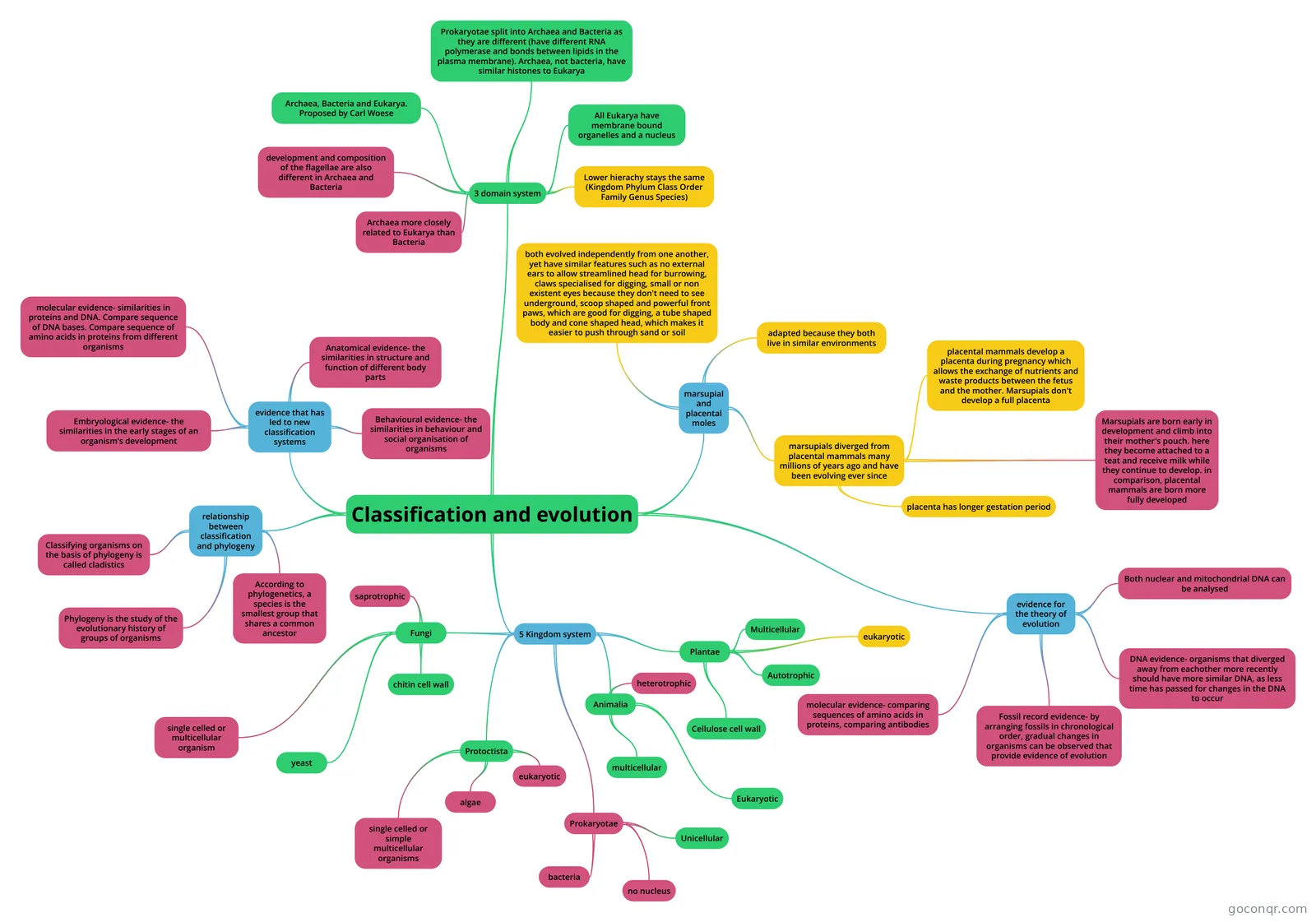
Mind map: Classification and evolution
Inhalt der Mindmap
Classification and evolution
evidence for the theory of evolution
- Fossil record evidence- by arranging fossils in chronological order, gradual changes in organisms can be observed that provide evidence of evolution
- DNA evidence- organisms that diverged away from eachother more recently should have more similar DNA, as less time has passed for changes in the DNA to occur
- Both nuclear and mitochondrial DNA can be analysed
- molecular evidence- comparing sequences of amino acids in proteins, comparing antibodies
evidence that has led to new classification systems
- molecular evidence- similarities in proteins and DNA. Compare sequence of DNA bases. Compare sequence of amino acids in proteins from different organisms
- Embryological evidence- the similarities in the early stages of an organism's development
- Anatomical evidence- the similarities in structure and function of different body parts
- Behavioural evidence- the similarities in behaviour and social organisation of organisms
relationship between classification and phylogeny
- Phylogeny is the study of the evolutionary history of groups of organisms
- According to phylogenetics, a species is the smallest group that shares a common ancestor
- Classifying organisms on the basis of phylogeny is called cladistics
marsupial and placental moles
- both evolved independently from one another, yet have similar features such as no external ears to allow streamlined head for burrowing, claws specialised for digging, small or non existent eyes because they don't need to see underground, scoop shaped and powerful front paws, which are good for digging, a tube shaped body and cone shaped head, which makes it easier to push through sand or soil
- marsupials diverged from placental mammals many millions of years ago and have been evolving ever since
- placenta has longer gestation period
- placental mammals develop a placenta during pregnancy which allows the exchange of nutrients and waste products between the fetus and the mother. Marsupials don't develop a full placenta
- Marsupials are born early in development and climb into their mother's pouch. here they become attached to a teat and receive milk while they continue to develop. in comparison, placental mammals are born more fully developed
- adapted because they both live in similar environments
5 Kingdom system
- Protoctista
- eukaryotic
- algae
- single celled or simple multicellular organisms
- Animalia
- multicellular
- Eukaryotic
- heterotrophic
- Plantae
- Cellulose cell wall
- Autotrophic
- Multicellular
- eukaryotic
- Fungi
- chitin cell wall
- yeast
- saprotrophic
- single celled or multicellular organism
- Prokaryotae
- Unicellular
- bacteria
- no nucleus
- Protoctista
3 domain system
- Archaea, Bacteria and Eukarya. Proposed by Carl Woese
- Prokaryotae split into Archaea and Bacteria as they are different (have different RNA polymerase and bonds between lipids in the plasma membrane). Archaea, not bacteria, have similar histones to Eukarya
- All Eukarya have membrane bound organelles and a nucleus
- Lower hierachy stays the same (Kingdom Phylum Class Order Family Genus Species)
- development and composition of the flagellae are also different in Archaea and Bacteria
- Archaea more closely related to Eukarya than Bacteria
Informationen
- Beschreibung
- Mindmap am Classification and evolution, erstellt von Maya Cruz-Mantell am 11/06/2024.
- Erstellt von
- Maya Cruz-Mantell
- Aufrufe
- 0
- Bewertung
Mehr zu Classification and Evolution