
Mindmap
ELSS
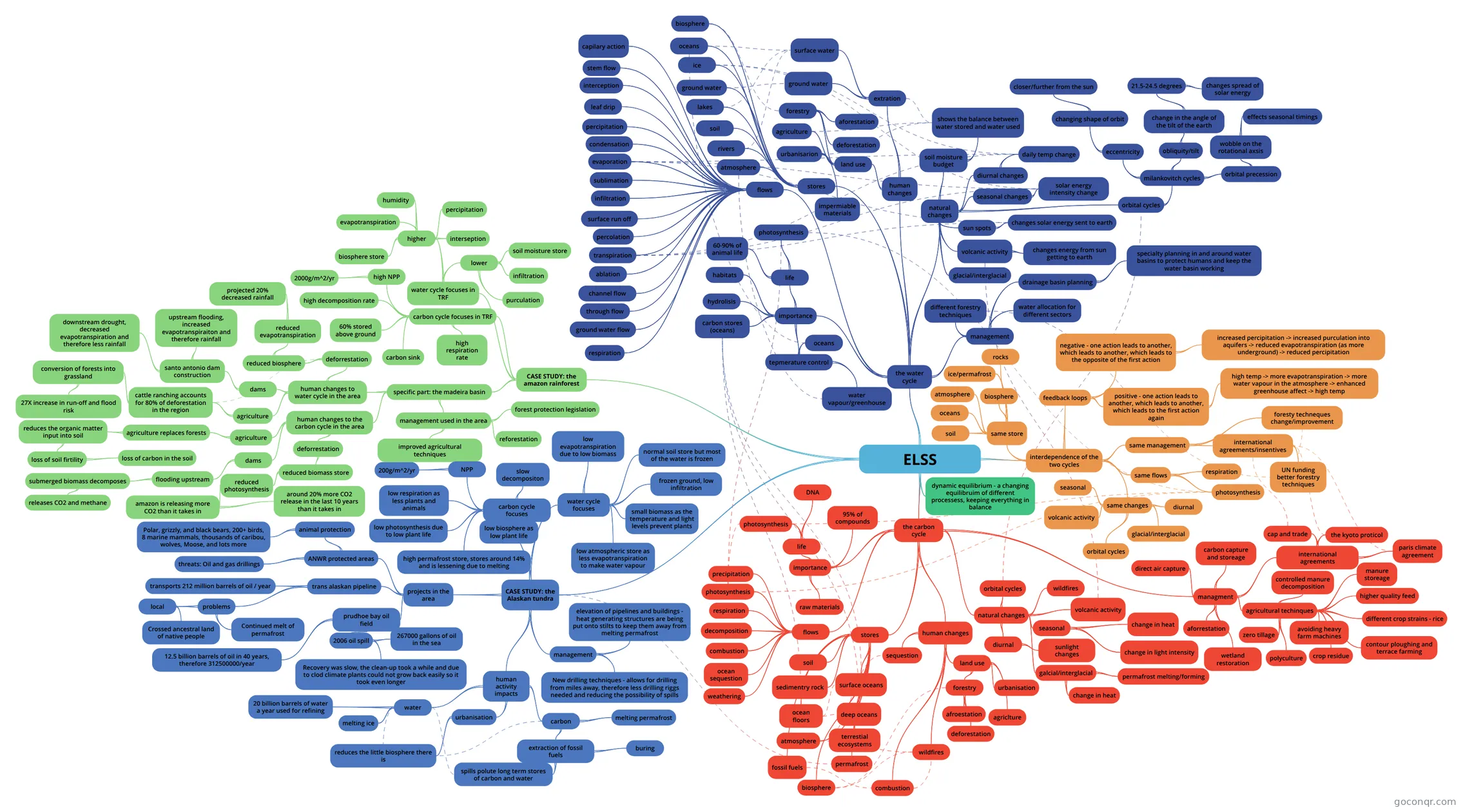
Mind map: the water and carbon cycles
Inhalt der Mindmap
ELSS
CASE STUDY: the amazon rainforest
- water cycle focuses in TRF
- higher
- interseption
- percipitation
- humidity
- evapotranspiration
- biosphere store
- lower
- infiltration
- purculation
- soil moisture store
- higher
- carbon cycle focuses in TRF
- high NPP
- 2000g/m^2/yr
- high decomposition rate
- 60% stored above ground
- carbon sink
- high respiration rate
- high NPP
- specific part: the madeira basin
- human changes to water cycle in the area
- deforrestation
- reduced biosphere
- reduced evapotranspiration
- projected 20% decreased rainfall
- reduced evapotranspiration
- reduced biosphere
- dams
- santo antonio dam construction
- upstream flooding, increased evapotranspiraiton and therefore rainfall
- downstream drought, decreased evapotranspiration and therefore less rainfall
- santo antonio dam construction
- agriculture
- cattle ranching accounts for 80% of deforestation in the region
- conversion of forests into grassland
- 27X increase in run-off and flood risk
- conversion of forests into grassland
- cattle ranching accounts for 80% of deforestation in the region
- deforrestation
- human changes to the carbon cycle in the area
- agriculture
- agriculture replaces forests
- reduces the organic matter input into soil
- loss of soil firtility
- loss of carbon in the soil
- loss of soil firtility
- reduces the organic matter input into soil
- agriculture replaces forests
- dams
- flooding upstream
- submerged biomass decomposes
- releases CO2 and methane
- submerged biomass decomposes
- flooding upstream
- deforrestation
- reduced biomass store
- reduced photosynthesis
- amazon is releasing more CO2 than it takes in
- around 20% more CO2 release in the last 10 years than it takes in
- amazon is releasing more CO2 than it takes in
- reduced photosynthesis
- reduced biomass store
- agriculture
- management used in the area
- forest protection legislation
- reforestation
- improved agricultural techniques
- human changes to water cycle in the area
- water cycle focuses in TRF
CASE STUDY: the Alaskan tundra
- water cycle focuses
- low evapotranspiration due to low biomass
- frozen ground, low infiltration
- normal soil store but most of the water is frozen
- low atmospheric store as less evapotranspiration to make water vapour
- small biomass as the temperature and light levels prevent plants
- carbon cycle focuses
- slow decompositon
- NPP
- 200g/m^2/yr
- low respiration as less plants and animals
- low photosynthesis due to low plant life
- low biosphere as low plant life
- high permafrost store, stores around 14% and is lessening due to melting
- management
- elevation of pipelines and buildings - heat generating structures are being put onto stilts to keep them away from melting permafrost
- New drilling techniques - allows for drilling from miles away, therefore less drilling riggs needed and reducing the possibility of spills
- projects in the area
- ANWR protected areas
- animal protection
- Polar, grizzly, and black bears, 200+ birds, 8 marine mammals, thousands of caribou, wolves, Moose, and lots more
- threats: Oil and gas drillings
- animal protection
- trans alaskan pipeline
- transports 212 million barrels of oil / year
- problems
- local
- Crossed ancestral land of native people
- Continued melt of permafrost
- local
- prudhoe bay oil field
- 12.5 billion barrels of oil in 40 years, therefore 312500000/year
- 2006 oil spill
- 267000 gallons of oil in the sea
- Recovery was slow, the clean-up took a while and due to clod climate plants could not grow back easily so it took even longer
- ANWR protected areas
- human activity impacts
- water
- 20 billion barrels of water a year used for refining
- melting ice
- carbon
- melting permafrost
- extraction of fossil fuels
- buring
- spills polute long term stores of carbon and water
- urbanisation
- reduces the little biosphere there is
- water
- water cycle focuses
the water cycle
- importance
- life
- photosynthesis
- 60-90% of animal life
- tepmerature control
- water vapour/greenhouse
- oceans
- habitats
- carbon stores (oceans)
- hydrolisis
- life
- flows
- infiltration
- percolation
- evaporation
- condensation
- transpiration
- surface run off
- ablation
- percipitation
- sublimation
- channel flow
- through flow
- ground water flow
- leaf drip
- interception
- stem flow
- capilary action
- respiration
- stores
- oceans
- ice
- ground water
- lakes
- soil
- rivers
- atmosphere
- biosphere
- management
- different forestry techniques
- water allocation for different sectors
- drainage basin planning
- specialty planning in and around water basins to protect humans and keep the water basin working
- human changes
- land use
- urbanisarion
- impermiable materials
- agriculture
- forestry
- deforestation
- aforestation
- urbanisarion
- extration
- ground water
- surface water
- land use
- natural changes
- soil moisture budget
- shows the balance between water stored and water used
- diurnal changes
- daily temp change
- seasonal changes
- solar energy intensity change
- orbital cycles
- milankovitch cycles
- eccentricity
- changing shape of orbit
- closer/further from the sun
- changing shape of orbit
- obliquity/tilt
- change in the angle of the tilt of the earth
- 21.5-24.5 degrees
- changes spread of solar energy
- 21.5-24.5 degrees
- change in the angle of the tilt of the earth
- orbital precession
- wobble on the rotational axsis
- effects seasonal timings
- wobble on the rotational axsis
- eccentricity
- milankovitch cycles
- sun spots
- changes solar energy sent to earth
- volcanic activity
- changes energy from sun getting to earth
- glacial/interglacial
- soil moisture budget
- importance
the carbon cycle
- importance
- 95% of compounds
- life
- DNA
- photosynthesis
- raw materials
- flows
- precipitation
- photosynthesis
- respiration
- decomposition
- combustion
- ocean sequestion
- weathering
- stores
- soil
- sedimentry rock
- ocean floors
- atmosphere
- surface oceans
- deep oceans
- terrestial ecosystems
- fossil fuels
- permafrost
- biosphere
- managment
- aforrestation
- wetland restoration
- agricultural techinques
- zero tillage
- polyculture
- crop residue
- avoiding heavy farm machines
- contour ploughing and terrace farming
- different crop strains - rice
- higher quality feed
- controlled manure decomposition
- manure storeage
- international agreements
- paris climate agreement
- the kyoto proticol
- cap and trade
- direct air capture
- carbon capture and storeage
- human changes
- combustion
- sequestion
- land use
- urbanisation
- agriclture
- forestry
- deforestation
- afroestation
- wildfires
- natural changes
- diurnal
- sunlight changes
- seasonal
- change in heat
- change in light intensity
- galcial/interglacial
- permafrost melting/forming
- change in heat
- volcanic activity
- wildfires
- orbital cycles
- diurnal
- importance
interdependence of the two cycles
- same changes
- diurnal
- seasonal
- glacial/interglacial
- volcanic activity
- orbital cycles
- same flows
- photosynthesis
- respiration
- same store
- soil
- oceans
- rocks
- biosphere
- atmosphere
- ice/permafrost
- same management
- international agreements/insentives
- UN funding better forestry techniques
- foresty techneques change/improvement
- international agreements/insentives
- feedback loops
- positive - one action leads to another, which leads to another, which leads to the first action again
- high temp -> more evapotranspiration -> more water vapour in the atmosphere -> enhanced greenhouse affect -> high temp
- negative - one action leads to another, which leads to another, which leads to the opposite of the first action
- increased percipitation -> increased purculation into aquifers -> reduced evapotranspiration (as more underground) -> reduced percipitation
- positive - one action leads to another, which leads to another, which leads to the first action again
- same changes
dynamic equilibrium - a changing equilibruim of different processess, keeping everything in balance
Informationen
- Beschreibung
- A level Geography (ELSS) Mindmap am ELSS, erstellt von Mrjiggles 17 am 20/06/2024.
- Erstellt von
- Mrjiggles 17
- Aufrufe
- 1
- Bewertung
Mehr zu Water and Carbon Cycles