
Mindmap
Univariate static measures
Inhalt der Mindmap
Univariate static measures
Position measurements
- indican un valor de la variable en torno al cual se sitúan un grupo de observaciones
- Measures of central tendency position
- Esta tendencia al agrupamiento de los datos hacia la parte central de los gráficos que los representan da lugar .
- Clustering data toward the center of the graphs that represent them gives rise to what is known as measures of central tendency. The following are known as measures of central tendency:
- Arithmetic mean
- Es la medida más conocida y la más fácil de calcular. Se define como la suma de los valores de una cantidad dada de números dividido entre la cantidad de números.
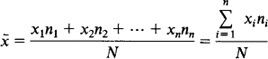
- Given a frequency distribution (xi; ni), the arithmetic mean, or simply mean, which is denoted by x¯, is defined by the expression
- Mode
- indican un valor de la variable en torno al cual se sitúan un grupo de observaciones
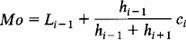
- SThis is the most frequent value in a data set. It is considered the most representative or typical value of a series of values. It is symbolized as Mo. If two values have the same frequency, the set is said to be bimodal. When more than two values occur with the same frequency, and this frequency is the highest, all values are modes, so the data set is called multimodal.
- Geometric Mean.
- se utiliza para promediar crecimientos geométricos de la variable, o cuando se quiere dar importancia a valores pequeños, o cuando se quiere determinar el valor medio para un conjunto de porcentajes.
- The geometric mean of a frequency distribution (xi; ni), represented by G, is defined as the Nth root of the product of the values of the variable raised to their corresponding absolute frequencies. It is represented by :
- Median
- Se define como el valor que divide una distribución de datos ordenados en dos mitades, es decir, se encuentra en el centro de la distribución. La mediana se simboliza como Me. Es menos usada que la media aritmética. Para su cálculo es necesario que los datos estén ordenados. Cuando la cantidad de datos es impar, fácilmente se identifica la mediana; pero cuando el número de datos es par, la mediana se calcula hallando el valor medio entre los dos valores centrales y no coincidirá con ninguno de los valores del conjunto de datos.
- It is described as follows
- Arithmetic mean
- Non-central deposition measures
- no reflejan ninguna tendencia central. Se denominan genéricamente cuantiles y son aquellos valores de la variable, ordenados en sentido creciente, que dividen la distribución en partes, de tal manera que cada una de ellas contiene el mismo número de frecuencias.
- extension, where the quartiles (Ci), deciles (Di), and percentiles (Pi) are divided into 4, 10, and 100 parts, respectively, with the same number of frequencies.
- Los cuartiles, deciles y percentiles son medidas que se utilizan para determinar los intervalos dentro de los cuales quedan proporcionalmente repartidos los términos de la distribución.
Dispersion measurements
- son los datos extremos podían estar bastante alejados de esa tendencia central. Medir esa variación respecto a los promedios ,es un cálculo importante en el tratamiento estadístico de datos, medidas a las que se les denomina de dispersión o de variación.
- There are two types of dispersion measures:
- Absolute dispersion measures
- .Se trata de la diferencia entre el límite superior y el límite inferior de un conjunto de datos.
- Measures of dispersion are obtained from direct comparison between the values of the variable. Range is defined as the difference between the maximum and minimum values of the variable and is expressed as
- Esta medida tiene la ventaja de ser muy sencilla de calcular. Sin embargo, el inconveniente que presenta es que sólo depende de los valores extremos, por lo que si éstos se encuentran alejados del resto de los valores de la distribución (es decir, son valores anómalos) puede dar lugar a conclusiones erróneas.
- To avoid the problem of anomalous values, the so-called interquartile range is often used, which is defined as the difference between the third and first quartiles.
- Relative dispersion measures
- se define su valor en relación con otra medida, por lo que para obtener su valor real, se debe realizar alguna operación con el valor indicado.
- The most commonly used is Pearson's coefficient of variation. This coefficient is defined as the ratio of the standard deviation to the absolute value of the arithmetic mean and is expressed as follows:
- Absolute dispersion measures
Bilder und Dateien der Mindmap





Informationen
- Beschreibung
- Fase 3 de estadistica descriptiva
- Erstellt von
- Estudiante UNAD
- Aufrufe
- 4
- Tags
- Verlauf
-
- Erstellt von erika jimenez perez · 26 Mär 2019
- Kopiert von Estudiante UNAD · 14 Mär 2025
- Bewertung