
Descriptive Statistics
798 resources created by 690 users
This Descriptive Statistics page on GoConqr gathers community-made quizzes, mind maps, flashcards and notes, from data types and measures of central tendency to measures of dispersion, z-scores and skewed distributions. It's built for university students and professional candidates, school students, and teachers after ready-made material. There are over 700 resources here, including more than 50 quizzes, over 500 mind maps and more than 140 flashcard decks. Open a quiz to find your gaps, then make your own revision sets.
Top Descriptive Statistics resources
-
16 questionsSkewed Distributions in Data Science. Quiz on skewed distributions.
-
18 questionsStandard Deviation and Percentiles What is the equation for Population Standard Deviation?
-
32 questionsECON 261 EXAM 1
-
Mind map Business Statistics Estadística Comerciales
-
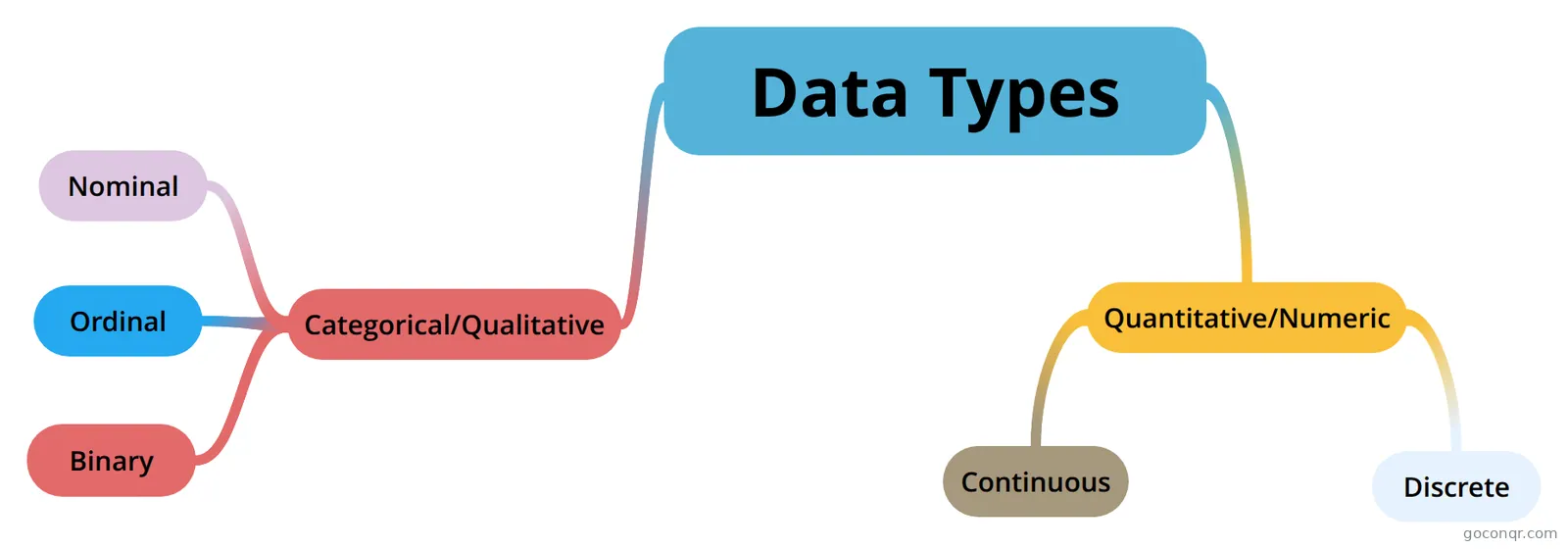 Mind map Data Types https://blog.minitab.com/blog/understanding-statistics/understanding-qualitative-quantitative-attribute-dis...
-
Mind map Measures of dispersion
-
 Mind map Measures of central tendency. Measures of central tendency
-
Mind map Measures of dispersion
Quizzes
See all 56 quizzes-
16 questionsSkewed Distributions in Data Science. Quiz on skewed distributions.
-
18 questionsStandard Deviation and Percentiles What is the equation for Population Standard Deviation?
-
32 questionsECON 261 EXAM 1
-
10 questionsSTA 115 In-Class Notes Practice This is a practice quiz based off of notes I've taken in class.
-
32 questionsCOMM 304 Week 12.1 Descriptive Statistics
-
35 questionsStats A company has three divisions and three conference rooms for meetings. To keep track of the use of their fa...
-
48 questionsSOCI 231 Which of the following is NOT true of a normal distribution?
-
50 questionsB - Stat The main purpose of descriptive statistics is to
Mind maps
See all 544 mind maps-
Business Statistics Estadística Comerciales
-
Data Types https://blog.minitab.com/blog/understanding-statistics/understanding-qualitative-quantitative-attribute-dis...
-
Measures of dispersion
-
Measures of central tendency. Measures of central tendency
-
Measures of dispersion
-
MEASURES OF DISPERSION MAPA MENTAL ESTADISTICA DORA MARIA ROPAIN
-
Business Statistics Bus 214 Peru State
-
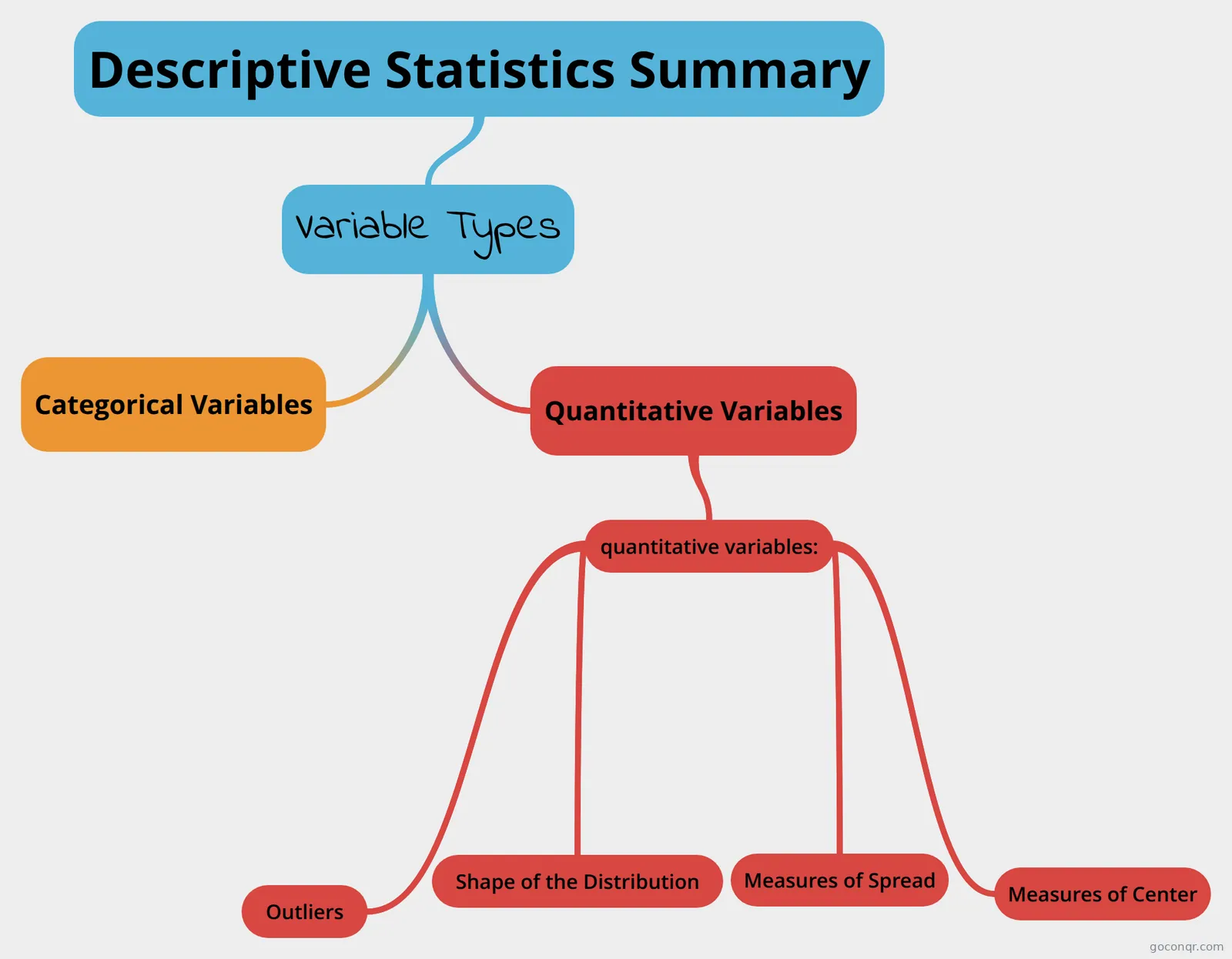 Descriptive Statistics Summary brief description in the statics course
Flashcards
See all 150 flashcards-
4 cardsGraphs These flash cards have information on graphs that includes definitions, and different types of graphs.
-
19 cardsStatistics Key Words
-
116 cardsStatistical Analysis and Design Define Descriptive Statistics
-
41 cardsJablon Flashcards - DESCRIPTIVE STATISTICS
-
41 cardsBA Module 1 Some people are naturally more comfortable working with numbers than others. For most of us, visual represe...
-
76 cardsstats test 2 the measure of center (average)
-
62 cardsGeneral MCQ Statistics 1 why is the range not a great descriptive statistic?
-
61 cardsChapter 1, 2, and 3 Vocab
Flowcharts
See all 18 flowchartsNotes
See all 28 notes-
Information Processing Qualitative Data- describes nominal categorical aspects often presented in tabular form, usually comprise absolute or relative frequenciesOrdinal Data - represents observable quantifications (eg: disease stages, ...
-
Untitled What Is Central Tendency? Central tendency is defined as the typical value of a set of data. There are three main ways that we measure central tendency: mean, median, and mode. The m...
-
Module 2 Notes Measures of Central Location: Median - If the data set contains an odd number of values, the median is one of the values. If there is an even number of values in the data set, the median is not necessarily one of the ...
-
STATISTICS 1 Topic 1: Mathematical Models and Topic 2: Locationmathematical model=simplification of real world situationnumerical data- quantitative; non numerical data- qualitativecontinuous variable takes any value in given rang...
-
Statistics Ch 3 Statistics 3.1Compute the mean of a data set Arithmetic mean/mean- average Mean=sum of data points/# of data points We will round the mean to one more decimal place than the Σ x=x1+x2+...+xn Sample mean: mean of a sam...
-
STAT Chapter 2 What To Know (a) Be able to understand and read a frequency distribution table, a bar chart, and a pie chart. (b) Given raw data, be able to calculate angles in pie charts, heights of bars in bar charts, and any of the entries in ...
-
Measures of Dispersion The Range The Mean Absolute Deviation Population Variance and Population Standard Deviation Sample Variance and Sample Standard Deviation Semi-variance, Semi-deviation and Related Concepts (not a LO) Chebyshev’s Inequ...
-
L2 - Descriptive Statistics
Slides
Topics in Descriptive Statistics
More Statistics and probability topics
About Descriptive Statistics
GoConqr OriginalWhat the resources cover
This unit sits in the Descriptive Statistics strand of Statistics and probability. The resources move through the usual path of summarising data: what kind of data you have, where its centre lies, how spread out it is, and what shape it takes.
- Data types: the Data Types mind map separates quantitative and categorical data, then breaks them into nominal, ordinal, continuous, discrete and binary.
- Centre: the notes and maps on central tendency cover the mean, median and mode, including weighted means.
- Spread: several Measures of dispersion maps explain low and high dispersion, and the Standard Deviation and Percentiles quiz tests the population formula.
- Shape: the quiz on skewed distributions asks what we call data that clusters on one side.
Where to start
Begin with the Descriptive Statistics Summary mind map. It lays out variable types, measures of centre, measures of spread, shape and outliers in one view, so you can see what you already know.
Next, pick the topic that feels weakest. If it is averages, try the quiz on the advantages and disadvantages of mean, median and mode. If it is spread, move on to the Standard Deviation and Percentiles quiz.
Using quizzes and maps together
- Read a mind map first, to get the structure of a topic.
- Take a related quiz without looking back at the map.
- Return to the map for any question you missed.
- Use a flashcard deck, such as the AP Statistics deck, to fix the key terms and formulas.
Quizzes such as the ECON 261 exam one show worked examples, like finding a median for an odd and an even number of values, so they teach as well as test.
Who it helps
Most resources are pitched at university level, with a good share suited to school students. Teachers can pick maps, notes and quizzes to share with a class.
Choose one topic today, work through a map and a quiz, and then try building a set of your own.
Frequently asked questions
Which resource should I open first?
Start with the Descriptive Statistics Summary mind map. It covers variable types, measures of centre and spread, the shape of a distribution and outliers in one place. After that, choose a quiz on the topic that felt least familiar and see how you get on.
What do the mind maps on this page cover?
They cover data types, measures of central tendency, measures of dispersion, frequency distributions, organising and graphing data, and business statistics. Some are short summaries and some are detailed, so you can pick one that fits how much time you have.
Are the resources free to use?
Yes. Every resource listed here is free to open, study and take, with no account needed. They were made by GoConqr users, not by GoConqr itself, so styles and depth vary from one resource to the next.
Which quizzes test standard deviation and skewness?
The Standard Deviation and Percentiles quiz asks for the population standard deviation equation and explains why it uses N rather than n-1. The Skewed Distributions in Data Science quiz tests how data clusters on one side of a distribution.
Is there anything here for AP Statistics?
Yes. There is a flashcard deck called AP Statistics, which is a handy place to review terms and ideas. It works well alongside the mind maps on centre, spread and shape, and the quizzes on the same topics.
What if I cannot find the topic I need?
Try the mind maps and flashcard decks, which have the widest range of titles, or search by a related term such as dispersion or central tendency. You can also make your own quiz, map or flashcards with a free account, which also saves your quiz scores.