
Mindmap
Clause elements
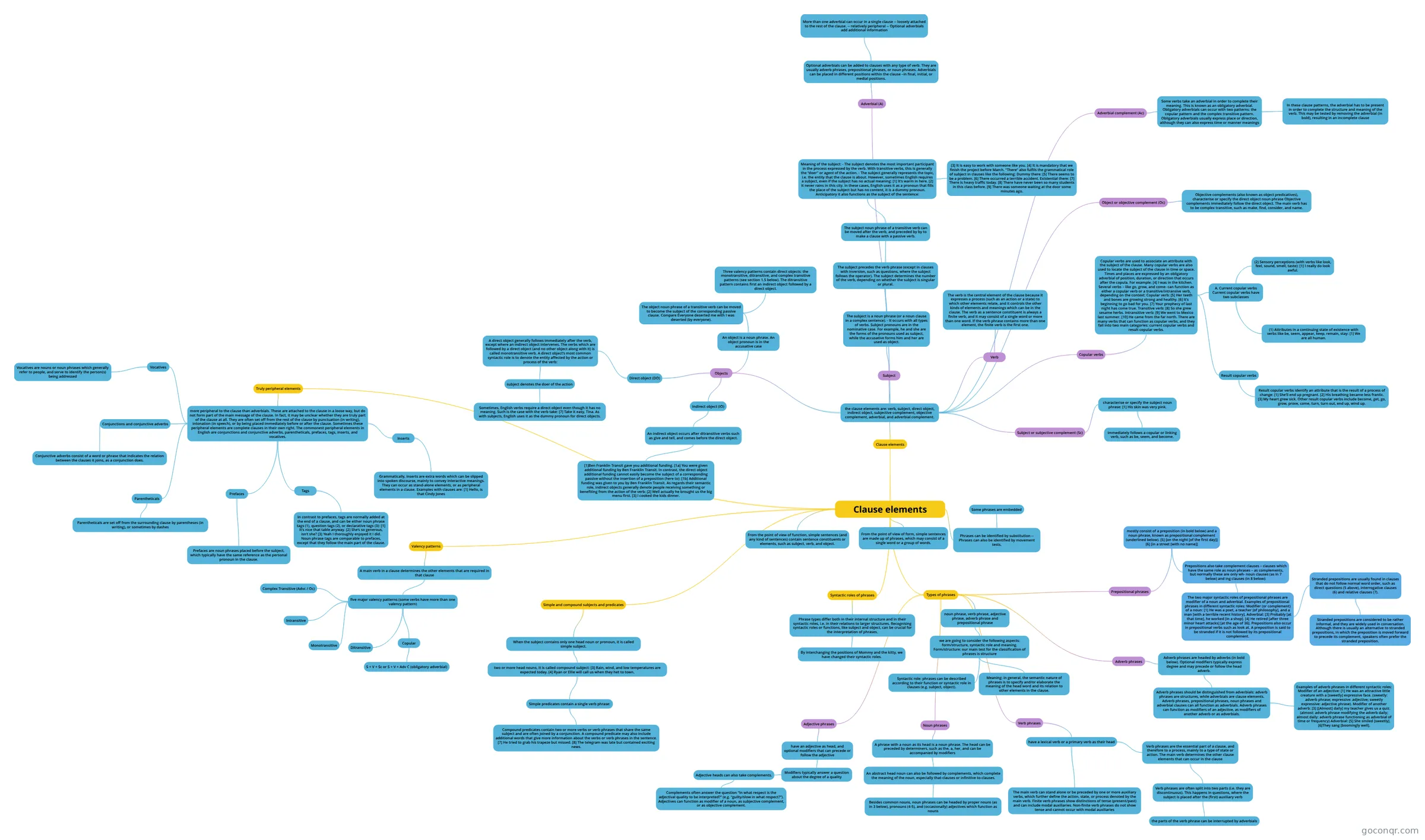
Mind map: Clause elements in grammar
Inhalt der Mindmap
Clause elements
From the point of view of function, simple sentences (and any kind of sentences) contain sentence constituents or elements, such as subject, verb, and object.
From the point of view of form, simple sentences are made up of phrases, which may consist of a single word or a group of words.
Phrases can be identified by substitution -- Phrases can also be identified by movement tests.
- Some phrases are embedded
Syntactic roles of phrases
- Phrase types differ both in their internal structure and in their syntactic roles, i.e. in their relations to larger structures. Recognising syntactic roles or functions, like subject and object, can be crucial for the interpretation of phrases.
- By interchanging the positions of Mommy and the kitty, we have changed their syntactic roles.
- Phrase types differ both in their internal structure and in their syntactic roles, i.e. in their relations to larger structures. Recognising syntactic roles or functions, like subject and object, can be crucial for the interpretation of phrases.
Types of phrases
- noun phrase, verb phrase, adjective phrase, adverb phrase and prepositional phrase
- we are going to consider the following aspects: form/structure, syntactic role and meaning. Form/structure: our main test for the classification of phrases is structure
- Syntactic role: phrases can be described according to their function or syntactic role in clauses (e.g. subject, object).
- Meaning: in general, the semantic nature of phrases is to specify and/or elaborate the meaning of the head word and its relation to other elements in the clause.
- we are going to consider the following aspects: form/structure, syntactic role and meaning. Form/structure: our main test for the classification of phrases is structure
- Noun phrases
- A phrase with a noun as its head is a noun phrase. The head can be preceded by determiners, such as the, a, her, and can be accompanied by modifiers
- An abstract head noun can also be followed by complements, which complete the meaning of the noun, especially that-clauses or infinitive to-clauses.
- Besides common nouns, noun phrases can be headed by proper nouns (as in 3 below), pronouns (4-5), and (occasionally) adjectives which function as nouns
- An abstract head noun can also be followed by complements, which complete the meaning of the noun, especially that-clauses or infinitive to-clauses.
- A phrase with a noun as its head is a noun phrase. The head can be preceded by determiners, such as the, a, her, and can be accompanied by modifiers
- Verb phrases
- have a lexical verb or a primary verb as their head
- The main verb can stand alone or be preceded by one or more auxiliary verbs, which further define the action, state, or process denoted by the main verb. Finite verb phrases show distinctions of tense (present/past) and can include modal auxiliaries. Non-finite verb phrases do not show tense and cannot occur with modal auxiliaries
- Verb phrases are the essential part of a clause, and therefore to a process, mainly to a type of state or action. The main verb determines the other clause elements that can occur in the clause
- Verb phrases are often split into two parts (i.e. they are discontinuous). This happens in questions, where the subject is placed after the (first) auxiliary verb
- the parts of the verb phrase can be interrupted by adverbials
- Verb phrases are often split into two parts (i.e. they are discontinuous). This happens in questions, where the subject is placed after the (first) auxiliary verb
- have a lexical verb or a primary verb as their head
- Adjective phrases
- have an adjective as head, and optional modifiers that can precede or follow the adjective
- Modifiers typically answer a question about the degree of a quality
- Adjective heads can also take complements.
- Complements often answer the question “In what respect is the adjectival quality to be interpreted?” (e.g. “guilty/slow in what respect?”). Adjectives can function as modifier of a noun, as subjective complement, or as objective complement.
- Adjective heads can also take complements.
- Modifiers typically answer a question about the degree of a quality
- have an adjective as head, and optional modifiers that can precede or follow the adjective
- Adverb phrases
- Adverb phrases are headed by adverbs (in bold below). Optional modifiers typically express degree and may precede or follow the head adverb.
- Adverb phrases should be distinguished from adverbials: adverb phrases are structures, while adverbials are clause elements. Adverb phrases, prepositional phrases, noun phrases and adverbial clauses can all function as adverbials. Adverb phrases can function as modifiers of an adjective, as modifiers of another adverb or as adverbials.
- Examples of adverb phrases in different syntactic roles: Modifier of an adjective: [1] He was an attractive little creature with a [sweetly] expressive face. (sweetly: adverb phrase; expressive: adjective; sweetly expressive: adjective phrase). Modifier of another adverb: [3] [[Almost] daily] my teacher gives us a quiz. (almost: adverb phrase modifying the adverb daily; almost daily: adverb phrase functioning as adverbial of time or frequency) Adverbial: [5] She smiled [sweetly]. [6]They sang [boomingly well].
- Adverb phrases should be distinguished from adverbials: adverb phrases are structures, while adverbials are clause elements. Adverb phrases, prepositional phrases, noun phrases and adverbial clauses can all function as adverbials. Adverb phrases can function as modifiers of an adjective, as modifiers of another adverb or as adverbials.
- Adverb phrases are headed by adverbs (in bold below). Optional modifiers typically express degree and may precede or follow the head adverb.
- Prepositional phrases
- mostly consist of a preposition (in bold below) and a noun phrase, known as prepositional complement (underlined below). [5] [on the night [of the first day]] [6] [in a street [with no name]]
- Prepositions also take complement clauses – clauses which have the same role as noun phrases – as complements, but normally these are only wh- noun clauses (as in 7 below) and ing clauses (in 8 below):
- The two major syntactic roles of prepositional phrases are modifier of a noun and adverbial. Examples of prepositional phrases in different syntactic roles: Modifier (or complement) of a noun: [1] He was a poet, a teacher [of philosophy], and a man [with a terrible recent history]. Adverbial: [3] Probably [at that time], he worked [in a shop]. [4] He retired [after three minor heart attacks] [at the age of 36]. Prepositions also occur in prepositional verbs such as look at. A preposition is said to be stranded if it is not followed by its prepositional complement.
- Stranded prepositions are usually found in clauses that do not follow normal word order, such as direct questions (5 above), interrogative clauses (6) and relative clauses (7).
- Stranded prepositions are considered to be rather informal, and they are widely used in conversation. Although there is usually an alternative to stranded prepositions, in which the preposition is moved forward to precede its complement, speakers often prefer the stranded preposition.
- Stranded prepositions are usually found in clauses that do not follow normal word order, such as direct questions (5 above), interrogative clauses (6) and relative clauses (7).
- The two major syntactic roles of prepositional phrases are modifier of a noun and adverbial. Examples of prepositional phrases in different syntactic roles: Modifier (or complement) of a noun: [1] He was a poet, a teacher [of philosophy], and a man [with a terrible recent history]. Adverbial: [3] Probably [at that time], he worked [in a shop]. [4] He retired [after three minor heart attacks] [at the age of 36]. Prepositions also occur in prepositional verbs such as look at. A preposition is said to be stranded if it is not followed by its prepositional complement.
- Prepositions also take complement clauses – clauses which have the same role as noun phrases – as complements, but normally these are only wh- noun clauses (as in 7 below) and ing clauses (in 8 below):
- mostly consist of a preposition (in bold below) and a noun phrase, known as prepositional complement (underlined below). [5] [on the night [of the first day]] [6] [in a street [with no name]]
- noun phrase, verb phrase, adjective phrase, adverb phrase and prepositional phrase
Clause elements
- the clause elements are: verb, subject, direct object, indirect object, subjective complement, objective complement, adverbial, and adverbial complement.
- Verb
- The verb is the central element of the clause because it expresses a process (such as an action or a state) to which other elements relate, and it controls the other kinds of elements and meanings which can be in the clause. The verb as a sentence constituent is always a finite verb, and it may consist of a single word or more than one word. If the verb phrase contains more than one element, the finite verb is the first one.
- Subject
- The subject is a noun phrase (or a noun clause in a complex sentence). - It occurs with all types of verbs. Subject pronouns are in the nominative case. For example, he and she are the forms of the pronouns used as subject, while the accusative forms him and her are used as object.
- The subject precedes the verb phrase (except in clauses with inversion, such as questions, where the subject follows the operator). The subject determines the number of the verb, depending on whether the subject is singular or plural.
- The subject noun phrase of a transitive verb can be moved after the verb, and preceded by by to make a clause with a passive verb.
- Meaning of the subject: - The subject denotes the most important participant in the process expressed by the verb. With transitive verbs, this is generally the “doer” or agent of the action. - The subject generally represents the topic, i.e. the entity that the clause is about. However, sometimes English requires a subject, even if the subject has no actual meaning: [1] It’s warm in here. [2] It never rains in this city. In these cases, English uses it as a pronoun that fills the place of the subject but has no content, it is a dummy pronoun. Anticipatory it also functions as the subject of the sentence:
- [3] It is easy to work with someone like you. [4] It is mandatory that we finish the project before March. “There” also fulfils the grammatical role of subject in clauses like the following: Dummy there: [5] There seems to be a problem. [6] There occurred a terrible accident. Existential there: [7] There is heavy traffic today. [8] There have never been so many students in this class before. [9] There was someone waiting at the door some minutes ago.
- Meaning of the subject: - The subject denotes the most important participant in the process expressed by the verb. With transitive verbs, this is generally the “doer” or agent of the action. - The subject generally represents the topic, i.e. the entity that the clause is about. However, sometimes English requires a subject, even if the subject has no actual meaning: [1] It’s warm in here. [2] It never rains in this city. In these cases, English uses it as a pronoun that fills the place of the subject but has no content, it is a dummy pronoun. Anticipatory it also functions as the subject of the sentence:
- The subject noun phrase of a transitive verb can be moved after the verb, and preceded by by to make a clause with a passive verb.
- The subject precedes the verb phrase (except in clauses with inversion, such as questions, where the subject follows the operator). The subject determines the number of the verb, depending on whether the subject is singular or plural.
- The subject is a noun phrase (or a noun clause in a complex sentence). - It occurs with all types of verbs. Subject pronouns are in the nominative case. For example, he and she are the forms of the pronouns used as subject, while the accusative forms him and her are used as object.
- Objects
- An object is a noun phrase. An object pronoun is in the accusative case
- The object noun phrase of a transitive verb can be moved to become the subject of the corresponding passive clause. Compare Everyone deserted me with I was deserted (by everyone).
- Three valency patterns contain direct objects: the monotransitive, ditransitive, and complex transitive patterns (see section 1.5 below). The ditransitive pattern contains first an indirect object followed by a direct object.
- The object noun phrase of a transitive verb can be moved to become the subject of the corresponding passive clause. Compare Everyone deserted me with I was deserted (by everyone).
- Direct object (DO)
- A direct object generally follows immediately after the verb, except where an indirect object intervenes. The verbs which are followed by a direct object (and no other object along with it) is called monotransitive verb. A direct object’s most common syntactic role is to denote the entity affected by the action or process of the verb:
- subject denotes the doer of the action
- Sometimes, English verbs require a direct object even though it has no meaning. Such is the case with the verb take: [7] Take it easy, Tina. As with subjects, English uses it as the dummy pronoun for direct objects.
- subject denotes the doer of the action
- A direct object generally follows immediately after the verb, except where an indirect object intervenes. The verbs which are followed by a direct object (and no other object along with it) is called monotransitive verb. A direct object’s most common syntactic role is to denote the entity affected by the action or process of the verb:
- Indirect object (IO)
- An indirect object occurs after ditransitive verbs such as give and tell, and comes before the direct object.
- [1]Ben Franklin Transit gave you additional funding. [1a] You were given additional funding by Ben Franklin Transit. In contrast, the direct object additional funding cannot easily become the subject of a corresponding passive without the insertion of a preposition (here to): [1b] Additional funding was given to you by Ben Franklin Transit. As regards their semantic role, indirect objects generally denote people receiving something or benefiting from the action of the verb: [2] Well actually he brought us the big menu first. [3] I cooked the kids dinner.
- An indirect object occurs after ditransitive verbs such as give and tell, and comes before the direct object.
- An object is a noun phrase. An object pronoun is in the accusative case
- Subject or subjective complement (Sc)
- characterise or specify the subject noun phrase: [1] His skin was very pink.
- immediately follows a copular or linking verb, such as be, seem, and become.
- characterise or specify the subject noun phrase: [1] His skin was very pink.
- Copular verbs
- Copular verbs are used to associate an attribute with the subject of the clause. Many copular verbs are also used to locate the subject of the clause in time or space. Times and places are expressed by an obligatory adverbial of position, duration, or direction that occurs after the copula. For example: [4] I was in the kitchen. Several verbs – like go, grow, and come- can function as either a copular verb or a transitive/intransive verb, depending on the context: Copular verb: [5] Her teeth and bones are growing strong and healthy. [6] It’s beginning to go bad for you. [7] Your prophecy of last night has come true. Transitive verb: [8] So she grew sesame herbs. Intransitive verb: [9] We went to Mexico last summer. [10] He came from the far north. There are many verbs that can function as copular verbs, and they fall into two main categories: current copular verbs and result copular verbs.
- A. Current copular verbs Current copular verbs have two subclasses
- (2) Sensory perceptions (with verbs like look, feel, sound, smell, taste): [1] I really do look awful.
- (1) Attributes in a continuing state of existence with verbs like be, seem, appear, keep, remain, stay: [1] We are all human.
- Result copular verbs
- Result copular verbs identify an attribute that is the result of a process of change: [1] She’ll end up pregnant. [2] His breathing became less frantic. [3] My heart grew sick. Other result copular verbs include become, get, go, grow, prove, come, turn, turn out, end up, wind up.
- A. Current copular verbs Current copular verbs have two subclasses
- Copular verbs are used to associate an attribute with the subject of the clause. Many copular verbs are also used to locate the subject of the clause in time or space. Times and places are expressed by an obligatory adverbial of position, duration, or direction that occurs after the copula. For example: [4] I was in the kitchen. Several verbs – like go, grow, and come- can function as either a copular verb or a transitive/intransive verb, depending on the context: Copular verb: [5] Her teeth and bones are growing strong and healthy. [6] It’s beginning to go bad for you. [7] Your prophecy of last night has come true. Transitive verb: [8] So she grew sesame herbs. Intransitive verb: [9] We went to Mexico last summer. [10] He came from the far north. There are many verbs that can function as copular verbs, and they fall into two main categories: current copular verbs and result copular verbs.
- Object or objective complement (Oc)
- Objective complements (also known as object predicatives), characterise or specify the direct object noun phrase Objective complements immediately follow the direct object. The main verb has to be complex transitive, such as make, find, consider, and name.
- Adverbial complement (Ac)
- Some verbs take an adverbial in order to complete their meaning. This is known as an obligatory adverbial. Obligatory adverbials can occur with two patterns: the copular pattern and the complex transitive pattern. Obligatory adverbials usually express place or direction, although they can also express time or manner meanings
- In these clause patterns, the adverbial has to be present in order to complete the structure and meaning of the verb. This may be tested by removing the adverbial (in bold), resulting in an incomplete clause
- Some verbs take an adverbial in order to complete their meaning. This is known as an obligatory adverbial. Obligatory adverbials can occur with two patterns: the copular pattern and the complex transitive pattern. Obligatory adverbials usually express place or direction, although they can also express time or manner meanings
- Adverbial (A)
- Optional adverbials can be added to clauses with any type of verb. They are usually adverb phrases, prepositional phrases, or noun phrases. Adverbials can be placed in different positions within the clause –in final, initial, or medial positions.
- More than one adverbial can occur in a single clause -- loosely attached to the rest of the clause. -- relatively peripheral -- Optional adverbials add additional information
- Optional adverbials can be added to clauses with any type of verb. They are usually adverb phrases, prepositional phrases, or noun phrases. Adverbials can be placed in different positions within the clause –in final, initial, or medial positions.
- Verb
- the clause elements are: verb, subject, direct object, indirect object, subjective complement, objective complement, adverbial, and adverbial complement.
Simple and compound subjects and predicates
- When the subject contains only one head noun or pronoun, it is called simple subject.
- two or more head nouns, it is called compound subject: [3] Rain, wind, and low temperatures are expected today. [4] Ryan or Ellie will call us when they het to town.
- Simple predicates contain a single verb phrase:
- Compound predicates contain two or more verbs or verb phrases that share the same subject and are often joined by a conjunction. A compound predicate may also include additional words that give more information about the verbs or verb phrases in the sentence. [7] He tried to grab his trapeze but missed. [8] The telegram was late but contained exciting news.
- Simple predicates contain a single verb phrase:
- two or more head nouns, it is called compound subject: [3] Rain, wind, and low temperatures are expected today. [4] Ryan or Ellie will call us when they het to town.
- When the subject contains only one head noun or pronoun, it is called simple subject.
Valency patterns
- A main verb in a clause determines the other elements that are required in that clause
- five major valency patterns (some verbs have more than one valency pattern)
- Intransitive
- Monotransitive
- Ditransitive
- Complex Transitive (Advc / Oc)
- Copular
- S + V + Sc or S + V + Adv C (obligatory adverbial)
- five major valency patterns (some verbs have more than one valency pattern)
- A main verb in a clause determines the other elements that are required in that clause
Truly peripheral elements
- more peripheral to the clause than adverbials. These are attached to the clause in a loose way, but do not form part of the main message of the clause. In fact, it may be unclear whether they are truly part of the clause at all. They are often set off from the rest of the clause by punctuation (in writing), intonation (in speech), or by being placed immediately before or after the clause. Sometimes these peripheral elements are complete clauses in their own right. The commonest peripheral elements in English are conjunctions and conjunctive adverbs, parentheticals, prefaces, tags, inserts, and vocatives.
- Conjunctions and conjunctive adverbs
- Conjunctive adverbs consist of a word or phrase that indicates the relation between the clauses it joins, as a conjunction does.
- Parentheticals
- Parentheticals are set off from the surrounding clause by parentheses (in writing), or sometimes by dashes
- Prefaces
- Prefaces are noun phrases placed before the subject, which typically have the same reference as the personal pronoun in the clause.
- Tags
- In contrast to prefaces, tags are normally added at the end of a clause, and can be either noun phrase tags (1), question tags (2), or declarative tags (3): [1] It’s nice that table anyway. [2] She’s so generous, isn’t she? [3] Yeah I thoroughly enjoyed it I did. Noun phrase tags are comparable to prefaces, except that they follow the main part of the clause.
- Inserts
- Grammatically, inserts are extra words which can be slipped into spoken discourse, mainly to convey interactive meanings. They can occur as stand-alone elements, or as peripheral elements in a clause. Examples with clauses are: [1] Hello, is that Cindy Jones
- Vocatives
- Vocatives are nouns or noun phrases which generally refer to people, and serve to identify the person(s) being addressed
- Conjunctions and conjunctive adverbs
- more peripheral to the clause than adverbials. These are attached to the clause in a loose way, but do not form part of the main message of the clause. In fact, it may be unclear whether they are truly part of the clause at all. They are often set off from the rest of the clause by punctuation (in writing), intonation (in speech), or by being placed immediately before or after the clause. Sometimes these peripheral elements are complete clauses in their own right. The commonest peripheral elements in English are conjunctions and conjunctive adverbs, parentheticals, prefaces, tags, inserts, and vocatives.
Informationen
- Beschreibung
- Universitario Gramatica 2 Mindmap am Clause elements, erstellt von Leon Gutierrez am 09/02/2026.
- Erstellt von
- Leon Gutierrez
- Aufrufe
- 0
- Verlauf
-
- Erstellt von Leon Gutierrez · 30 Jan 2026
- Kopiert von Leon Gutierrez · 9 Feb 2026
- Bewertung