
Mindmap
Verb phrase
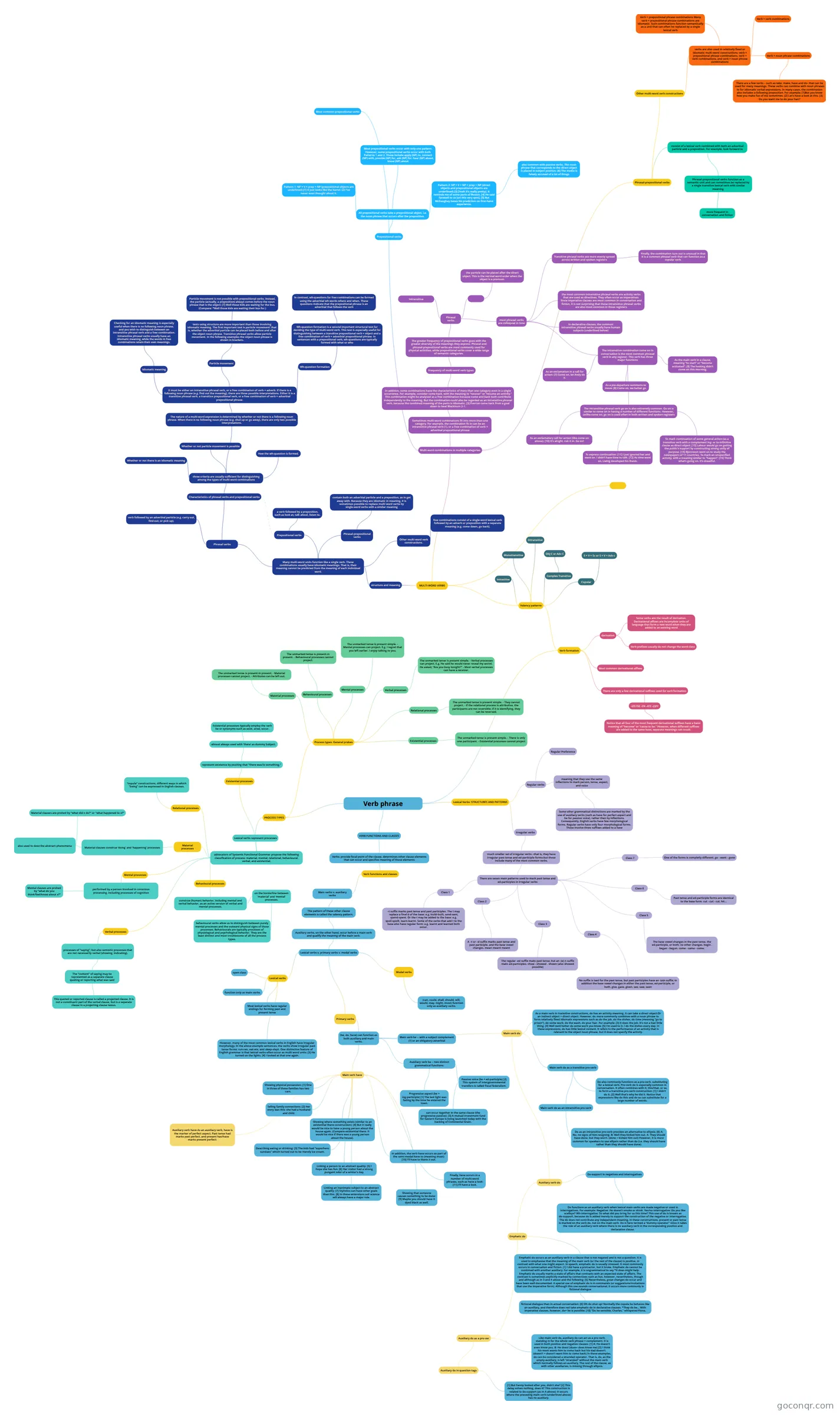
Mind map: Verb phrase
Inhalt der Mindmap
Verb phrase
VERB FUNCTIONS AND CLASSES
- Verbs: provide focal point of the clause. determines other clause elements that can occur and specifies meaning of those elements
- Verb functions and classes
- Main verbs v. auxiliary verbs
- The pattern of these other clause elements is called the valency pattern.
- Auxiliary verbs, on the other hand, occur before a main verb and qualify the meaning of the main verb.
- Lexical verbs v. primary verbs v. modal verbs
- Lexical verbs
- function only as main verbs.
- open class
- Most lexical verbs have regular endings for forming past and present tense
- However, many of the most common lexical verbs in English have irregular morphology. In the above example sentences, the verbs show irregular past tense forms: run-ran, eat-ate, and sleep-slept. One distinctive feature of English grammar is that lexical verbs often occur as multi word units: [3] He turned on the lights. [4] I looked at that one again.
- Primary verbs
- (be, do, have) can function as both auxiliary and main verbs.
- Main verb be -- with a subject complement (1) or an obligatory adverbial
- Auxiliary verb be -- two distinct grammatical functions:
- Progressive aspect (be + ing-participle) [1] The last light was fading by the time he entered the town.
- Passive voice (be + ed-participle) [2] This system of intergovernmental transfers is called fiscal federalism.
- can occur together in the same clause (the progressive passive): [3] A mutual investment fund for Eastern Europe is being launched today with the backing of Continental Grain.
- Main verb have
- Showing physical possession: [1] One in three of these families has two cars.
- Telling family connections: [2] Her story was this: she had a husband and child.
- Describing eating or drinking: [3] The kids had “superhero sundaes” which turned out to be merely ice cream.
- Showing where something exists (similar to an existential there construction): [4] But it really would be nice to have a young person about the house again. (Compare existential there: It would be nice if there was a young person about the house).
- Linking a person to an abstract quality: [5] I hope she has fun. [6] Her visitor had a strong pungent odor of a winter’s day.
- Linking an inanimate subject to an abstract quality: [7] Stylistics can have other goals than this. [8] In these extensions soil science will always have a major role.
- Showing that someone causes something to be done: [9] Maybe you should have it dyed black as well.
- Finally, have occurs in a number of multi-word phrases, such as have a look: [11] I’ll have a look.
- In addition, the verb have occurs as part of the semi-modal have to (meaning must): [10] I’ll have to blank it out.
- Auxiliary verb have As an auxiliary verb, have is the marker of perfect aspect. Past tense had marks past perfect, and present has/have marks present perfect:
- Main verb do
- As a main verb in transitive constructions, do has an activity meaning. It can take a direct object:Or an indirect object + direct object. However, do more commonly combines with a noun phrase to form relatively fixed idiomatic expressions such as do the job, do the dishes, do time (meaning “go to prison”), do some work, do the wash, do your hair. For example: [3] It does the job. It’s not a bad little thing. [4] Well we’d better do some work you know. [5] I’m used to it. I do the dishes every day. In these expressions, do has little lexical content. It refers to the performance of an activity that is relevant to the object noun phrase, but it does not specify the activity.
- As a main verb in transitive constructions, do has an activity meaning. It can take a direct object: [1] In that moment Franklin Field did a wonderful thing. Or an indirect object + direct object: [2] Will you do me a favour? However, do more commonly combines with a noun phrase to form relatively fixed idiomatic expressions such as do the job, do the dishes, do time (meaning “go to prison”), do some work, do the wash, do your hair. For example: [3] It does the job. It’s not a bad little thing. [4] Well we’d better do some work you know. [5] I’m used to it. I do the dishes every day. In these expressions, do has little lexical content. It refers to the performance of an activity that is relevant to the object noun phrase, but it does not specify the activity.
- Main verb do as a transitive pro-verb
- Do also commonly functions as a pro-verb, substituting for a lexical verb. Pro-verb do is especially common in conversation. It often combines with it, this/that, or so, to form a transitive pro-verb construction: [1] I didn’t do it. [2] Well that’s why he did it. Notice that expressions like do this and do so can substitute for a large number of words.
- Main verb do as an intransitive pro-verb
- Do as an intransitive pro-verb provides an alternative to ellipsis: [6] A: No, no signs of him resigning. B: Well they kicked him out. A: They should have done, but they won’t. (done = kicked him out) However, it is more common for speakers to use ellipsis rather than do (i.e. they should have rather than they should have done).
- Auxiliary verb do
- Do-support in negatives and interrogatives
- Do functions as an auxiliary verb when lexical main verbs are made negative or used in interrogatives. For example: Negative: He doesn’t smoke or drink. Yes/no interrogative: Do you like scallops? Wh-interrogative: So what did you bring for us this time? This use of do is known as do-support, because do is added merely to support the construction of the negative or interrogative. The do does not contribute any independent meaning. In these constructions, present or past tense is marked on the verb do, not on the main verb. Do is here termed a “dummy operator” since it takes the role of an auxiliary verb where there is no auxiliary verb in the corresponding positive and declarative clause.
- Do functions as an auxiliary verb when lexical main verbs are made negative or used in interrogatives. For example: Negative: He doesn’t smoke or drink. Yes/no interrogative: Do you like scallops? Wh-interrogative: So what did you bring for us this time? This use of do is known as do-support, because do is added merely to support the construction of the negative or interrogative. The do does not contribute any independent meaning. In these constructions, present or past tense is marked on the verb do, not on the main verb. Do is here termed a “dummy operator” since it takes the role of an auxiliary verb where there is no auxiliary verb in the corresponding positive and declarative clause.
- Do functions as an auxiliary verb when lexical main verbs are made negative or used in interrogatives. For example: Negative: He doesn’t smoke or drink. Yes/no interrogative: Do you like scallops? Wh-interrogative: So what did you bring for us this time? This use of do is known as do-support, because do is added merely to support the construction of the negative or interrogative. The do does not contribute any independent meaning. In these constructions, present or past tense is marked on the verb do, not on the main verb. Do is here termed a “dummy operator” since it takes the role of an auxiliary verb where there is no auxiliary verb in the corresponding positive and declarative clause.
- Emphatic do
- Emphatic do occurs as an auxiliary verb in a clause that is not negated and is not a question. It is used to emphasise that the meaning of the main verb (or the rest of the clause) is positive, in contrast with what one might expect. In speech, emphatic do is usually stressed. It most commonly occurs in conversation and fiction. [1] I did have a protractor, but it broke. Emphatic do cannot be combined with another auxiliary. For example, it is ungrammatical to say *It does might help. Emphatic do usually marks a state of affairs that contrasts with an expected state of affairs. The contrast is sometimes explicitly marked by connectives such as but, however, nevertheless, though and although as in 3 and 4 above and the following: [5] Nevertheless, great changes do occur and have been well documented. A special use of emphatic do is in commands (or suggestions/invitations that use the imperative form). Although this use sounds conversational, it occurs more commonly in fictional dialogue
- Emphatic do occurs as an auxiliary verb in a clause that is not negated and is not a question. It is used to emphasise that the meaning of the main verb (or the rest of the clause) is positive, in contrast with what one might expect. In speech, emphatic do is usually stressed. It most commonly occurs in conversation and fiction. [1] I did have a protractor, but it broke. Emphatic do cannot be combined with another auxiliary. For example, it is ungrammatical to say *It does might help. Emphatic do usually marks a state of affairs that contrasts with an expected state of affairs. The contrast is sometimes explicitly marked by connectives such as but, however, nevertheless, though and although as in 3 and 4 above and the following: [5] Nevertheless, great changes do occur and have been well documented. A special use of emphatic do is in commands (or suggestions/invitations that use the imperative form). Although this use sounds conversational, it occurs more commonly in fictional dialogue than in actual conversation: [6] Oh do shut up! Normally the copula be behaves like an auxiliary, and therefore does not take emphatic do in declarative clauses: *They do be… With imperative clauses, however, do+ be is possible: [10] “Do be sensible, Charles,” whispered Fiona.
- fictional dialogue than in actual conversation: [6] Oh do shut up! Normally the copula be behaves like an auxiliary, and therefore does not take emphatic do in declarative clauses: *They do be… With imperative clauses, however, do+ be is possible: [10] “Do be sensible, Charles,” whispered Fiona.
- Auxiliary do as a pro-ver
- Auxiliary do in question tags
- [1] But Fanny looked after you, didn’t she? [2] This delay solves nothing, does it? This construction is related to do-support (as in A above): it occurs where the preceding main verb (underlined above) has no auxiliary.
- Like main verb do, auxiliary do can act as a pro-verb, standing in for the whole verb phrase + complement. It is used in both positive and negative clauses: [1] A: He doesn’t even know you. B: He does! (does= does know me) [2] I think his mom wants him to come back but his dad doesn’t. (doesn’t = doesn’t want him to come back) In these examples, do can be considered a stranded operator. That is, do, as the empty auxiliary, is left “stranded” without the main verb which normally follows an auxiliary. The rest of the clause, as with other auxiliaries, is missing through ellipsis.
- Auxiliary do in question tags
- Emphatic do occurs as an auxiliary verb in a clause that is not negated and is not a question. It is used to emphasise that the meaning of the main verb (or the rest of the clause) is positive, in contrast with what one might expect. In speech, emphatic do is usually stressed. It most commonly occurs in conversation and fiction. [1] I did have a protractor, but it broke. Emphatic do cannot be combined with another auxiliary. For example, it is ungrammatical to say *It does might help. Emphatic do usually marks a state of affairs that contrasts with an expected state of affairs. The contrast is sometimes explicitly marked by connectives such as but, however, nevertheless, though and although as in 3 and 4 above and the following: [5] Nevertheless, great changes do occur and have been well documented. A special use of emphatic do is in commands (or suggestions/invitations that use the imperative form). Although this use sounds conversational, it occurs more commonly in fictional dialogue
- Do-support in negatives and interrogatives
- As a main verb in transitive constructions, do has an activity meaning. It can take a direct object:Or an indirect object + direct object. However, do more commonly combines with a noun phrase to form relatively fixed idiomatic expressions such as do the job, do the dishes, do time (meaning “go to prison”), do some work, do the wash, do your hair. For example: [3] It does the job. It’s not a bad little thing. [4] Well we’d better do some work you know. [5] I’m used to it. I do the dishes every day. In these expressions, do has little lexical content. It refers to the performance of an activity that is relevant to the object noun phrase, but it does not specify the activity.
- (be, do, have) can function as both auxiliary and main verbs.
- Modal verbs
- (can, could, shall, should, will, would, may, might, must) function only as auxiliary verbs.
- Lexical verbs
- Lexical verbs v. primary verbs v. modal verbs
- Auxiliary verbs, on the other hand, occur before a main verb and qualify the meaning of the main verb.
- The pattern of these other clause elements is called the valency pattern.
- Main verbs v. auxiliary verbs
- Verb functions and classes
- Verbs: provide focal point of the clause. determines other clause elements that can occur and specifies meaning of those elements
PROCESS TYPES
- Lexical verbs represent processes
- advocators of Systemic Functional Grammar propose the following classification of process: material, mental, relational, behavioural, verbal, and existential.
- Mental processes
- performed by a person involved in conscious processing, including processes of cognition
- Mental processes are performed by a person involved in conscious processing, including processes of cognition (“thinking”), and desideration (“wanting”), emotion (“feeling”) and perception (“seeing”).
- Mental clauses are probed by “what do you think/feel/know about x?”
- performed by a person involved in conscious processing, including processes of cognition
- Relational processes
- “copula” constructions, different ways in which “being” can be expressed in English clauses.
- Halliday’s category of relational clauses is a generalization of the traditional notion of “copula” constructions, and it covers the many different ways in which “being” can be expressed in English clauses.
- “copula” constructions, different ways in which “being” can be expressed in English clauses.
- Behavioural processes
- construe (human) behavior, including mental and verbal behavior, as an active version of verbal and mental processes.
- on the borderline between ‘material’ and ‘mental’ processes.
- behavioural verbs allow us to distinguish between purely mental processes and the outward physical signs of those processes. Behaviourals are typically processes of physiological and psychological behavior. They are the least distinct and most troublesome of all the process types.
- on the borderline between ‘material’ and ‘mental’ processes.
- construe (human) behavior, including mental and verbal behavior, as an active version of verbal and mental processes.
- Verbal processes
- processes of “saying”; but also semiotic processes that are not necessarily verbal (showing, indicating).
- processes of “saying”; but this category includes not only the different modes of saying (asking, commanding, offering, stating) but also semiotic processes that are not necessarily verbal (showing, indicating).
- The “content” of saying may be represented as a separate clause quoting or reporting what was said
- This quoted or reported clause is called a projected clause. It is not a constituent part of the verbal clause, but is a separate clause in a projecting clause nexus.
- processes of “saying”; but also semiotic processes that are not necessarily verbal (showing, indicating).
- Material processes
- Material clauses construe ‘doing’ and ‘happening’ processes
- Material clauses construe ‘doing’ and ‘happening’ processes; they construe (=create and construct) our experience of the world
- also used to describe abstract phenomena
- However, material processes are also used to describe abstract phenomena, as in Prices fell throughout this period. “Material” thus covers bot concrete and abstract processes
- Material clauses are probed by “what did x do?” or “what happened to x?”
- Material clauses construe ‘doing’ and ‘happening’ processes
- Existential processes
- represent existence by positing that “there was/is something.”
- almost always used with ‘there’ as dummy Subject.
- Existential processes typically employ the verb be or synonyms such as exist, arise, occur.
- almost always used with ‘there’ as dummy Subject.
- represent existence by positing that “there was/is something.”
- Mental processes
- advocators of Systemic Functional Grammar propose the following classification of process: material, mental, relational, behavioural, verbal, and existential.
- Process types: General probes
- Material processes
- The unmarked tense is present-in present. - Material processes cannot project. - Attributes can be left out.
- Existential processes
- The unmarked tense is present simple. - There is only one participant. - Existential processes cannot project
- Verbal processes
- The unmarked tense is present simple. - Verbal processes can project. E.g. He said he would never reveal my secret. He asked, “Are you busy tonight?” - Most verbal processes can have a receiver.
- Relational processes
- The unmarked tense is present simple. - They cannot project. - If the relational process is attributive, the participants are not reversible; if it is identifying, they can be reversed.
- Behavioural processes
- The unmarked tense is present-in present. - Behavioural processes cannot project.
- Mental processes
- The unmarked tense is present simple. - Mental processes can project. E.g. I regret that you left earlier. I enjoy talking to you.
- Material processes
- Lexical verbs represent processes
Verb formation
- derivation
- Some verbs are the result of derivation. Derivational affixes are incomplete units of language that form a new word when they are added to an existing word
- Verb prefixes usually do not change the word class
- Most common derivational affixes
- There are only a few derivational suffixes used for verb formation
- -IZE/ISE -EN -ATE -(I)FY
- Notice that all four of the most frequent derivational suffixes have a basic meaning of “become” or “cause to be.” However, when different suffixes are added to the same base, separate meanings can result.
- -IZE/ISE -EN -ATE -(I)FY
- Valency patterns
- Intrasitive
- Monotransitive
- Ditransitive
- Complex Transitive
- Obj C or Adv C
- Copular
- S + V + Sc or S + V + Adv c
- MULTI-WORD VERBS
- structure and meaning
- Many multi-word units function like a single verb. These combinations usually have idiomatic meanings. That is, their meaning cannot be predicted from the meaning of each individual word.
- Phrasal verbs
- verb followed by an adverbial particle (e.g. carry out, find out, or pick up).
- Phrasal verbs consist of a verb followed by an adverbial particle (e.g. carry out, find out, or pick up). When these adverbial particles are used independently, they have literal meanings signifying location or direction (e.g. out, in, up, down, on, off). However, in phrasal verbs they are commonly used with less literal meanings. For example, the meaning of find out does not include the “place” meaning of out.
- Characteristics of phrasal verbs and prepositional verbs
- three criteria are usually sufficient for distinguishing among the types of multi-word combinations
- Whether or not there is an idiomatic meaning
- Whether or not particle movement is possible
- How the wh-question is formed.
- The nature of a multi-word expression is determined by whether or not there is a following noun phrase. When there is no following noun phrase (e.g. shut up or go away), there are only two possible interpretations.
- It must be either an intransitive phrasal verb, or a free combination of verb + adverb. If there is a following noun phrase (e.g. find out the meaning), there are three possible interpretations. Either it is a transitive phrasal verb, a transitive prepositional verb, or a free combination of verb + adverbial prepositional phrase.
- Idiomatic meaning
- Checking for an idiomatic meaning is especially useful when there is no following noun phrase, and you wish to distinguish between an intransitive phrasal verb and a free combination. Intransitive phrasal verbs usually have an idiomatic meaning, while the words in free combinations retain their own meanings.
- Checking for an idiomatic meaning is especially useful when there is no following noun phrase, and you wish to distinguish between an intransitive phrasal verb and a free combination. Intransitive phrasal verbs usually have an idiomatic meaning, while the words in free combinations retain their own meanings. In contrast, both the verb and the adverb have separate meanings in free combinations like come back, come down, go back, go in, look back. Intransitive phrasal verbs: [1] Shut up you fool! [2] Come on! Tell us then! Intransitive free combinations: [3] If this was new, I wouldn’t let people go in. [4] Come back, or I’ll fire. [5] He was afraid to look back.
- Checking for an idiomatic meaning is especially useful when there is no following noun phrase, and you wish to distinguish between an intransitive phrasal verb and a free combination. Intransitive phrasal verbs usually have an idiomatic meaning, while the words in free combinations retain their own meanings.
- Particle movement
- tests using structure are more important than those involving idiomatic meaning. The first important test is particle movement: that is, whether the adverbial particle can be placed both before and after the object noun phrase. Transitive phrasal verbs allow particle movement. In the following examples the object noun phrase is shown in brackets.
- Particle movement is not possible with prepositional verbs. Instead, the particle (actually, a preposition) always comes before the noun phrase that is the object: [7] Well those kids are waiting for the bus. (Compare: *Well those kids are waiting their bus for.)
- tests using structure are more important than those involving idiomatic meaning. The first important test is particle movement: that is, whether the adverbial particle can be placed both before and after the object noun phrase. Transitive phrasal verbs allow particle movement. In the following examples the object noun phrase is shown in brackets.
- Wh-question formation
- Wh-question formation is a second important structural test for deciding the type of multi-word verb. This test is especially useful for distinguishing between a transitive prepositional verb + object and a free combination of verb + adverbial prepositional phrase. In sentences with a prepositional verb, wh-questions are typically formed with what or who
- Wh-question formation is a second important structural test for deciding the type of multi-word verb. This test is especially useful for distinguishing between a transitive prepositional verb + object and a free combination of verb + adverbial prepositional phrase. In sentences with a prepositional verb, wh-questions are typically formed with what or who. These questions indicate that the noun phrase that follows the preposition functions as object of the prepositional verb: [1] What are you talking about? [2] What are you laughing at? In contrast, wh-questions for free combinations can be formed using the adverbial wh-words where and when. These questions indicate that the prepositional phrase is an adverbial that follows the verb: Place: [5] Where are you walking? (Compare the statement: I am walking to that place.) [6] Where will we meet? (Compare the statement: We will meet at that place.) Time: [7] When are you playing? (Compare the statement: I am playing at that time.) [8] When are you leaving? (Compare the statement: I am leaving at that time.) Comparing these features does not always result in clear-cut distinctions between all multi-word verb combinations. Many combinations can function as more than one type, depending on the context. Further, some combinations can be interpreted as belonging to more than one category. The next section illustrates several of these problematic cases.
- In contrast, wh-questions for free combinations can be formed using the adverbial wh-words where and when. These questions indicate that the prepositional phrase is an adverbial that follows the verb
- Wh-question formation is a second important structural test for deciding the type of multi-word verb. This test is especially useful for distinguishing between a transitive prepositional verb + object and a free combination of verb + adverbial prepositional phrase. In sentences with a prepositional verb, wh-questions are typically formed with what or who
- Idiomatic meaning
- It must be either an intransitive phrasal verb, or a free combination of verb + adverb. If there is a following noun phrase (e.g. find out the meaning), there are three possible interpretations. Either it is a transitive phrasal verb, a transitive prepositional verb, or a free combination of verb + adverbial prepositional phrase.
- three criteria are usually sufficient for distinguishing among the types of multi-word combinations
- verb followed by an adverbial particle (e.g. carry out, find out, or pick up).
- Prepositional verbs
- a verb followed by a preposition, such as look at, talk about, listen to.
- Phrasal-prepositional verbs
- contain both an adverbial particle and a preposition, as in get away with. Because they are idiomatic in meaning, it is sometimes possible to replace multi word verbs by single-word verbs with a similar meaning
- Other multi-word verb constructions.
- free combinations consist of a single-word lexical verb followed by an adverb or preposition with a separate meaning (e.g. come down, go back).
- free combinations consist of a single-word lexical verb followed by an adverb or preposition with a separate meaning (e.g. come down, go back). In practice, it is hard to make an absolute distinction between free combinations and multi-word verbs. It is better to think of a continuum where some uses of verbs are relatively free and others relatively idiomatic.
- free combinations consist of a single-word lexical verb followed by an adverb or preposition with a separate meaning (e.g. come down, go back).
- Phrasal verbs
- Many multi-word units function like a single verb. These combinations usually have idiomatic meanings. That is, their meaning cannot be predicted from the meaning of each individual word.
- Multi-word combinations in multiple categories
- Sometimes multi-word combinations fit into more than one category. For example, the combination fit in can be an intransitive phrasal verb (1), or a free combination of verb + adverbial prepositional phrase
- In addition, some combinations have the characteristics of more than one category even in a single occurrence. For example, consider come back, with the meaning to “recover” or “resume an activity.” This combination might be analysed as a free combination because come and back both contribute independently to the meaning. But the combination could also be regarded as an intransitive phrasal verb, because the combined meaning of the parts is idiomatic. [3] Everton came back from a goal down to beat Blackburn 2-1.
- In addition, some combinations have the characteristics of more than one category even in a single occurrence. For example, consider come back, with the meaning to “recover” or “resume an activity.” This combination might be analysed as a free combination because come and back both contribute independently to the meaning. But the combination could also be regarded as an intransitive phrasal verb, because the combined meaning of the parts is idiomatic. [3] Everton came back from a goal down to beat Blackburn 2-1.
- Frequency of multi-word verb types
- The greater frequency of prepositional verbs goes with the greater diversity of the meanings they express. Phrasal and phrasal-prepositional verbs are most commonly used for physical activities, while prepositional verbs cover a wide range of semantic categories.
- Phrasal verbs
- Intransitive
- the particle can be placed after the direct object. This is the normal word order when the object is a pronoun.
- the particle can be placed after the direct object. This is the normal word order when the object is a pronoun: [7] Terri turned it on. [8] I just thought I would point it out to you. [9] The warden said that she would turn the heating on. In addition, a few phrasal verbs are copular, such as turn out, end up, and wind up.
- the particle can be placed after the direct object. This is the normal word order when the object is a pronoun.
- most phrasal verbs are colloquial in tone
- the most common intransitive phrasal verbs are activity verbs that are used as directives. They often occur as imperatives. Since imperative clauses are most common in conversation and fiction, it is not surprising that these intransitive phrasal verbs are also most common in those registers
- In declarative clauses, the common intransitive phrasal verbs usually have human subjects (underlined below)
- The intransitive combination come on in conversation is the most common phrasal verb in any register. This verb has three major functions
- As an exclamation in a call for action: [7] Come on, let Andy do it.
- As a pre-departure summons to move: [8] Come on, we better go.
- As the main verb in a clause, meaning “to start” or “become activated”: [9] The heating didn’t come on this morning.
- The intransitive phrasal verb go on is also extremely common. Go on is similar to come on in having a number of different functions. However, unlike come on, go on is used often in both written and spoken registers
- As an exclamatory call for action (like come on above): [10] It’s alright, rub it in. Go on!
- To express continuation: [11] I just ignored her and went on. I didn’t have time to talk. [12] As time went on, Liebig developed his thesis.
- To mark continuation of some general action (as a transitive verb with a complement ing- or to-infinitive clause as direct object: [13] Labour would go on getting the public’s support by constructing strong unity of purpose. [14] Bjornsson went on to study the newspapers of 11 countries. To mark an unspecified activity, with a meaning similar to “happen”: [15] Think what’s going on. It’s dreadful.
- Transitive phrasal verbs are more evenly spread across written and spoken registers
- Finally, the combination turn out is unusual in that it is a common phrasal verb that can function as a copular verb.
- Phrasal verbs
- The greater frequency of prepositional verbs goes with the greater diversity of the meanings they express. Phrasal and phrasal-prepositional verbs are most commonly used for physical activities, while prepositional verbs cover a wide range of semantic categories.
- In addition, some combinations have the characteristics of more than one category even in a single occurrence. For example, consider come back, with the meaning to “recover” or “resume an activity.” This combination might be analysed as a free combination because come and back both contribute independently to the meaning. But the combination could also be regarded as an intransitive phrasal verb, because the combined meaning of the parts is idiomatic. [3] Everton came back from a goal down to beat Blackburn 2-1.
- Prepositional verbs
- All prepositional verbs take a prepositional object, i.e. the noun phrase that occurs after the preposition.
- Pattern 1: NP + V + prep + NP (prepositional objects are underlined) [1] It just looks like the barrel. [2] I’ve never even thought about it.
- Pattern 2: NP + V + NP + prep + NP (direct objects and prepositional objects are underlined) [3] [Yeah it’s really pretty]. It reminds me of some parts of Boston. [4] He said farewell to us [on this very spot]. [5] But McGaughey bases his prediction on first-hand experience.
- also common with passive verbs. The noun phrase that corresponds to the direct object is placed in subject position: [6] The media is falsely accused of a lot of things
- Most prepositional verbs occur with only one pattern. However, some prepositional verbs occur with both Patterns 1 and 2. These include apply (NP) to, connect (NP) with, provide (NP) for, ask (NP) for, hear (NP) about, know (NP) about
- Most common prepositional verbs
- All prepositional verbs take a prepositional object, i.e. the noun phrase that occurs after the preposition.
- Phrasal-prepositional verbs
- consist of a lexical verb combined with both an adverbial particle and a preposition. For example, look forward to
- Phrasal-prepositional verbs function as a semantic unit and can sometimes be replaced by a single transitive lexical verb with similar meaning.
- more frequent in conversation and fiction
- Phrasal-prepositional verbs function as a semantic unit and can sometimes be replaced by a single transitive lexical verb with similar meaning.
- Other multi-word verb constructions
- verbs are also used in relatively fixed or idiomatic multi-word constructions: verb + prepositional phrase combinations, verb + verb combinations, and verb + noun phrase combinations
- Verb + prepositional phrase combinations Many verb + prepositional phrase combinations are idiomatic. Such combinations function semantically as a unit that can often be replaced by a single lexical verb
- Verb + prepositional phrase combinations Many verb + prepositional phrase combinations are idiomatic. Such combinations function semantically as a unit that can often be replaced by a single lexical verb, as in the following sentences: [1] I also have to bear in mind the interests of my wife and family. (Compare: remember) [2] The triumph came as a surprise to many. (Compare: surprised) [3] You have to take into account where the younger shoots are dominant. (Compare: consider)
- Verb + verb combinations
- Verb + noun phrase combinations
- There are a few verbs – such as take, make, have and do- that can be used for many meanings. These verbs can combine with noun phrases to for idiomatic verbal expressions. In many cases, the combination also includes a following preposition. For example: [1]But you know how you make fun of me sometimes. [2] Let’s have a look at this. [3] Do you want me to do your hair?
- Verb + prepositional phrase combinations Many verb + prepositional phrase combinations are idiomatic. Such combinations function semantically as a unit that can often be replaced by a single lexical verb
- verbs are also used in relatively fixed or idiomatic multi-word constructions: verb + prepositional phrase combinations, verb + verb combinations, and verb + noun phrase combinations
- consist of a lexical verb combined with both an adverbial particle and a preposition. For example, look forward to
- Sometimes multi-word combinations fit into more than one category. For example, the combination fit in can be an intransitive phrasal verb (1), or a free combination of verb + adverbial prepositional phrase
- structure and meaning
- derivation
Lexical Verbs: STRUCTURES AND PATTERNS
- Regular verbs
- meaning that they use the same inflections to mark person, tense, aspect, and voice
- Most verbs are regular, meaning that they use the same inflections to mark person, tense, aspect, and voice (inflections are morphemes that express grammatical meanings like person and number). For example, all regular verbs mark third person singular with an –s suffix and past tense with an –ed suffix. Yet many grammatical distinctions are not marked on verbs in English.
- Some other grammatical distinctions are marked by the use of auxiliary verbs (such as have for perfect aspect and be for passive voice), rather than by inflections. Consequently, English verbs have few morphological forms. Regular verbs have only four morphological forms. These involve three suffixes added to a base
- Regular Preference
- Many irregular verbs also have regular alternatives. For example, two different forms are used for the past tense of speed: the irregular sped and the regular form speeded. In most cases, one form is used more than the other. For example, the irregular forms hung, lit, quit, and sped are more common than the regular forms hanged, lighted, quitted, and speeded. In contrast, regular forms dreamed, knitted, and leaned are much more common than the irregular forms dreamt, knit, and leant. For a few verbs, different forms are associated with different grammatical functions. For example, the regular form spoiled is used more commonly for past tense, but the irregular form spoilt is used more commonly for the ed-participle (in British English). In American English, the verb get is unusual because it has two irregular ed participle forms that occur following have: got and gotten. In British English, the combination have + gotten almost never occurs.
- meaning that they use the same inflections to mark person, tense, aspect, and voice
- Irregular verbs
- much smaller set of irregular verbs –that is, they have irregular past tense and ed-participle forms-but these include many of the most common verbs.
- Note that the ed-participle is a good label for regular verbs, since all regular verbs have an ed-participle (i.e. past participle) ending in –ed. But it is a misleading label to use for irregular verbs, since irregular past participles (like cut, eaten) rarely end in –ed.
- There are seven main patterns used to mark past tense and ed-participles in irregular verbs
- Class 1
- –t suffix marks past tense and past participles. The t may replace a final d of the base: e.g. build-built, send-sent, spend-spent. Or the t may be added to the base: e.g. spoil-spoilt, learn-learnt. Some of the verbs that add t to the base also have regular form: e.g. learnt and learned both occur.
- Class 2
- A –t or –d suffix marks past tense and past participle, and the base vowel changes. mean meant meant
- Class 3
- The regular -ed suffix maks past tense, but an -(e) n suffix maks ed-participles. show - showed . shown (also showed possible)
- Class 6
- Past tense and ed-participle forms are identical to the base form. cut - cut - cut. hit...
- Class 4
- No suffix is ised for the past tense, but past participles have an -(e)n suffix; in addition the base vowel changes in either the past tense, ed-participle, or both. give, gave, given. see, saw, seen
- Class 5
- The base vowel changes in the past tense, the ed-participle, or both; no other changes. begin . began - begun. come - came - come.
- Class 7
- One of the forms is completly different. go - went - gone
- Class 1
- much smaller set of irregular verbs –that is, they have irregular past tense and ed-participle forms-but these include many of the most common verbs.
- Regular verbs
Informationen
- Beschreibung
- Universitario Gramatica 2 Mindmap am Verb phrase, erstellt von Leon Gutierrez am 09/02/2026.
- Erstellt von
- Leon Gutierrez
- Aufrufe
- 2
- Verlauf
-
- Erstellt von Leon Gutierrez · 31 Jan 2026
- Kopiert von Leon Gutierrez · 9 Feb 2026
- Bewertung