
Mindmap
GENE TECHNOLOGIES
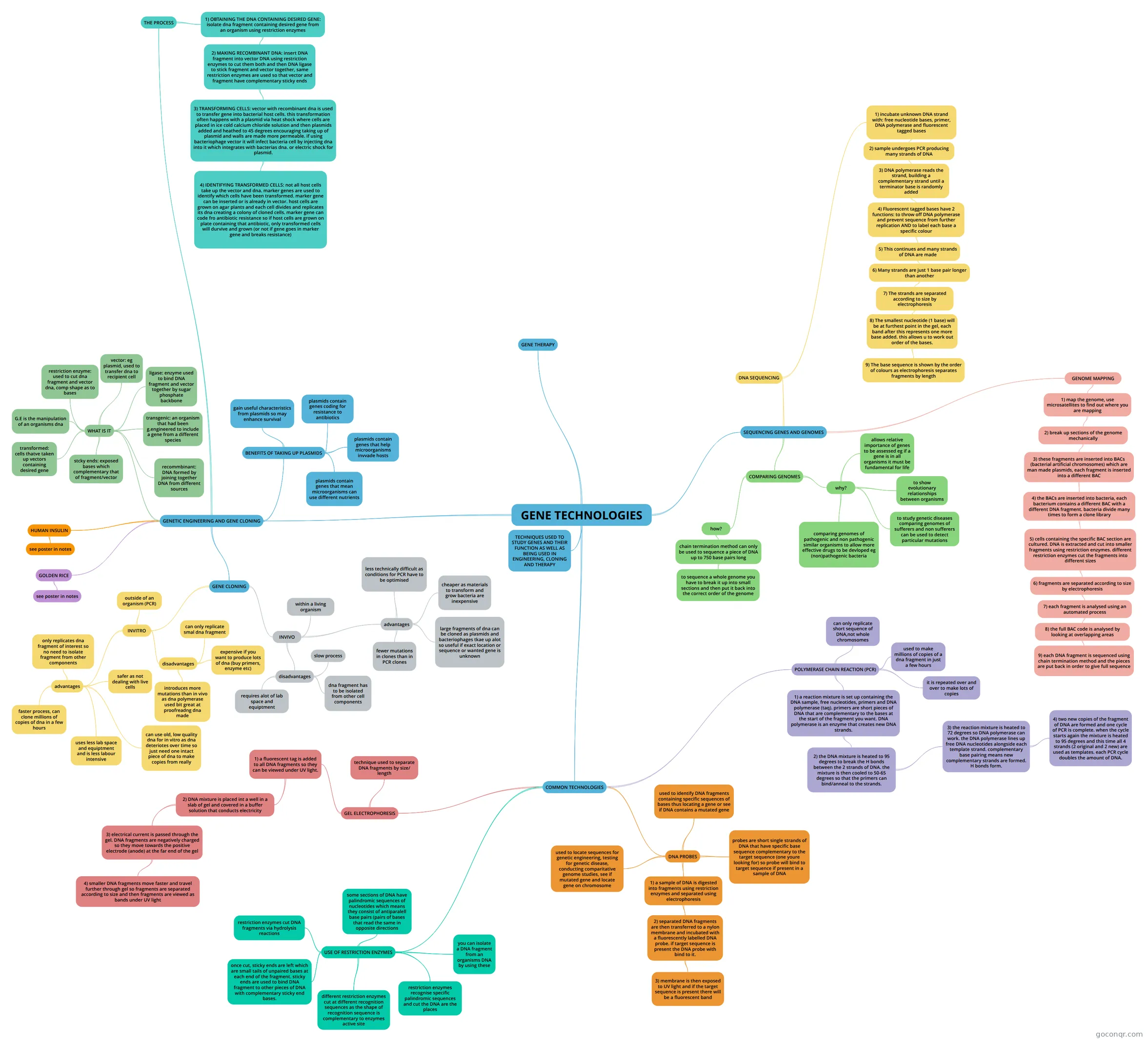
Mind map: Gene technologies
Inhalt der Mindmap
GENE TECHNOLOGIES
GENETIC ENGINEERING AND GENE CLONING
- WHAT IS IT
- G.E is the manipulation of an organisms dna
- transgenic: an organism that had been g.engineered to include a gene from a different species
- recommbinant: DNA formed by joining together DNA from different sources
- ligase: enzyme used to bind DNA fragment and vector together by sugar phosphate backbone
- stcky ends: exposed bases which complementary that of fragment/vector
- restriction enzyme: used to cut dna fragment and vector dna, comp shape as to bases
- vector: eg plasmid, used to transfer dna to recipient cell
- transformed: cells thatve taken up vectors containing desired gene
- THE PROCESS
- 1) OBTAINING THE DNA CONTAINING DESIRED GENE: isolate dna fragment containing desired gene from an organism using restriction enzymes
- 2) MAKING RECOMBINANT DNA: insert DNA fragment into vector DNA using restriction enzymes to cut them both and then DNA ligase to stick fragment and vector together, same restriction enzymes are used so that vector and fragment have complementary sticky ends
- 3) TRANSFORMING CELLS: vector with recombinant dna is used to transfer gene into bacterial host cells. this transformation often happens with a plasmid via heat shock where cells are placed in ice cold calcium chloride solution and then plasmids added and heathed to 45 degrees encouraging taking up of plasmid and walls are made more permeable. if using bacteriophage vector it will infect bacteria cell by injecting dna into it which integrates with bacterias dna. or electric shock for plasmid.
- 4) IDENTIFYING TRANSFORMED CELLS: not all host cells take up the vector and dna. marker genes are used to identify which cells have been transformed. marker gene can be inserted or is already in vector. host cells are grown on agar plants and each cell divides and replicates its dna creating a colony of cloned cells. marker gene can code fro antibiotic resistance so if host cells are grown on plate containing that antibiotic, only transformed cells will durvive and grown (or not if gene goes in marker gene and breaks resistance)
- 3) TRANSFORMING CELLS: vector with recombinant dna is used to transfer gene into bacterial host cells. this transformation often happens with a plasmid via heat shock where cells are placed in ice cold calcium chloride solution and then plasmids added and heathed to 45 degrees encouraging taking up of plasmid and walls are made more permeable. if using bacteriophage vector it will infect bacteria cell by injecting dna into it which integrates with bacterias dna. or electric shock for plasmid.
- 2) MAKING RECOMBINANT DNA: insert DNA fragment into vector DNA using restriction enzymes to cut them both and then DNA ligase to stick fragment and vector together, same restriction enzymes are used so that vector and fragment have complementary sticky ends
- 1) OBTAINING THE DNA CONTAINING DESIRED GENE: isolate dna fragment containing desired gene from an organism using restriction enzymes
- GENE CLONING
- INVIVO
- within a living organism
- advantages
- cheaper as materials to transform and grow bacteria are inexpensive
- large fragments of dna can be cloned as plasmids and bacteriophages tkae up alot so useful if exact location or sequence or wanted gene is unknown
- less technically difficult as conditions for PCR have to be optimised
- fewer mutations in clones than in PCR clones
- disadvantages
- dna fragment has to be isolated from other cell components
- slow process
- requires alot of lab space and equiptment
- INVITRO
- outside of an organism (PCR)
- disadvantages
- can only replicate smal dna fragment
- expensive if you want to produce lots of dna (buy primers, enzyme etc)
- introduces more mutations than in vivo as dna polymerase used bit great at proofreadng dna made
- advantages
- only replicates dna fragment of interest so no need to isolate fragment from other components
- faster process, can clone millions of copies of dna in a few hours
- safer as not dealing with live cells
- uses less lab space and equiptment and is less labour intensive
- can use old, low quality dna for in vitro as dna deteriotes over time so just need one intact piece of dna to make copies from really
- INVIVO
- HUMAN INSULIN
- see poster in notes
- GOLDEN RICE
- see poster in notes
- BENEFITS OF TAKING UP PLASMIDS
- gain useful characteristics from plasmids so may enhance survival
- plasmids contain genes coding for resistance to antibiotics
- plasmids contain genes that help microorganisms invvade hosts
- plasmids contain genes that mean microorganisms can use different nutrients
- WHAT IS IT
COMMON TECHNOLOGIES
- POLYMERASE CHAIN REACTION (PCR)
- used to make millions of copies of a dna fragment in just a few hours
- it is repeated over and over to make lots of copies
- 1) a reaction mixture is set up containing the DNA sample, free nucleotides, primers and DNA polymerase (taq). primers are short pieces of DNA that are complementary to the bases at the start of the fragment you want. DNA polymerase is an enzyme that creates new DNA strands.
- 2) the DNA mixture is heated to 95 degrees to break the H bonds between the 2 strands of DNA. the mixture is then cooled to 50-65 degrees so that the primers can bind/anneal to the strands.
- 3) the reaction mixture is heated to 72 degrees so DNA polymerase can work. the DNA polymerase lines up free DNA nucleotides alongside each template strand. complementary base pairing means new complementary strands are formed. H bonds form.
- 4) two new copies of the fragment of DNA are formed and one cycle of PCR is complete. when the cycle starts again the mixture is heated to 95 degrees and this time all 4 strands (2 original and 2 new) are used as templates. each PCR cycle doubles the amount of DNA.
- 3) the reaction mixture is heated to 72 degrees so DNA polymerase can work. the DNA polymerase lines up free DNA nucleotides alongside each template strand. complementary base pairing means new complementary strands are formed. H bonds form.
- 2) the DNA mixture is heated to 95 degrees to break the H bonds between the 2 strands of DNA. the mixture is then cooled to 50-65 degrees so that the primers can bind/anneal to the strands.
- can only replicate short sequence of DNA,not whole chromosomes
- USE OF RESTRICTION ENZYMES
- you can isolate a DNA fragment from an organisms DNA by using these
- some sections of DNA have palindromic sequences of nucleotides which means they consist of antiparalell base pairs (pairs of bases that read the same in opposite directions
- restriction enzymes recognise specific palindromic sequences and cut the DNA are the places
- different restriction enzymes cut at different recognition sequences as the shape of recognition sequence is complementary to enzymes active site
- restriction enzymes cut DNA fragments via hydrolysis reactions
- once cut, sticky ends are left which are small tails of unpaired bases at each end of the fragment. sticky ends are used to bind DNA fragment to other pieces of DNA with complementary sticky end bases.
- GEL ELECTROPHORESIS
- technique used to separate DNA fragments by size/ length
- 1) a fluorescent tag is added to all DNA fragments so they can be viewed under UV light.
- 2) DNA mixture is placed int a well in a slab of gel and covered in a buffer solution that conducts electricity
- 3) electrical current is passed through the gel. DNA fragments are negatively charged so they move towards the positive electrode (anode) at the far end of the gel
- 4) smaller DNA fragments move faster and travel further through gel so fragments are separated according to size and then fragments are viewed as bands under UV light
- 3) electrical current is passed through the gel. DNA fragments are negatively charged so they move towards the positive electrode (anode) at the far end of the gel
- 2) DNA mixture is placed int a well in a slab of gel and covered in a buffer solution that conducts electricity
- DNA PROBES
- used to identify DNA fragments containing specific sequences of bases thus locating a gene or see if DNA contains a mutated gene
- probes are short single strands of DNA that have specific base sequence complementary to the target sequence (one youre looking for) so probe will bind to target sequence if present in a sample of DNA
- 1) a sample of DNA is digested into fragments using restriction enzymes and separated using electrophoresis
- 2) separated DNA fragments are then transferred to a nylon membrane and incubated with a fluorescently labelled DNA probe. if target sequence is present the DNA probe with bind to it.
- 3) membrane is then exposed to UV light and if the target sequence is present there will be a fluorescent band
- 2) separated DNA fragments are then transferred to a nylon membrane and incubated with a fluorescently labelled DNA probe. if target sequence is present the DNA probe with bind to it.
- used to locate sequences for genetic engineering, testing for genetic disease, conducting comparitative genome studies, see if mutated gene and locate gene on chromosome
- POLYMERASE CHAIN REACTION (PCR)
GENE THERAPY
SEQUENCING GENES AND GENOMES
- DNA SEQUENCING
- 1) incubate unknown DNA strand with: free nucleotide bases, primer, DNA polymerase and fluorescent tagged bases
- 2) sample undergoes PCR producing many strands of DNA
- 3) DNA polymerase reads the strand, building a complementary strand until a terminator base is randomly added
- 4) Fluorescent tagged bases have 2 functions: to throw off DNA polymerase and prevent sequence from further replication AND to label each base a specific colour
- 5) This continues and many strands of DNA are made
- 6) Many strands are just 1 base pair longer than another
- 7) The strands are separated according to size by electrophoresis
- 8) The smallest nucleotide (1 base) will be at furthest point in the gel, each band after this represents one more base added. this allows u to work out order of the bases.
- 9) The base sequence is shown by the order of colours as electrophoresis separates fragments by length
- 8) The smallest nucleotide (1 base) will be at furthest point in the gel, each band after this represents one more base added. this allows u to work out order of the bases.
- 7) The strands are separated according to size by electrophoresis
- 6) Many strands are just 1 base pair longer than another
- 5) This continues and many strands of DNA are made
- 4) Fluorescent tagged bases have 2 functions: to throw off DNA polymerase and prevent sequence from further replication AND to label each base a specific colour
- 3) DNA polymerase reads the strand, building a complementary strand until a terminator base is randomly added
- 2) sample undergoes PCR producing many strands of DNA
- 1) incubate unknown DNA strand with: free nucleotide bases, primer, DNA polymerase and fluorescent tagged bases
- GENOME MAPPING
- 1) map the genome, use microsatellites to find out where you are mapping
- 2) break up sections of the genome mechanically
- 3) these fragments are inserted into BACs (bacterial artificial chromosomes) which are man made plasmids, each fragment is inserted into a different BAC
- 4) the BACs are inserted into bacteria, each bacterium contains a different BAC with a different DNA fragment. bacteria divide many times to form a clone library
- 5) cells containing the specific BAC section are cultured. DNA is extracted and cut into smaller fragments using restriction enzymes. different restriction enzymes cut the fragments into different sizes
- 6) fragments are separated according to size by electrophoresis
- 7) each fragment is analysed using an automated process
- 8) the full BAC code is analysed by looking at overlapping areas
- 9) each DNA fragment is sequenced using chain termination method and the pieces are put back in order to give full sequence
- 8) the full BAC code is analysed by looking at overlapping areas
- 7) each fragment is analysed using an automated process
- 6) fragments are separated according to size by electrophoresis
- 5) cells containing the specific BAC section are cultured. DNA is extracted and cut into smaller fragments using restriction enzymes. different restriction enzymes cut the fragments into different sizes
- 4) the BACs are inserted into bacteria, each bacterium contains a different BAC with a different DNA fragment. bacteria divide many times to form a clone library
- 3) these fragments are inserted into BACs (bacterial artificial chromosomes) which are man made plasmids, each fragment is inserted into a different BAC
- 2) break up sections of the genome mechanically
- 1) map the genome, use microsatellites to find out where you are mapping
- COMPARING GENOMES
- why?
- allows relative importance of genes to be assessed eg if a gene is in all organisms it must be fundamental for life
- to show evolutionary relationships between organisms
- to study genetic diseases comparing genomes of sufferers and non sufferers can be used to detect particular mutations
- comparing genomes of pathogenic and non pathogenic similar organisms to allow more effective drugs to be devloped eg (non)pathogenic bacteria
- how?
- chain termination method can only be used to sequence a piece of DNA up to 750 base pairs long
- to sequence a whole genome you have to break it up into small sections and then put it back into the correct order of the genome
- chain termination method can only be used to sequence a piece of DNA up to 750 base pairs long
- why?
- DNA SEQUENCING
TECHNIQUES USED TO STUDY GENES AND THEIR FUNCTION AS WELL AS BEING USED IN ENGINEERING, CLONING AND THERAPY
Informationen
- Beschreibung
- Mindmap am GENE TECHNOLOGIES, erstellt von shannon.kelly4 am 22/11/2015.
- Erstellt von
- shannon.kelly4
- Aufrufe
- 0
- Bewertung