
Mindmap
SUPPLY CHAIN
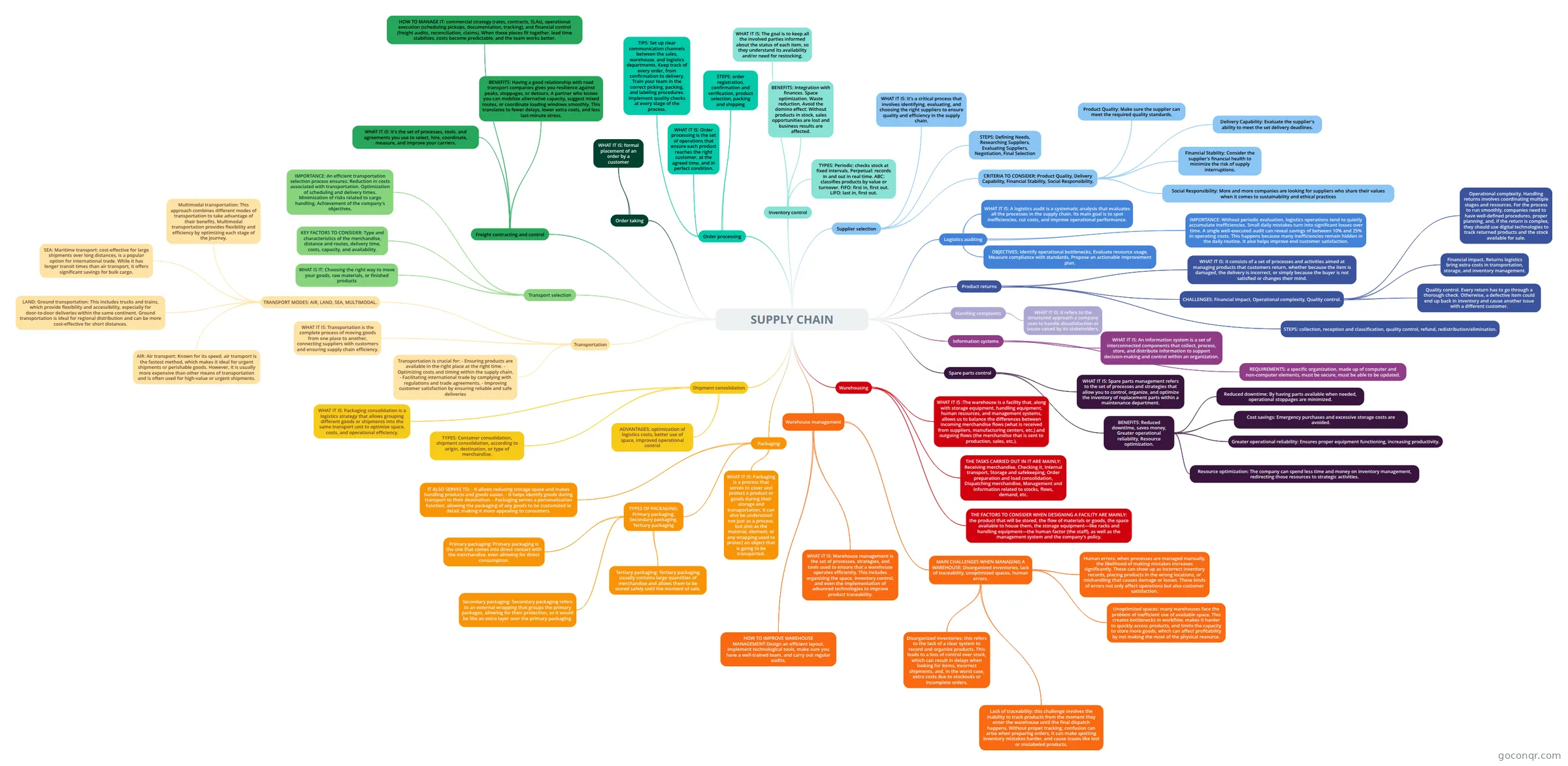
Mind map: Supply chain
Inhalt der Mindmap
SUPPLY CHAIN
Packaging
- WHAT IT IS: Packaging is a process that serves to cover and protect a product or goods during their storage and transportation. It can also be understood not just as a process, but also as the material, element, or any wrapping used to protect an object that is going to be transported.
- TYPES OF PACKAGING: Primary packaging, Secondary packaging, Tertiary packaging
- Tertiary packaging: Tertiary packaging usually contains large quantities of merchandise and allows them to be stored safely until the moment of sale.
- Secondary packaging: Secondary packaging refers to an external wrapping that groups the primary packages, allowing for their protection, so it would be like an extra layer over the primary packaging.
- Primary packaging: Primary packaging is the one that comes into direct contact with the merchandise, even allowing for direct consumption.
- IT ALSO SERVES TO: - It allows reducing storage space and makes handling products and goods easier. - It helps identify goods during transport to their destination. - Packaging serves a personalization function, allowing the packaging of any goods to be customized in detail, making it more appealing to consumers.
Inventory control
- WHAT IT IS: The goal is to keep all the involved parties informed about the status of each item, so they understand its availability and/or need for restocking.
- BENEFITS: Integration with finances. Space optimization. Waste reduction. Avoid the domino effect: Without products in stock, sales opportunities are lost and business results are affected.
- TYPES: Periodic: checks stock at fixed intervals. Perpetual: records in and out in real time. ABC: classifies products by value or turnover. FIFO: first in, first out. LIFO: last in, first out.
Warehouse management
- WHAT IT IS: Warehouse management is the set of processes, strategies, and tools used to ensure that a warehouse operates efficiently. This includes organizing the space, inventory control, and even the implementation of advanced technologies to improve product traceability.
- MAIN CHALLENGES WHEN MANAGING A WAREHOUSE: Disorganized inventories, lack of traceability, unoptimized spaces, human errors.
- Lack of traceability: this challenge involves the inability to track products from the moment they enter the warehouse until the final dispatch happens. Without proper tracking, confusion can arise when preparing orders, it can make spotting inventory mistakes harder, and cause issues like lost or mislabeled products.
- Unoptimized spaces: many warehouses face the problem of inefficient use of available space. This creates bottlenecks in workflow, makes it harder to quickly access products, and limits the capacity to store more goods, which can affect profitability by not making the most of the physical resource.
- Human errors: when processes are managed manually, the likelihood of making mistakes increases significantly. These can show up as incorrect inventory records, placing products in the wrong locations, or mishandling that causes damage or losses. These kinds of errors not only affect operations but also customer satisfaction.
- Disorganized inventories: this refers to the lack of a clear system to record and organize products. This leads to a loss of control over stock, which can result in delays when looking for items, incorrect shipments, and, in the worst case, extra costs due to stockouts or incomplete orders.
- HOW TO IMPROVE WAREHOUSE MANAGEMENT:Design an efficient layout, implement technological tools, make sure you have a well-trained team, and carry out regular audits.
Product returns
- WHAT IT IS: it consists of a set of processes and activities aimed at managing products that customers return, whether because the item is damaged, the delivery is incorrect, or simply because the buyer is not satisfied or changes their mind.
- CHALLENGES: Financial impact, Operational complexity, Quality control.
- Financial impact. Returns logistics bring extra costs in transportation, storage, and inventory management.
- Operational complexity. Handling returns involves coordinating multiple stages and resources. For the process to run smoothly, companies need to have well-defined procedures, proper planning, and, if the return is complex, they should use digital technologies to track returned products and the stock available for sale.
- Quality control. Every return has to go through a thorough check. Otherwise, a defective item could end up back in inventory and cause another issue with a different customer.
- STEPS: collection, reception and classification, quality control, refund, redistribution/elimination.
Information systems
- WHAT IT IS: An information system is a set of interconnected components that collect, process, store, and distribute information to support decision-making and control within an organization.
- REQUIREMENTS: a specific organization, made up of computer and non-computer elements, must be secure, must be able to be updated.
Transport selection
- WHAT IS IT: Choosing the right way to move your goods, raw materials, or finished products
- KEY FACTORS TO CONSIDER: Type and characteristics of the merchandise, distance and routes, delivery time, costs, capacity, and availability.
- IMPORTANCE: An efficient transportation selection process ensures: Reduction in costs associated with transportation. Optimization of scheduling and delivery times. Minimization of risks related to cargo handling. Achievement of the company's objectives.
Shipment consolidation
- WHAT IT IS: Packaging consolidation is a logistics strategy that allows grouping different goods or shipments into the same transport unit to optimize space, costs, and operational efficiency.
- ADVANTAGES: optimization of logistics costs, better use of space, improved operational control
- TYPES: Container consolidation, shipment consolidation, according to origin, destination, or type of merchandise.
Freight contracting and control
- WHAT IT IS: It's the set of processes, tools, and agreements you use to select, hire, coordinate, measure, and improve your carriers.
- HOW TO MANAGE IT: commercial strategy (rates, contracts, SLAs), operational execution (scheduling pickups, documentation, tracking), and financial control (freight audits, reconciliation, claims). When these pieces fit together, lead time stabilizes, costs become predictable, and the team works better.
- BENEFITS: Having a good relationship with road transport companies gives you resilience against peaks, stoppages, or detours. A partner who knows you can mobilize alternative capacity, suggest mixed routes, or coordinate loading windows smoothly. This translates to fewer delays, lower extra costs, and less last-minute stress.
Order processing
- WHAT IT IS: Order processing is the set of operations that ensure each product reaches the right customer, at the agreed time, and in perfect condition.
- STEPS: order registration, confirmation and verification, product selection, packing and shipping
- TIPS: Set up clear communication channels between the sales, warehouse, and logistics departments. Keep track of every order, from confirmation to delivery. Train your team in the correct picking, packing, and labeling procedures. Implement quality checks at every stage of the process.
Supplier selection
- WHAT IT IS: It's a critical process that involves identifying, evaluating, and choosing the right suppliers to ensure quality and efficiency in the supply chain.
- STEPS: Defining Needs, Researching Suppliers, Evaluating Suppliers, Negotiation, Final Selection
- CRITERIA TO CONSIDER: Product Quality, Delivery Capability, Financial Stability, Social Responsibility.
- Product Quality: Make sure the supplier can meet the required quality standards.
- Delivery Capability: Evaluate the supplier's ability to meet the set delivery deadlines.
- Financial Stability: Consider the supplier's financial health to minimize the risk of supply interruptions.
- Social Responsibility: More and more companies are looking for suppliers who share their values when it comes to sustainability and ethical practices
Handling complaints
- WHAT IT IS: it refers to the structured approach a company uses to handle dissatisfaction or issues raised by its stakeholders.
Order taking
- WHAT IT IS: formal placement of an order by a customer
Transportation
- WHAT IT IS: Transportation is the complete process of moving goods from one place to another, connecting suppliers with customers and ensuring supply chain efficiency.
- TRANSPORT MODES: AIR, LAND, SEA, MULTIMODAL.
- LAND: Ground transportation: This includes trucks and trains, which provide flexibility and accessibility, especially for door-to-door deliveries within the same continent. Ground transportation is ideal for regional distribution and can be more cost-effective for short distances.
- AIR: Air transport: Known for its speed, air transport is the fastest method, which makes it ideal for urgent shipments or perishable goods. However, it is usually more expensive than other means of transportation and is often used for high-value or urgent shipments.
- SEA: Maritime transport: cost-effective for large shipments over long distances, is a popular option for international trade. While it has longer transit times than air transport, it offers significant savings for bulk cargo.
- Multimodal transportation: This approach combines different modes of transportation to take advantage of their benefits. Multimodal transportation provides flexibility and efficiency by optimizing each stage of the journey.
- Transportation is crucial for: - Ensuring products are available in the right place at the right time. - Optimizing costs and timing within the supply chain. - Facilitating international trade by complying with regulations and trade agreements. - Improving customer satisfaction by ensuring reliable and safe deliveries
Logistics auditing
- WHAT IT IS: A logistics audit is a systematic analysis that evaluates all the processes in the supply chain. Its main goal is to spot inefficiencies, cut costs, and improve operational performance.
- IMPORTANCE: Without periodic evaluation, logistics operations tend to quietly accumulate inefficiencies. Small daily mistakes turn into significant losses over time. A single well-executed audit can reveal savings of between 10% and 25% in operating costs. This happens because many inefficiencies remain hidden in the daily routine. It also helps improve end customer satisfaction.
- OBJECTIVES: Identify operational bottlenecks, Evaluate resource usage, Measure compliance with standards, Propose an actionable improvement plan.
Spare parts control
- WHAT IT IS: Spare parts management refers to the set of processes and strategies that allow you to control, organize, and optimize the inventory of replacement parts within a maintenance department.
- BENEFITS: Reduced downtime, saves money, Greater operational reliability, Resource optimization.
- Reduced downtime: By having parts available when needed, operational stoppages are minimized.
- Cost savings: Emergency purchases and excessive storage costs are avoided.
- Greater operational reliability: Ensures proper equipment functioning, increasing productivity.
- Resource optimization: The company can spend less time and money on inventory management, redirecting those resources to strategic activities.
Warehousing
- WHAT IT IS :The warehouse is a facility that, along with storage equipment, handling equipment, human resources, and management systems, allows us to balance the differences between incoming merchandise flows (what is received from suppliers, manufacturing centers, etc.) and outgoing flows (the merchandise that is sent to production, sales, etc.).
- THE TASKS CARRIED OUT IN IT ARE MAINLY: Receiving merchandise, Checking it, Internal transport, Storage and safekeeping, Order preparation and load consolidation, Dispatching merchandise, Management and information related to stocks, flows, demand, etc.
- THE FACTORS TO CONSIDER WHEN DESIGNING A FACILITY ARE MAINLY: the product that will be stored, the flow of materials or goods, the space available to house them, the storage equipment—like racks and handling equipment—the human factor (the staff), as well as the management system and the company's policy.
Informationen
- Beschreibung
- Mindmap am SUPPLY CHAIN, erstellt von LUCIA ELEONOR ESPARZA SAUCEDO am 12/06/2026.
- Erstellt von
- LUCIA ELEONOR ESPARZA SAUCEDO
- Aufrufe
- 1
- Bewertung