
Mindmap
Chapter 4: Sensation and Perception
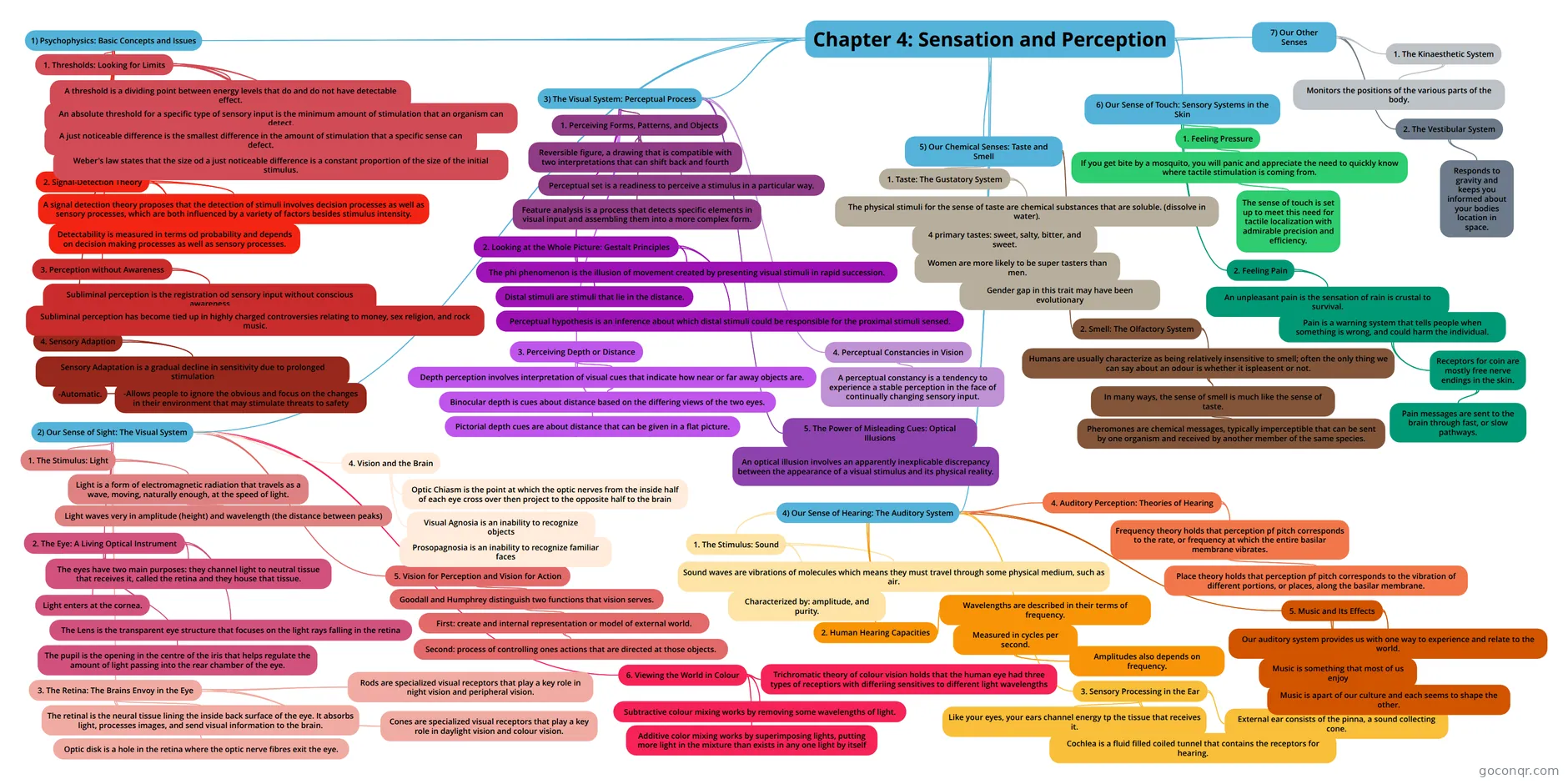
Mind map: Sensation and perception
Inhalt der Mindmap
Chapter 4: Sensation and Perception
1) Psychophysics: Basic Concepts and Issues
- 1. Thresholds: Looking for Limits
- A threshold is a dividing point between energy levels that do and do not have detectable effect.
- An absolute threshold for a specific type of sensory input is the minimum amount of stimulation that an organism can detect.
- A just noticeable difference is the smallest difference in the amount of stimulation that a specific sense can defect.
- Weber's law states that the size od a just noticeable difference is a constant proportion of the size of the initial stimulus.
- 2. Signal-Detection Theory
- A signal detection theory proposes that the detection of stimuli involves decision processes as well as sensory processes, which are both influenced by a variety of factors besides stimulus intensity.
- Detectability is measured in terms od probability and depends on decision making processes as well as sensory processes.
- 3. Perception without Awareness
- Subliminal perception is the registration od sensory input without conscious awareness
- Subliminal perception has become tied up in highly charged controversies relating to money, sex religion, and rock music.
- Subliminal perception is the registration od sensory input without conscious awareness
- 4. Sensory Adaption
- Sensory Adaptation is a gradual decline in sensitivity due to prolonged stimulation
- -Automatic.
- -Allows people to ignore the obvious and focus on the changes in their environment that may stimulate threats to safety
- Sensory Adaptation is a gradual decline in sensitivity due to prolonged stimulation
- 1. Thresholds: Looking for Limits
2) Our Sense of Sight: The Visual System
- 1. The Stimulus: Light
- Light is a form of electromagnetic radiation that travels as a wave, moving, naturally enough, at the speed of light.
- Light waves very in amplitude (height) and wavelength (the distance between peaks)
- Light is a form of electromagnetic radiation that travels as a wave, moving, naturally enough, at the speed of light.
- 2. The Eye: A Living Optical Instrument
- The eyes have two main purposes: they channel light to neutral tissue that receives it, called the retina and they house that tissue.
- Light enters at the cornea.
- The Lens is the transparent eye structure that focuses on the light rays falling in the retina
- The pupil is the opening in the centre of the iris that helps regulate the amount of light passing into the rear chamber of the eye.
- 3. The Retina: The Brains Envoy in the Eye
- The retinal is the neural tissue lining the inside back surface of the eye. It absorbs light, processes images, and send visual information to the brain.
- Optic disk is a hole in the retina where the optic nerve fibres exit the eye.
- Cones are specialized visual receptors that play a key role in daylight vision and colour vision.
- Rods are specialized visual receptors that play a key role in night vision and peripheral vision.
- 4. Vision and the Brain
- Optic Chiasm is the point at which the optic nerves from the inside half of each eye cross over then project to the opposite half to the brain
- Prosopagnosia is an inability to recognize familiar faces
- Visual Agnosia is an inability to recognize objects
- Optic Chiasm is the point at which the optic nerves from the inside half of each eye cross over then project to the opposite half to the brain
- 5. Vision for Perception and Vision for Action
- Goodall and Humphrey distinguish two functions that vision serves.
- First: create and internal representation or model of external world.
- Second: process of controlling ones actions that are directed at those objects.
- First: create and internal representation or model of external world.
- Goodall and Humphrey distinguish two functions that vision serves.
- 6. Viewing the World in Colour
- Subtractive colour mixing works by removing some wavelengths of light.
- Additive color mixing works by superimposing lights, putting more light in the mixture than exists in any one light by itself
- Trichromatic theory of colour vision holds that the human eye had three types of receptiors with differiing sensitives to different light wavelengths
- 1. The Stimulus: Light
3) The Visual System: Perceptual Process
- 1. Perceiving Forms, Patterns, and Objects
- Reversible figure, a drawing that is compatible with two interpretations that can shift back and fourth
- Perceptual set is a readiness to perceive a stimulus in a particular way.
- Feature analysis is a process that detects specific elements in visual input and assembling them into a more complex form.
- 2. Looking at the Whole Picture: Gestalt Principles
- The phi phenomenon is the illusion of movement created by presenting visual stimuli in rapid succession.
- Distal stimuli are stimuli that lie in the distance.
- Perceptual hypothesis is an inference about which distal stimuli could be responsible for the proximal stimuli sensed.
- 3. Perceiving Depth or Distance
- Depth perception involves interpretation of visual cues that indicate how near or far away objects are.
- Binocular depth is cues about distance based on the differing views of the two eyes.
- Pictorial depth cues are about distance that can be given in a flat picture.
- Depth perception involves interpretation of visual cues that indicate how near or far away objects are.
- 4. Perceptual Constancies in Vision
- A perceptual constancy is a tendency to experience a stable perception in the face of continually changing sensory input.
- 5. The Power of Misleading Cues: Optical Illusions
- An optical illusion involves an apparently inexplicable discrepancy between the appearance of a visual stimulus and its physical reality.
- 1. Perceiving Forms, Patterns, and Objects
4) Our Sense of Hearing: The Auditory System
- 1. The Stimulus: Sound
- Sound waves are vibrations of molecules which means they must travel through some physical medium, such as air.
- Characterized by: amplitude, and purity.
- 2. Human Hearing Capacities
- Wavelengths are described in their terms of frequency.
- Measured in cycles per second.
- Amplitudes also depends on frequency.
- Measured in cycles per second.
- Wavelengths are described in their terms of frequency.
- 3. Sensory Processing in the Ear
- Like your eyes, your ears channel energy tp the tissue that receives it.
- External ear consists of the pinna, a sound collecting cone.
- Cochlea is a fluid filled coiled tunnel that contains the receptors for hearing.
- 4. Auditory Perception: Theories of Hearing
- Frequency theory holds that perception pf pitch corresponds to the rate, or frequency at which the entire basilar membrane vibrates.
- Place theory holds that perception pf pitch corresponds to the vibration of different portions, or places, along the basilar membrane.
- Frequency theory holds that perception pf pitch corresponds to the rate, or frequency at which the entire basilar membrane vibrates.
- 5. Music and Its Effects
- Our auditory system provides us with one way to experience and relate to the world.
- Music is something that most of us enjoy
- Music is apart of our culture and each seems to shape the other.
- 1. The Stimulus: Sound
5) Our Chemical Senses: Taste and Smell
- 1. Taste: The Gustatory System
- The physical stimuli for the sense of taste are chemical substances that are soluble. (dissolve in water).
- 4 primary tastes: sweet, salty, bitter, and sweet.
- Women are more likely to be super tasters than men.
- Gender gap in this trait may have been evolutionary
- Women are more likely to be super tasters than men.
- 4 primary tastes: sweet, salty, bitter, and sweet.
- The physical stimuli for the sense of taste are chemical substances that are soluble. (dissolve in water).
- 2. Smell: The Olfactory System
- Humans are usually characterize as being relatively insensitive to smell; often the only thing we can say about an odour is whether it ispleasent or not.
- In many ways, the sense of smell is much like the sense of taste.
- Pheromones are chemical messages, typically imperceptible that can be sent by one organism and received by another member of the same species.
- In many ways, the sense of smell is much like the sense of taste.
- Humans are usually characterize as being relatively insensitive to smell; often the only thing we can say about an odour is whether it ispleasent or not.
- 1. Taste: The Gustatory System
6) Our Sense of Touch: Sensory Systems in the Skin
- 1. Feeling Pressure
- If you get bite by a mosquito, you will panic and appreciate the need to quickly know where tactile stimulation is coming from.
- The sense of touch is set up to meet this need for tactile localization with admirable precision and efficiency.
- If you get bite by a mosquito, you will panic and appreciate the need to quickly know where tactile stimulation is coming from.
- 2. Feeling Pain
- An unpleasant pain is the sensation of rain is crustal to survival.
- Pain is a warning system that tells people when something is wrong, and could harm the individual.
- Receptors for coin are mostly free nerve endings in the skin.
- Pain messages are sent to the brain through fast, or slow pathways.
- Receptors for coin are mostly free nerve endings in the skin.
- Pain is a warning system that tells people when something is wrong, and could harm the individual.
- An unpleasant pain is the sensation of rain is crustal to survival.
- 1. Feeling Pressure
7) Our Other Senses
- 1. The Kinaesthetic System
- Monitors the positions of the various parts of the body.
- 2. The Vestibular System
- Responds to gravity and keeps you informed about your bodies location in space.
- 1. The Kinaesthetic System
Informationen
- Beschreibung
- Mindmap am Chapter 4: Sensation and Perception, erstellt von janayea.benko am 16/02/2016.
- Erstellt von
- janayea.benko
- Aufrufe
- 5
- Bewertung