
Mindmap
Vertebrate Evolutionary biology
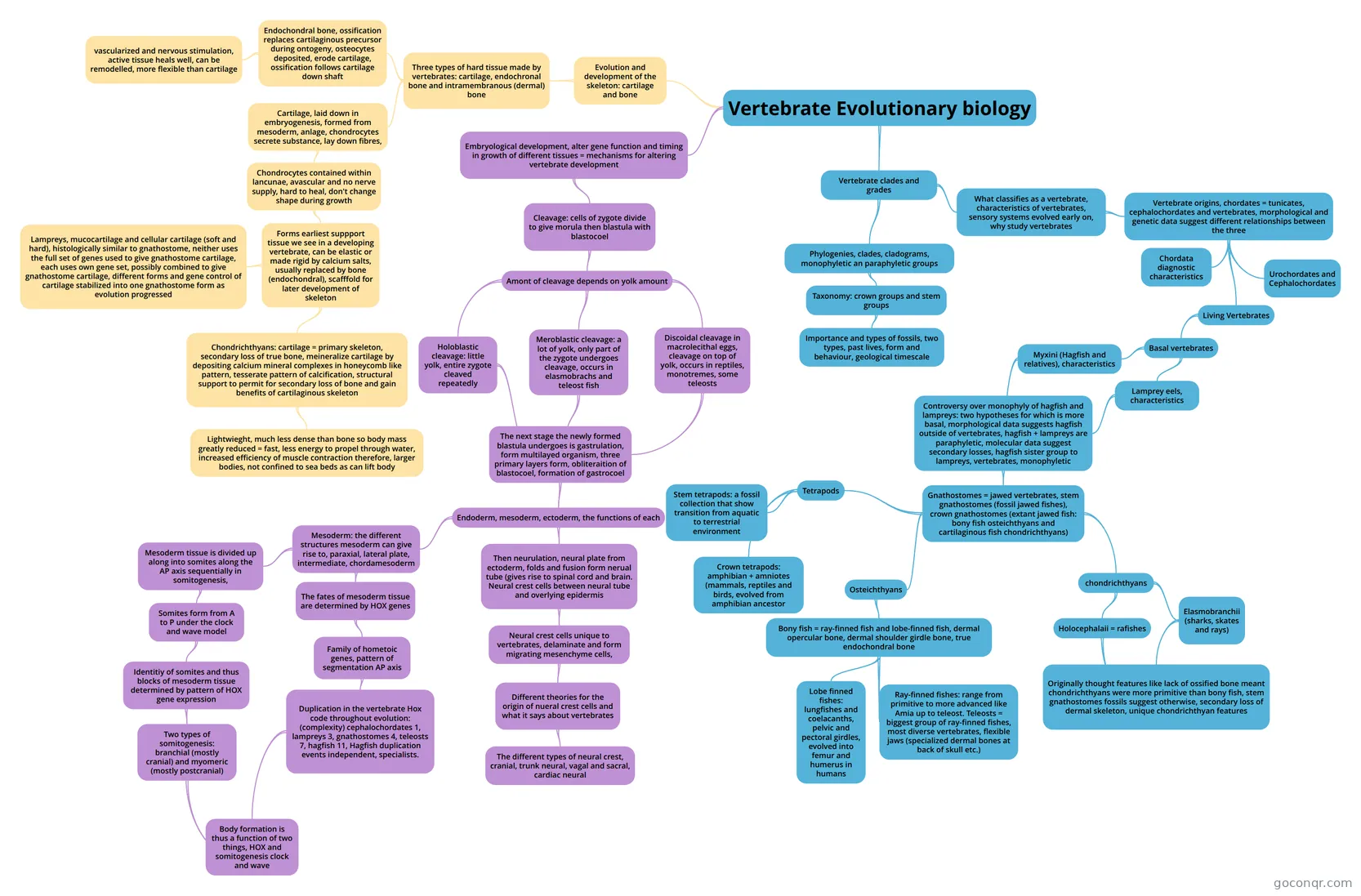
Mind map: Vertebrate evolutionary biology
Inhalt der Mindmap
Vertebrate Evolutionary biology
Vertebrate clades and grades
- What classifies as a vertebrate, characteristics of vertebrates, sensory systems evolved early on, why study vertebrates
- Vertebrate origins, chordates = tunicates, cephalochordates and vertebrates, morphological and genetic data suggest different relationships between the three
- Chordata diagnostic characteristics
- Urochordates and Cephalochordates
- Living Vertebrates
- Basal vertebrates
- Myxini (Hagfish and relatives), characteristics
- Lamprey eels, characteristics
- Controversy over monophyly of hagfish and lampreys: two hypotheses for which is more basal, morphological data suggests hagfish outside of vertebrates, hagfish + lampreys are paraphyletic, molecular data suggest secondary losses, hagfish sister group to lampreys, vertebrates, monophyletic
- Gnathostomes = jawed vertebrates, stem gnathostomes (fossil jawed fishes), crown gnathostomes (extant jawed fish: bony fish osteichthyans and cartilaginous fish chondrichthyans)
- chondrichthyans
- Elasmobranchii (sharks, skates and rays)
- Originally thought features like lack of ossified bone meant chondrichthyans were more primitive than bony fish, stem gnathostomes fossils suggest otherwise, secondary loss of dermal skeleton, unique chondrichthyan features
- Holocephalaii = rafishes
- Elasmobranchii (sharks, skates and rays)
- Osteichthyans
- Bony fish = ray-finned fish and lobe-finned fish, dermal opercular bone, dermal shoulder girdle bone, true endochondral bone
- Ray-finned fishes: range from primitive to more advanced like Amia up to teleost. Teleosts = biggest group of ray-finned fishes, most diverse vertebrates, flexible jaws (specialized dermal bones at back of skull etc.)
- Lobe finned fishes: lungfishes and coelacanths, pelvic and pectoral girdles, evolved into femur and humerus in humans
- Bony fish = ray-finned fish and lobe-finned fish, dermal opercular bone, dermal shoulder girdle bone, true endochondral bone
- Tetrapods
- Stem tetrapods: a fossil collection that show transition from aquatic to terrestrial environment
- Crown tetrapods: amphibian + amniotes (mammals, reptiles and birds, evolved from amphibian ancestor
- chondrichthyans
- Gnathostomes = jawed vertebrates, stem gnathostomes (fossil jawed fishes), crown gnathostomes (extant jawed fish: bony fish osteichthyans and cartilaginous fish chondrichthyans)
- Controversy over monophyly of hagfish and lampreys: two hypotheses for which is more basal, morphological data suggests hagfish outside of vertebrates, hagfish + lampreys are paraphyletic, molecular data suggest secondary losses, hagfish sister group to lampreys, vertebrates, monophyletic
- Myxini (Hagfish and relatives), characteristics
- Basal vertebrates
- Vertebrate origins, chordates = tunicates, cephalochordates and vertebrates, morphological and genetic data suggest different relationships between the three
- Phylogenies, clades, cladograms, monophyletic an paraphyletic groups
- Taxonomy: crown groups and stem groups
- Importance and types of fossils, two types, past lives, form and behaviour, geological timescale
- Taxonomy: crown groups and stem groups
- What classifies as a vertebrate, characteristics of vertebrates, sensory systems evolved early on, why study vertebrates
Embryological development, alter gene function and timing in growth of different tissues = mechanisms for altering vertebrate development
- Cleavage: cells of zygote divide to give morula then blastula with blastocoel
- Amont of cleavage depends on yolk amount
- Holoblastic cleavage: little yolk, entire zygote cleaved repeatedly
- Meroblastic cleavage: a lot of yolk, only part of the zygote undergoes cleavage, occurs in elasmobrachs and teleost fish
- Discoidal cleavage in macrolecithal eggs, cleavage on top of yolk, occurs in reptiles, monotremes, some teleosts
- The next stage the newly formed blastula undergoes is gastrulation, form multilayed organism, three primary layers form, obliteraition of blastocoel, formation of gastrocoel
- Endoderm, mesoderm, ectoderm, the functions of each
- Then neurulation, neural plate from ectoderm, folds and fusion form nerual tube (gives rise to spinal cord and brain. Neural crest cells between neural tube and overlying epidermis
- Neural crest cells unique to vertebrates, delaminate and form migrating mesenchyme cells,
- Different theories for the origin of nueral crest cells and what it says about vertebrates
- The different types of neural crest, cranial, trunk neural, vagal and sacral, cardiac neural
- Different theories for the origin of nueral crest cells and what it says about vertebrates
- Neural crest cells unique to vertebrates, delaminate and form migrating mesenchyme cells,
- Mesoderm: the different structures mesoderm can give rise to, paraxial, lateral plate, intermediate, chordamesoderm
- The fates of mesoderm tissue are determined by HOX genes
- Family of hometoic genes, pattern of segmentation AP axis
- Duplication in the vertebrate Hox code throughout evolution: (complexity) cephalochordates 1, lampreys 3, gnathostomes 4, teleosts 7, hagfish 11, Hagfish duplication events independent, specialists.
- Body formation is thus a function of two things, HOX and somitogenesis clock and wave
- Duplication in the vertebrate Hox code throughout evolution: (complexity) cephalochordates 1, lampreys 3, gnathostomes 4, teleosts 7, hagfish 11, Hagfish duplication events independent, specialists.
- Family of hometoic genes, pattern of segmentation AP axis
- Mesoderm tissue is divided up along into somites along the AP axis sequentially in somitogenesis,
- Somites form from A to P under the clock and wave model
- Identitiy of somites and thus blocks of mesoderm tissue determined by pattern of HOX gene expression
- Two types of somitogenesis: branchial (mostly cranial) and myomeric (mostly postcranial)
- Two types of somitogenesis: branchial (mostly cranial) and myomeric (mostly postcranial)
- Identitiy of somites and thus blocks of mesoderm tissue determined by pattern of HOX gene expression
- Somites form from A to P under the clock and wave model
- The fates of mesoderm tissue are determined by HOX genes
- Then neurulation, neural plate from ectoderm, folds and fusion form nerual tube (gives rise to spinal cord and brain. Neural crest cells between neural tube and overlying epidermis
- Endoderm, mesoderm, ectoderm, the functions of each
- The next stage the newly formed blastula undergoes is gastrulation, form multilayed organism, three primary layers form, obliteraition of blastocoel, formation of gastrocoel
- Holoblastic cleavage: little yolk, entire zygote cleaved repeatedly
- Amont of cleavage depends on yolk amount
- Cleavage: cells of zygote divide to give morula then blastula with blastocoel
Evolution and development of the skeleton: cartilage and bone
- Three types of hard tissue made by vertebrates: cartilage, endochronal bone and intramembranous (dermal) bone
- Cartilage, laid down in embryogenesis, formed from mesoderm, anlage, chondrocytes secrete substance, lay down fibres,
- Chondrocytes contained within lancunae, avascular and no nerve supply, hard to heal, don't change shape during growth
- Forms earliest suppport tissue we see in a developing vertebrate, can be elastic or made rigid by calcium salts, usually replaced by bone (endochondral), scafffold for later development of skeleton
- Chondrichthyans: cartilage = primary skeleton, secondary loss of true bone, meineralize cartilage by depositing calcium mineral complexes in honeycomb like pattern, tesserate pattern of calcification, structural support to permit for secondary loss of bone and gain benefits of cartilaginous skeleton
- Lightwieght, much less dense than bone so body mass greatly reduced = fast, less energy to propel through water, increased efficiency of muscle contraction therefore, larger bodies, not confined to sea beds as can lift body
- Lampreys, mucocartilage and cellular cartilage (soft and hard), histologically similar to gnathostome, neither uses the full set of genes used to give gnathostome cartilage, each uses own gene set, possibly combined to give gnathostome cartilage, different forms and gene control of cartilage stabilized into one gnathostome form as evolution progressed
- Chondrichthyans: cartilage = primary skeleton, secondary loss of true bone, meineralize cartilage by depositing calcium mineral complexes in honeycomb like pattern, tesserate pattern of calcification, structural support to permit for secondary loss of bone and gain benefits of cartilaginous skeleton
- Forms earliest suppport tissue we see in a developing vertebrate, can be elastic or made rigid by calcium salts, usually replaced by bone (endochondral), scafffold for later development of skeleton
- Chondrocytes contained within lancunae, avascular and no nerve supply, hard to heal, don't change shape during growth
- Endochondral bone, ossification replaces cartilaginous precursor during ontogeny, osteocytes deposited, erode cartilage, ossification follows cartilage down shaft
- vascularized and nervous stimulation, active tissue heals well, can be remodelled, more flexible than cartilage
- Cartilage, laid down in embryogenesis, formed from mesoderm, anlage, chondrocytes secrete substance, lay down fibres,
- Three types of hard tissue made by vertebrates: cartilage, endochronal bone and intramembranous (dermal) bone
Informationen
- Beschreibung
- 2nd year Vertebrate evolutionary biology Mindmap am Vertebrate Evolutionary biology, erstellt von Emily Lythgoe am 20/02/2016.
- Erstellt von
- Emily Lythgoe
- Aufrufe
- 1
- Bewertung