
Mindmap
Basic Concepts in Stem Cell Biology
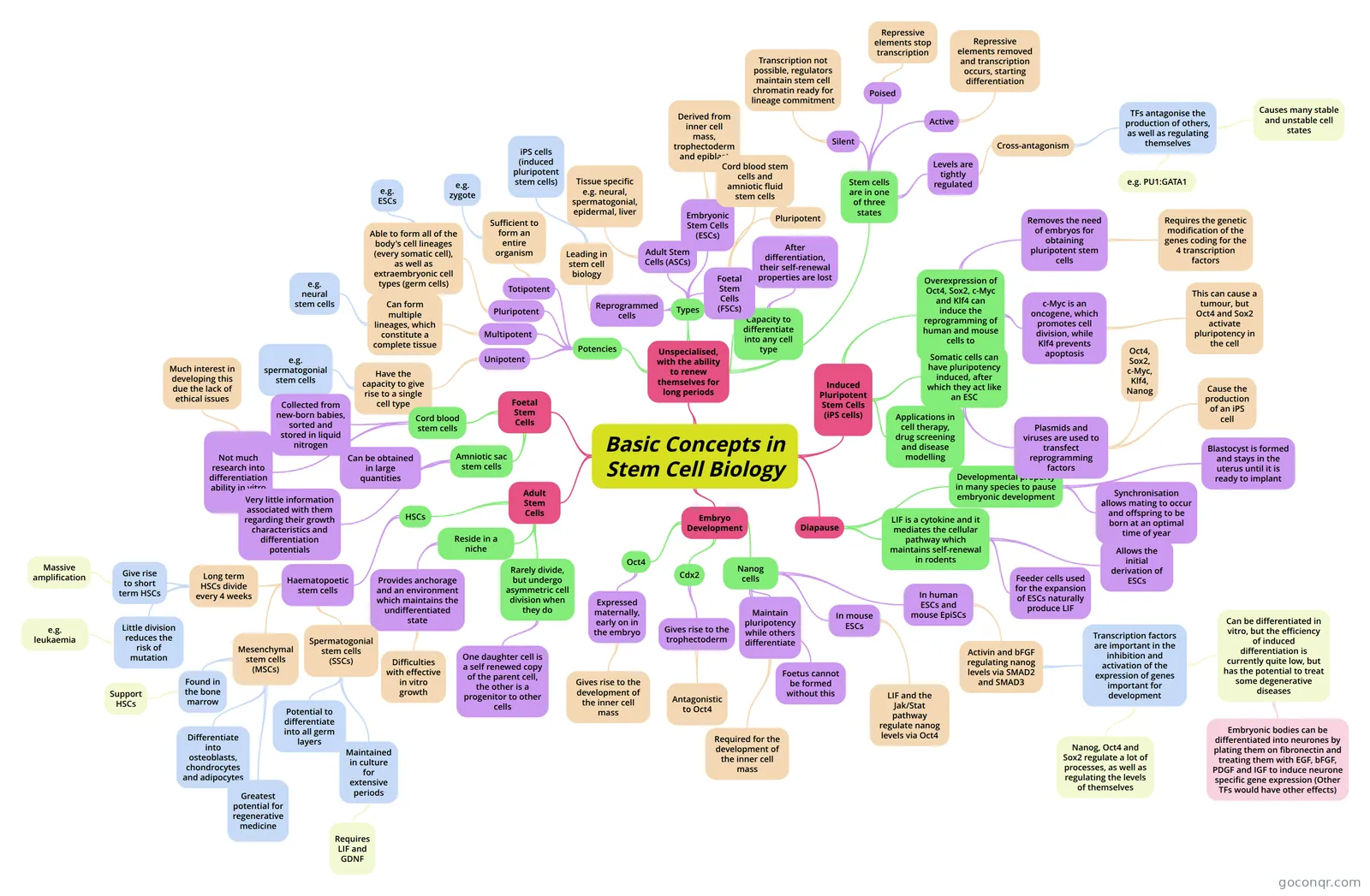
Mind map: Basic concepts in stem cell biology
Inhalt der Mindmap
Basic Concepts in Stem Cell Biology
Unspecialised, with the ability to renew themselves for long periods
- Capacity to differentiate into any cell type
- After differentiation, their self-renewal properties are lost
- Types
- Embryonic Stem Cells (ESCs)
- Derived from inner cell mass, trophectoderm and epiblast
- Foetal Stem Cells (FSCs)
- Cord blood stem cells and amniotic fluid stem cells
- Pluripotent
- Adult Stem Cells (ASCs)
- Tissue specific e.g. neural, spermatogonial, epidermal, liver
- Reprogrammed cells
- Leading in stem cell biology
- iPS cells (induced pluripotent stem cells)
- Leading in stem cell biology
- Embryonic Stem Cells (ESCs)
- Potencies
- Totipotent
- Sufficient to form an entire organism
- e.g. zygote
- Sufficient to form an entire organism
- Pluripotent
- Able to form all of the body's cell lineages (every somatic cell), as well as extraembryonic cell types (germ cells)
- e.g. ESCs
- Able to form all of the body's cell lineages (every somatic cell), as well as extraembryonic cell types (germ cells)
- Multipotent
- Can form multiple lineages, which constitute a complete tissue
- e.g. neural stem cells
- Can form multiple lineages, which constitute a complete tissue
- Unipotent
- Have the capacity to give rise to a single cell type
- e.g. spermatogonial stem cells
- Have the capacity to give rise to a single cell type
- Totipotent
- Stem cells are in one of three states
- Silent
- Transcription not possible, regulators maintain stem cell chromatin ready for lineage commitment
- Poised
- Repressive elements stop transcription
- Active
- Repressive elements removed and transcription occurs, starting differentiation
- Levels are tightly regulated
- Cross-antagonism
- TFs antagonise the production of others, as well as regulating themselves
- e.g. PU1:GATA1
- Causes many stable and unstable cell states
- TFs antagonise the production of others, as well as regulating themselves
- Cross-antagonism
- Silent
- Capacity to differentiate into any cell type
Diapause
- Developmental property in many species to pause embryonic development
- Synchronisation allows mating to occur and offspring to be born at an optimal time of year
- Blastocyst is formed and stays in the uterus until it is ready to implant
- LIF is a cytokine and it mediates the cellular pathway which maintains self-renewal in rodents
- Allows the initial derivation of ESCs
- Feeder cells used for the expansion of ESCs naturally produce LIF
- Developmental property in many species to pause embryonic development
Embryo Development
- Oct4
- Expressed maternally, early on in the embryo
- Gives rise to the development of the inner cell mass
- Expressed maternally, early on in the embryo
- Cdx2
- Gives rise to the trophectoderm
- Antagonistic to Oct4
- Gives rise to the trophectoderm
- Nanog cells
- Maintain pluripotency while others differentiate
- Required for the development of the inner cell mass
- Foetus cannot be formed without this
- In mouse ESCs
- LIF and the Jak/Stat pathway regulate nanog levels via Oct4
- In human ESCs and mouse EpiSCs
- Activin and bFGF regulating nanog levels via SMAD2 and SMAD3
- Transcription factors are important in the inhibition and activation of the expression of genes important for development
- Nanog, Oct4 and Sox2 regulate a lot of processes, as well as regulating the levels of themselves
- Can be differentiated in vitro, but the efficiency of induced differentiation is currently quite low, but has the potential to treat some degenerative diseases
- Embryonic bodies can be differentiated into neurones by plating them on fibronectin and treating them with EGF, bFGF, PDGF and IGF to induce neurone specific gene expression (Other TFs would have other effects)
- Transcription factors are important in the inhibition and activation of the expression of genes important for development
- Activin and bFGF regulating nanog levels via SMAD2 and SMAD3
- Maintain pluripotency while others differentiate
- Oct4
Foetal Stem Cells
- Cord blood stem cells
- Collected from new-born babies, sorted and stored in liquid nitrogen
- Not much research into differentiation ability in vitro
- Much interest in developing this due the lack of ethical issues
- Amniotic sac stem cells
- Very little information associated with them regarding their growth characteristics and differentiation potentials
- Can be obtained in large quantities
- Cord blood stem cells
Adult Stem Cells
- Rarely divide, but undergo asymmetric cell division when they do
- One daughter cell is a self renewed copy of the parent cell, the other is a progenitor to other cells
- Reside in a niche
- Provides anchorage and an environment which maintains the undifferentiated state
- Difficulties with effective in vitro growth
- Provides anchorage and an environment which maintains the undifferentiated state
- HSCs
- Haematopoetic stem cells
- Long term HSCs divide every 4 weeks
- Give rise to short term HSCs
- Massive amplification
- Little division reduces the risk of mutation
- e.g. leukaemia
- Give rise to short term HSCs
- Mesenchymal stem cells (MSCs)
- Found in the bone marrow
- Support HSCs
- Differentiate into osteoblasts, chondrocytes and adipocytes
- Greatest potential for regenerative medicine
- Found in the bone marrow
- Spermatogonial stem cells (SSCs)
- Potential to differentiate into all germ layers
- Maintained in culture for extensive periods
- Requires LIF and GDNF
- Long term HSCs divide every 4 weeks
- Haematopoetic stem cells
- Rarely divide, but undergo asymmetric cell division when they do
Induced Pluripotent Stem Cells (iPS cells)
- Overexpression of Oct4, Sox2, c-Myc and Klf4 can induce the reprogramming of human and mouse cells to pluripotency
- Removes the need of embryos for obtaining pluripotent stem cells
- Requires the genetic modification of the genes coding for the 4 transcription factors
- c-Myc is an oncogene, which promotes cell division, while Klf4 prevents apoptosis
- This can cause a tumour, but Oct4 and Sox2 activate pluripotency in the cell
- Removes the need of embryos for obtaining pluripotent stem cells
- Somatic cells can have pluripotency induced, after which they act like an ESC
- Plasmids and viruses are used to transfect reprogramming factors
- Oct4, Sox2, c-Myc, Klf4, Nanog
- Cause the production of an iPS cell
- Plasmids and viruses are used to transfect reprogramming factors
- Applications in cell therapy, drug screening and disease modelling
- Overexpression of Oct4, Sox2, c-Myc and Klf4 can induce the reprogramming of human and mouse cells to pluripotency
Informationen
- Beschreibung
- Undergraduate Biotechnology in Animal Physiology Mindmap am Basic Concepts in Stem Cell Biology, erstellt von Lydia Buckmaster am 18/01/2014.
- Erstellt von
- Lydia Buckmaster
- Aufrufe
- 35
- Tags
- Bewertung