
Cell Structure, Cell Theory and Microscopy
1,989 resources created by 1,589 users
This Cell Structure, Cell Theory and Microscopy page on GoConqr gathers community-made mind maps, quizzes, flashcards, notes and slide sets, from eukaryotic and prokaryotic cells to microscopes, diffusion and cell division. It's built for school students revising a topic, and for teachers after ready-made material, with a few university students filling gaps too. There are over 13,000 resources here, including more than 1,200 quizzes, over 6,000 mind maps and more than 4,800 flashcards, mostly at secondary level. Pick a mind map, then test yourself with a quiz.
Top Cell Structure, Cell Theory and Microscopy resources
-
116 cardsA Level Biology - Basic components of living systems Explain what a microscope is and describe its function.
-
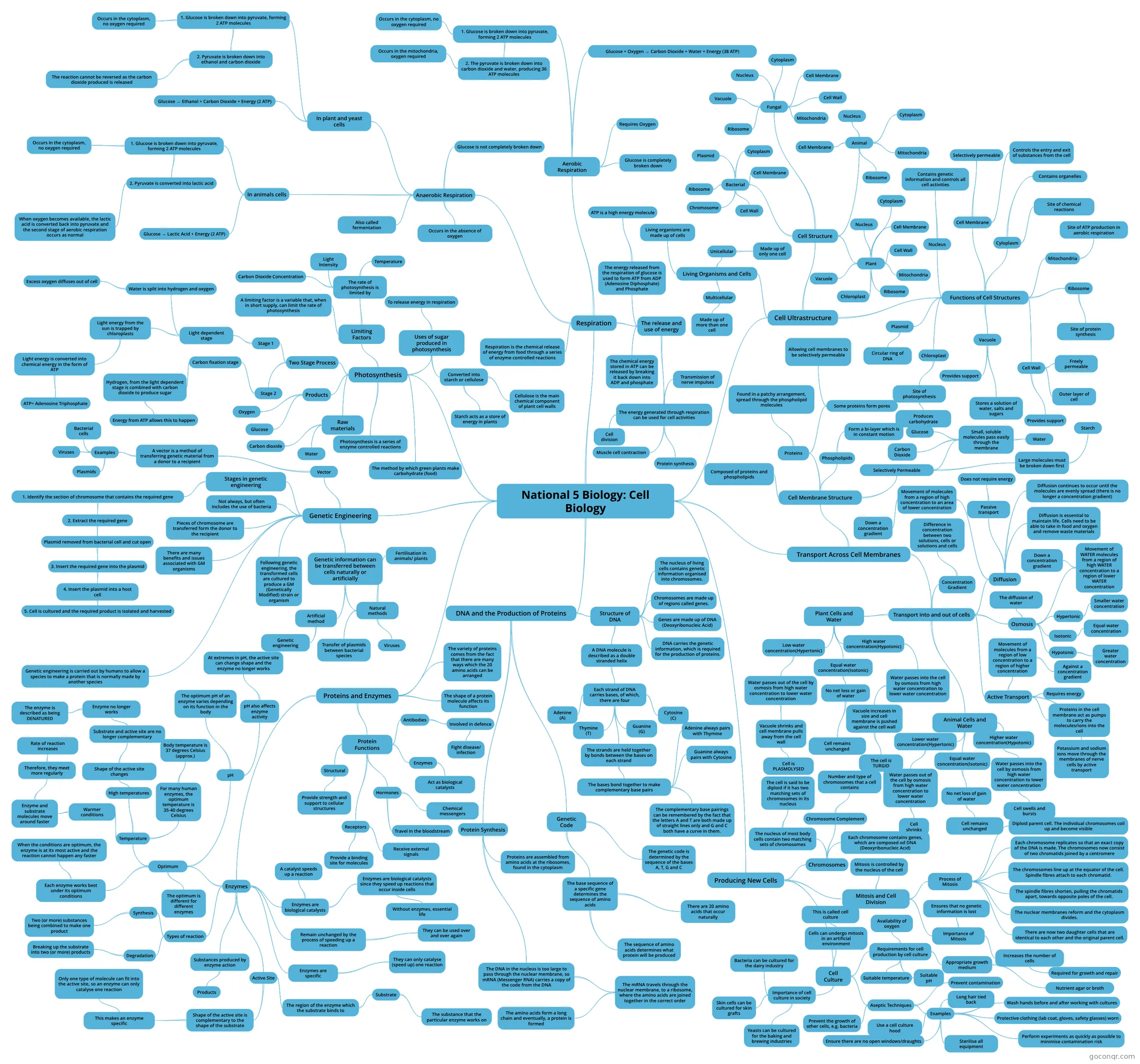 Mind map National 5 Biology: Cell Biology A mind map of National 5 Biology Unit 1: Cell Biology
-
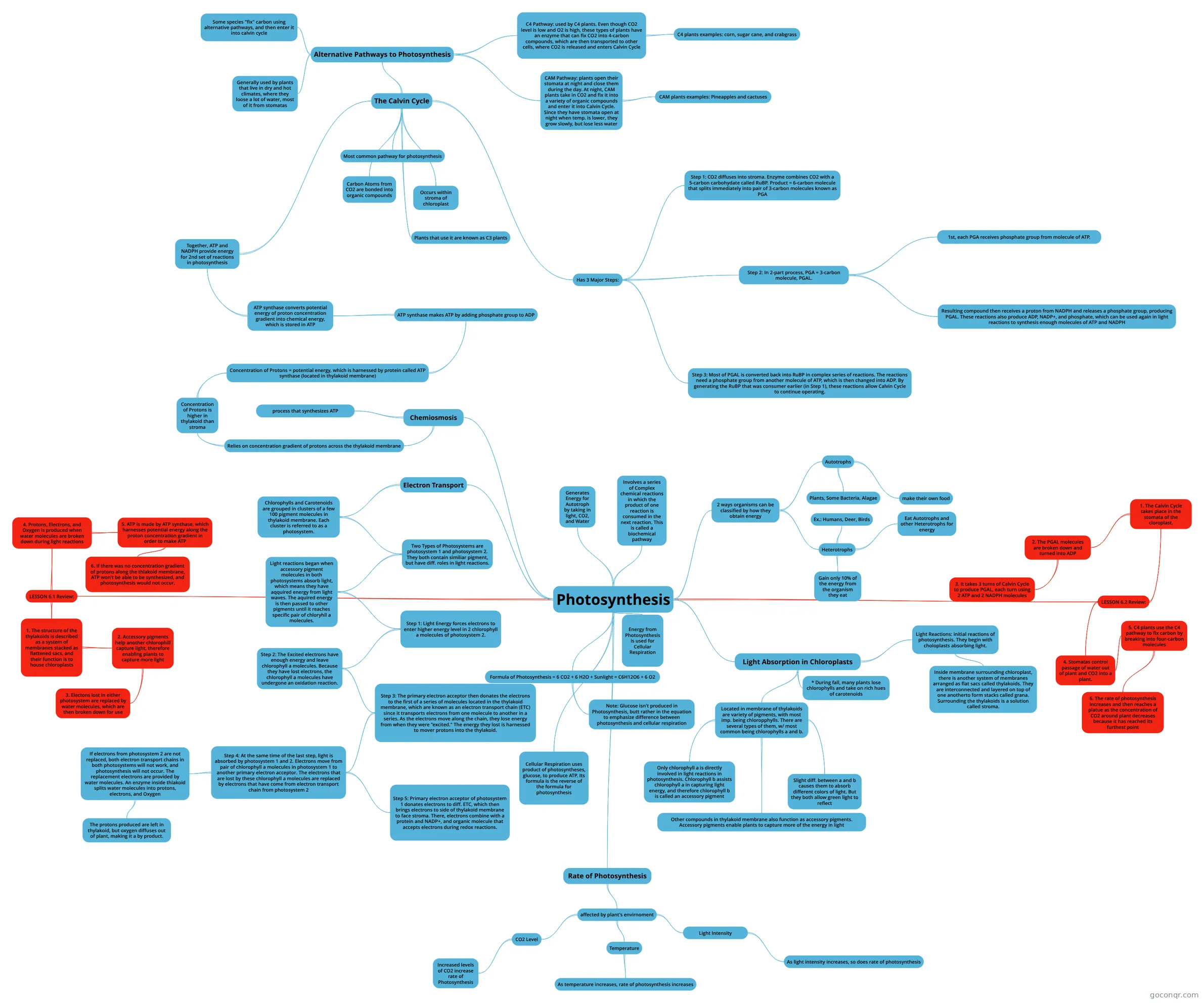 Mind map Photosynthesis This Mind Map contains information regarding the process of Photosynthesis
-
32 cards1.1 Cell Biology | IB Biology HL State the 3 principles of cell theory
-
Mind map 2.1.4 The ultrastructure of eukaryotic cells: membrane-bound organelles
-
Mind map Movement in and out of cells
-
Mind map 3.4 Eukaryotic Cell Structure
-
Mind map Level 2 NCEA Cell Structure Copyright limited Christine Lee 04.09.14 may be used for educational purposes only Based on ESA Study Guide...
Quizzes
See all 310 quizzes-
80 questionsExam 2 Chapters 6-9 Which structure is not part of the endomembrane system?
-
60 questionsUnit 3 MCQs One of the most pronounced differences between animal and plant cells is
-
55 questionsBiology 1010 LAB Test Biology 1010 lab practice test
-
50 questionsNMAT - Biology An erythrocyte is placed in a beaker with a hypertonic solution. What do you think will happen to the cell ...
-
70 questionsBiology 172 CQ3 The changing environment hypothesis states that-
-
33 questionsMitochondria: Structure, function and development This is our learning resource on Mitochondria, in the form of a quiz. There may be more than one correct an...
-
18 questionsPlasma Membrane Label the Plasma Membrane
-
49 questionsUnit 5 Cells Plant and animal cells are similar, but have different distinct differences. The following images were seen...
Mind maps
See all 641 mind maps-
National 5 Biology: Cell Biology A mind map of National 5 Biology Unit 1: Cell Biology
-
Photosynthesis This Mind Map contains information regarding the process of Photosynthesis
-
2.1.4 The ultrastructure of eukaryotic cells: membrane-bound organelles
-
Movement in and out of cells
-
3.4 Eukaryotic Cell Structure
-
Level 2 NCEA Cell Structure Copyright limited Christine Lee 04.09.14 may be used for educational purposes only Based on ESA Study Guide...
-
Prokaryotic and Eukaryotic cells
-
Microscopes
Flashcards
See all 837 flashcards-
116 cardsA Level Biology - Basic components of living systems Explain what a microscope is and describe its function.
-
32 cards1.1 Cell Biology | IB Biology HL State the 3 principles of cell theory
-
23 cardsBiology: B2.1, cells and simple cell transport; B2.2, tissues, organs and organ systems What are plants and animals made up of?
-
79 cardsBIOL1020 Flash Cards Where can you find DNA?
-
84 cardsOrganelles What is phagocytosis?
-
95 cardsS294 Open University Revision What are the energy sources and carbon sources of chemoautotrophs?
-
100 cardsOCR Biology AS level (f211) flashcards/revision notes what is the maximum resolution of the light microscope and the electron microscope?
-
123 cardsCels191 3 Domains of Life
Flowcharts
See all 12 flowcharts-
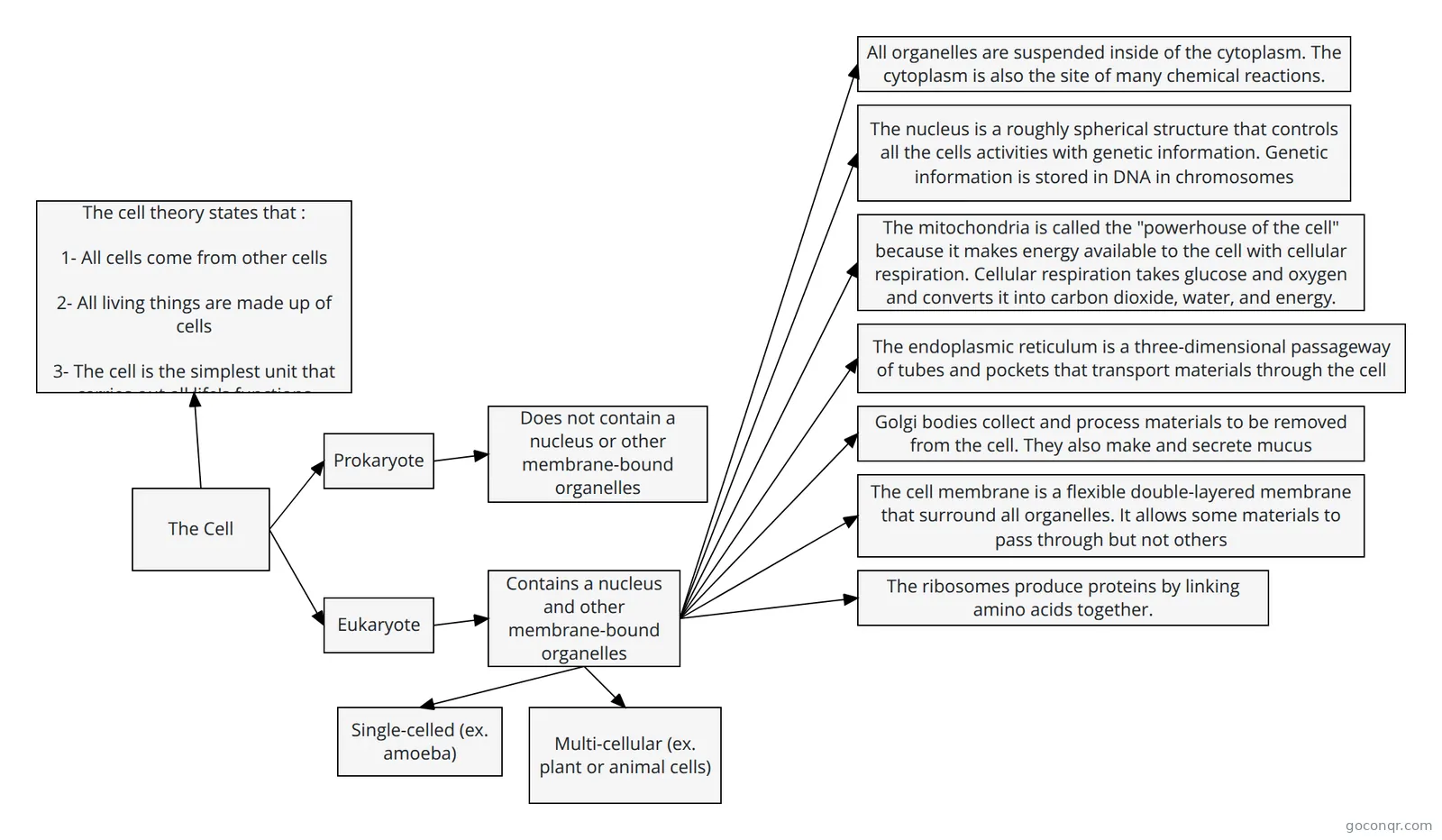 The Cell A flow chart that explains the first unit of biology for grade 10.
-
Protein transport Flow diagram of the transport and modification of a protein after it has been made in the Ribosome.
-
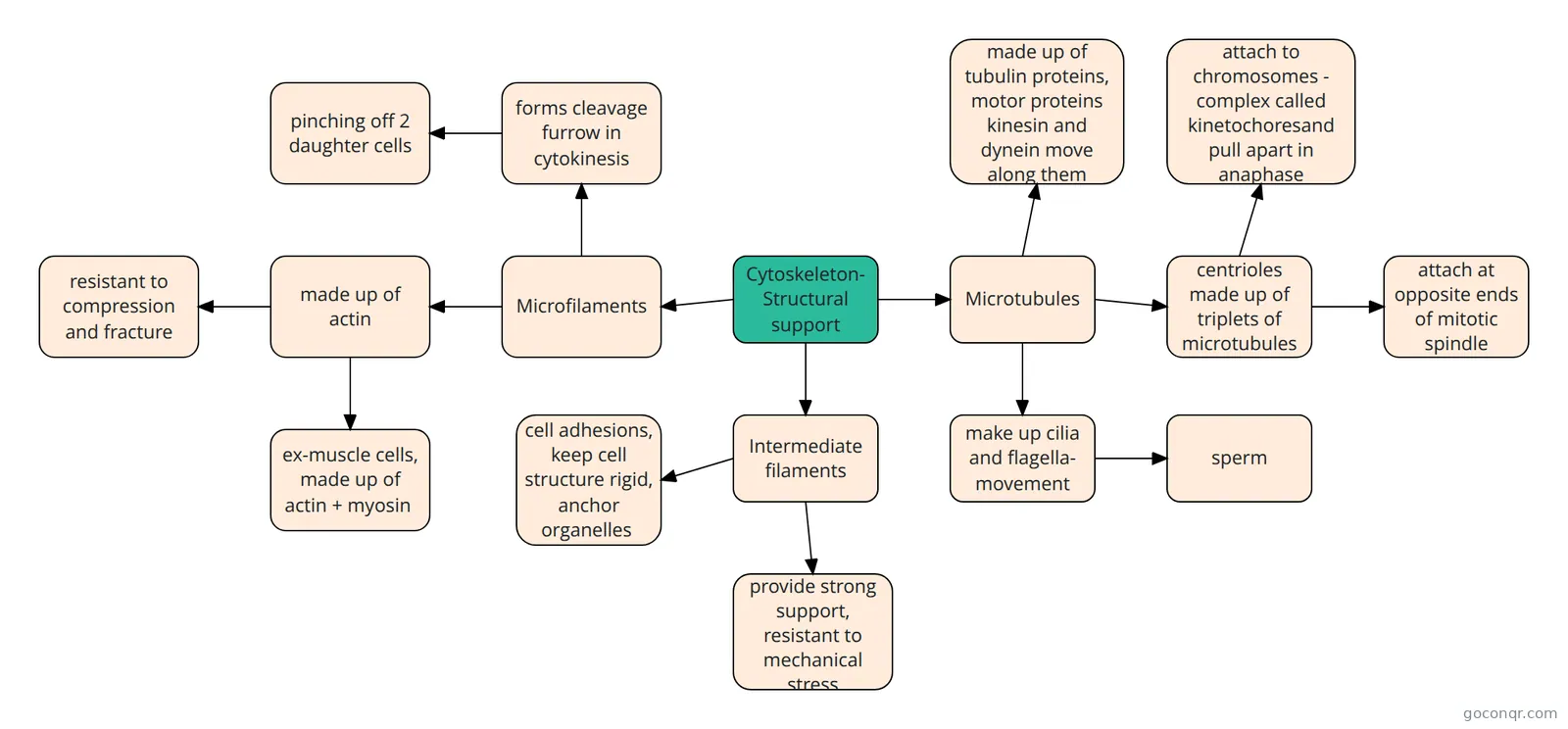 Cytoskeleton Cytoskeleton 3 elements-microtubules, microfilaments, intermediate filaments
-
DISAGGREGATION OF PLANTS
-
Respiration
-
DISAGGREGATION OF EX-PLANT
-
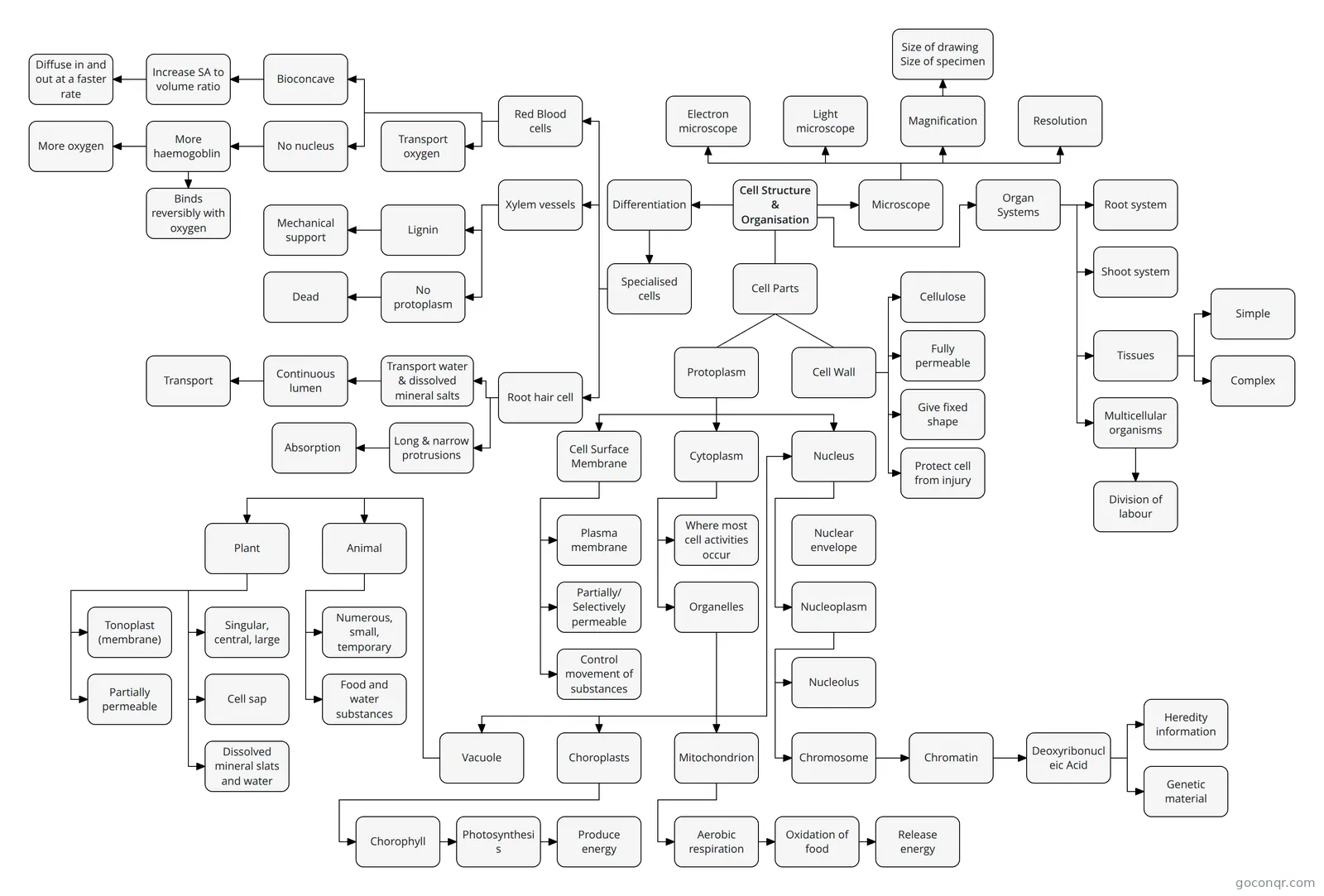 Cell Structure & Organisation (Revision Flowchart)
-
History of Cells cellular biology - a history
Notes
See all 143 notes-
Cell Structure Microscopes:The compound microscope uses two lenses, an objective lens, and an eyepiece lens.The simple microscope uses a single lens.Both of these microsocopes use light to show the image. Cells are measured in units...
-
Plasma Membrane and Cell Transport Plasma Membrane Cell membranes are composed of two phospholipid layers. The cell membrane , or the plasma membrane, forms a boundary between a cell and the outside environment and controls the passage of materials int...
-
Cells and simple cell transport All living things are made up of cells. Different types of cells have different structures and different functions. Animal cells and plant cells have features in common, such as: a nucleus cytoplasm&...
-
Things to Remember VCE Biology Enzymes Important Details Enzyme are not used up in the process of a chemical reaction Enzymes catalyse reactions by destabilising bonds in the substrate so that it is more reactive General SAC Tips
-
Cell Structure in Relation to Function Variation exists between cells of one type of tissue and between cells of different types of tissue. When cells are examined closely structures called organelles become visible. Red Blood Cells are disk shaped with po...
-
Biology B2 Notes- Diffusion Diffusion is the random movement of particles in a fluid from an area of high concentration to an area of low concentration until there is no net movement or equilibrium has been achieved. The larger the difference in...
-
Animal and Plant cells These things are both inside an animal and a plant cell Cell membrane: controls what enters and leaves the cell e.g. oxygen, carbon dioxide, glucose. (Like the brain of the cell) Nucleus: a large structu...
-
Basic Cell Parts & Functions The cell is the smallest unit of life. It is the building block from which all living things are made. Cells are so small that you need to use a microscope to see them. Every human, animal&...
Slides
See all 46 slidesMore Biology and natural sciences topics
About Cell Structure, Cell Theory and Microscopy
GoConqr OriginalWhat the resources cover
The unit follows the cell from the big picture to the detail. The mind map Cell Structure & Division links eukaryotic cells, prokaryotic cells and mitosis, with the nucleus, its pores and the mitochondrion broken down branch by branch. Eukaryotic cell structure goes further into the nuclear envelope, nucleolus, chromosomes and the double membrane and cristae of the mitochondrion.
Cell theory and microscopy have their own material. The flashcard deck A Level Biology - Basic components of living systems asks what cell theory states and why light microscopy has advantages. The notes called Cell Structure explain that a compound microscope uses an objective lens and an eyepiece lens, while a simple microscope uses one lens. There are also the mind maps Microscopes and Cell Theory.
Where to start
- Begin with Prokaryotic and Eukaryotic cells to see how the two cell types differ.
- Move to 3.4 Eukaryotic Cell Structure to compare animal and plant cells.
- Read the notes on microscopes, then work through the Microscopy flashcards.
- Finish with Movement in and out of cells, which covers diffusion as passive transport.
Using maps and quizzes together
Read a map first, then close it and try a quiz such as Cell Structure and Function Practice Test, Organelles or Mitochondria Quiz. Note the questions you miss and go back to the matching branch of the map. Flashcards suit short, repeated sessions on key terms.
The resources mention exams including GCSE Biology, A-level Biology, IB Biology, National 5 Biology and AP Biology, so look for a title that matches your course. Teachers can set a quiz or share a map as a starting point for a lesson.
Where it sits
This unit belongs to the Molecules and Cells strand of Biology and natural sciences. It is the foundation for related topics on the page, such as cell membranes, stem cells and photosynthesis.
Choose a resource that matches your course and see how much you can recall without looking.
Frequently asked questions
Which resource should I open first?
Start with the mind map Prokaryotic and Eukaryotic cells, which sets out how the two cell types differ. Then move to Eukaryotic cell structure for the organelles in detail. Once you have read both, a short quiz such as Organelles will show what has stuck and what needs another look.
Where can I revise microscopes and cell theory?
Try the flashcard deck A Level Biology - Basic components of living systems, which asks what cell theory states and lists advantages of light microscopy. The notes called Cell Structure describe compound and simple microscopes. There are also separate Microscopy flashcards, a Microscopes mind map and a Cell Theory mind map.
Which exams do these resources suit?
The listed resources mention GCSE Biology, IGCSE Biology, A-level Biology, IB Biology, AP Biology, National 5 Biology and OCR AS Biology, among others. Most are at secondary level. Check the title of each resource to see which course it was made for, then use it alongside your own syllabus.
Are the resources free, and who made them?
Every resource here is free to open, study and take, with no account needed. They were made by GoConqr users, not by GoConqr itself. If you sign up for a free account, your quiz scores are saved and you can make your own quizzes, mind maps, flashcards and notes.
How can teachers use this page?
Teachers can use the ready-made mind maps to introduce a topic, such as Cell Structure & Division, and set quizzes like Cell Structure and Function Practice Test for practice. The flashcard decks work well for short revision tasks. Check each resource against your own course before sharing it with a class.
What if the topic I need is missing?
Look at the related resources on the page, which also cover diffusion, cell membranes, stem cells, specialised cells and photosynthesis. If you still cannot find what you need, make your own mind map, flashcards or quiz from the notes you have.