
Mindmap
Labelling Theory (INTERACTIONISM)
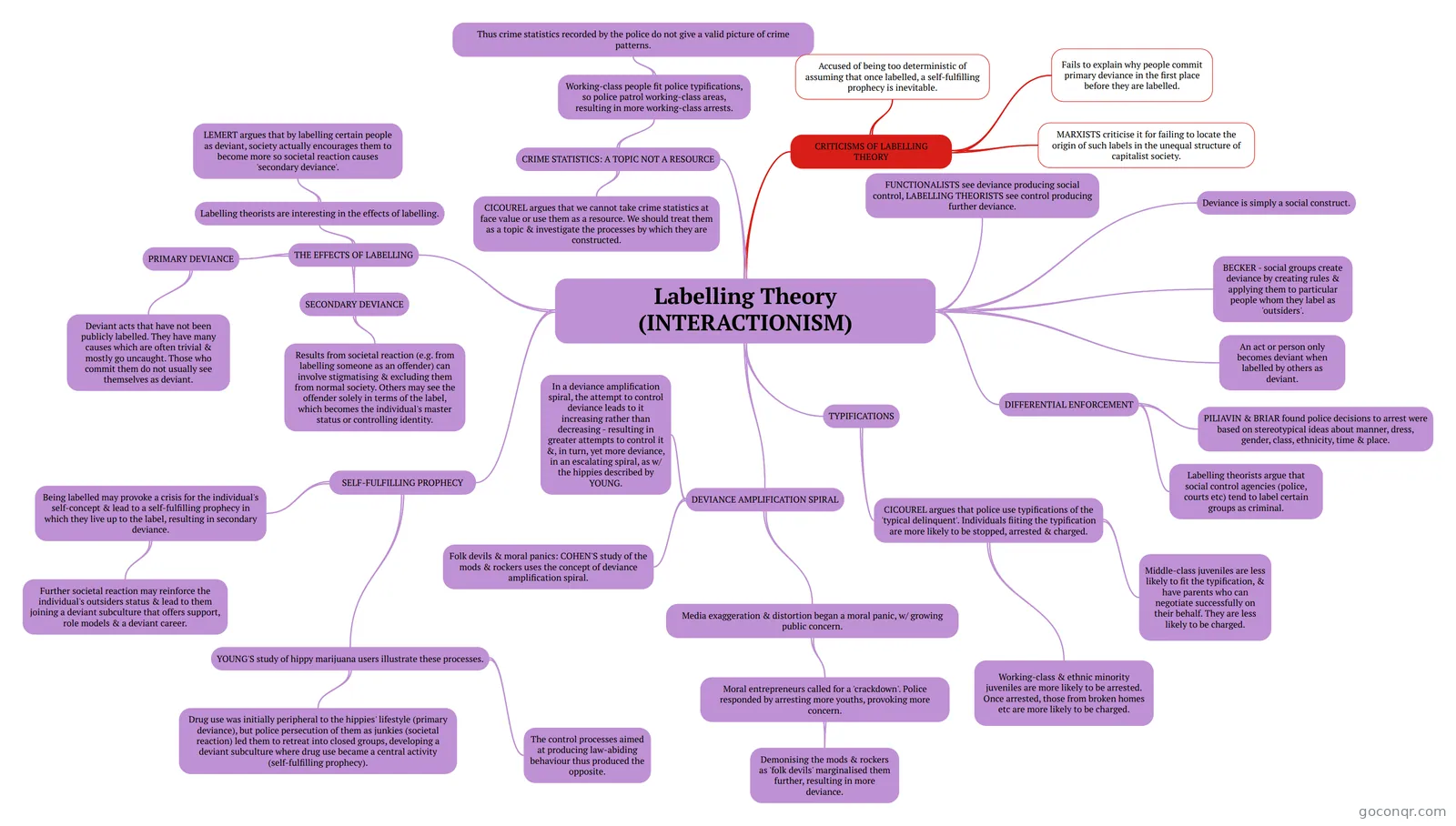
Mind map: labelling theory interactionism sociology
Inhalt der Mindmap
Labelling Theory (INTERACTIONISM)
Deviance is simply a social construct.
BECKER - social groups create deviance by creating rules & applying them to particular people whom they label as 'outsiders'.
An act or person only becomes deviant when labelled by others as deviant.
DIFFERENTIAL ENFORCEMENT
- Labelling theorists argue that social control agencies (police, courts etc) tend to label certain groups as criminal.
- PILIAVIN & BRIAR found police decisions to arrest were based on stereotypical ideas about manner, dress, gender, class, ethnicity, time & place.
TYPIFICATIONS
- CICOUREL argues that police use typifications of the 'typical delinquent'. Individuals fiiting the typification are more likely to be stopped, arrested & charged.
- Working-class & ethnic minority juveniles are more likely to be arrested. Once arrested, those from broken homes etc are more likely to be charged.
- Middle-class juveniles are less likely to fit the typification, & have parents who can negotiate successfully on their behalf. They are less likely to be charged.
- CICOUREL argues that police use typifications of the 'typical delinquent'. Individuals fiiting the typification are more likely to be stopped, arrested & charged.
CRIME STATISTICS: A TOPIC NOT A RESOURCE
- Working-class people fit police typifications, so police patrol working-class areas, resulting in more working-class arrests.
- Thus crime statistics recorded by the police do not give a valid picture of crime patterns.
- CICOUREL argues that we cannot take crime statistics at face value or use them as a resource. We should treat them as a topic & investigate the processes by which they are constructed.
- Working-class people fit police typifications, so police patrol working-class areas, resulting in more working-class arrests.
THE EFFECTS OF LABELLING
- Labelling theorists are interesting in the effects of labelling.
- LEMERT argues that by labelling certain people as deviant, society actually encourages them to become more so societal reaction causes 'secondary deviance'.
- PRIMARY DEVIANCE
- Deviant acts that have not been publicly labelled. They have many causes which are often trivial & mostly go uncaught. Those who commit them do not usually see themselves as deviant.
- SECONDARY DEVIANCE
- Results from societal reaction (e.g. from labelling someone as an offender) can involve stigmatising & excluding them from normal society. Others may see the offender solely in terms of the label, which becomes the individual's master status or controlling identity.
- Labelling theorists are interesting in the effects of labelling.
SELF-FULFILLING PROPHECY
- Being labelled may provoke a crisis for the individual's self-concept & lead to a self-fulfilling prophecy in which they live up to the label, resulting in secondary deviance.
- Further societal reaction may reinforce the individual's outsiders status & lead to them joining a deviant subculture that offers support, role models & a deviant career.
- YOUNG'S study of hippy marijuana users illustrate these processes.
- Drug use was initially peripheral to the hippies' lifestyle (primary deviance), but police persecution of them as junkies (societal reaction) led them to retreat into closed groups, developing a deviant subculture where drug use became a central activity (self-fulfilling prophecy).
- The control processes aimed at producing law-abiding behaviour thus produced the opposite.
- Being labelled may provoke a crisis for the individual's self-concept & lead to a self-fulfilling prophecy in which they live up to the label, resulting in secondary deviance.
DEVIANCE AMPLIFICATION SPIRAL
- In a deviance amplification spiral, the attempt to control deviance leads to it increasing rather than decreasing - resulting in greater attempts to control it &, in turn, yet more deviance, in an escalating spiral, as w/ the hippies described by YOUNG.
- Folk devils & moral panics: COHEN'S study of the mods & rockers uses the concept of deviance amplification spiral.
- Media exaggeration & distortion began a moral panic, w/ growing public concern.
- Moral entrepreneurs called for a 'crackdown'. Police responded by arresting more youths, provoking more concern.
- Demonising the mods & rockers as 'folk devils' marginalised them further, resulting in more deviance.
- Moral entrepreneurs called for a 'crackdown'. Police responded by arresting more youths, provoking more concern.
FUNCTIONALISTS see deviance producing social control, LABELLING THEORISTS see control producing further deviance.
CRITICISMS OF LABELLING THEORY
- Accused of being too deterministic of assuming that once labelled, a self-fulfilling prophecy is inevitable.
- Fails to explain why people commit primary deviance in the first place before they are labelled.
- MARXISTS criticise it for failing to locate the origin of such labels in the unequal structure of capitalist society.
Informationen
- Beschreibung
- A-Level Sociology (Crime & Deviance) Mindmap am Labelling Theory (INTERACTIONISM), erstellt von A M am 05/04/2016.
- Erstellt von
- A M
- Aufrufe
- 189
- Tags
- Bewertung