
Mindmap
3.3.3: Computer architectures
Inhalt der Mindmap
3.3.3: Computer architectures
Von Neumann
- Takes each instruction serially
- Performs each instruction before carrying out the next.
- Instructions and data stored together in memory
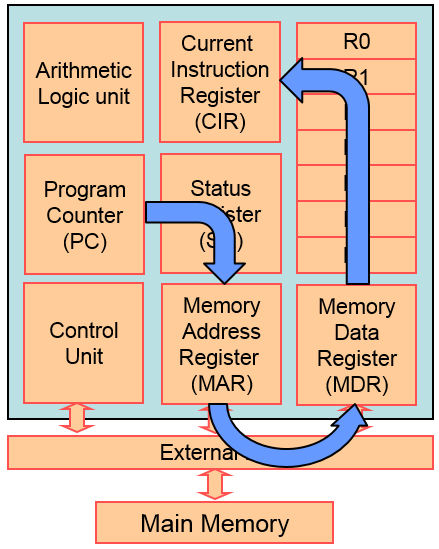
FETCH
- 1: PC holds address of next instruction to be executed
- 2: Address is copied to the MAR
- 3: Data in address at MAR is copied to MDR
- 4: Contents of MDR copied to CIR
- 5: Contents of PC are incremented
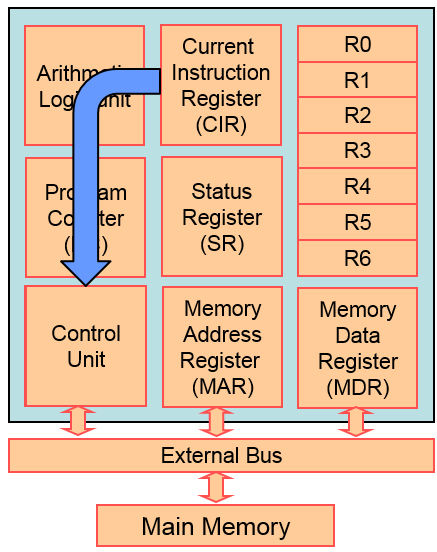
DECODE
- 6: Contents of CIR divided into code for operation to be carried out and the address that the data will be used by
- 7: Control Unit interprets the code so that the processor knows what to do next.
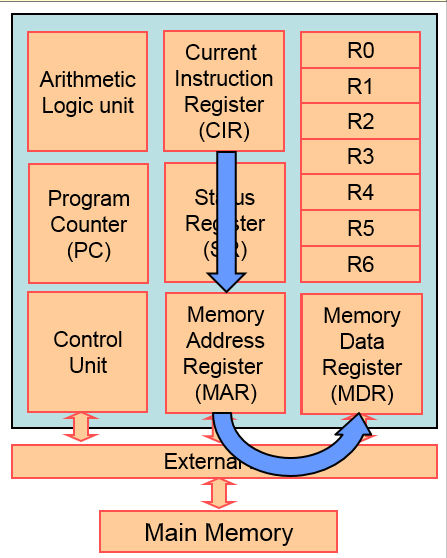
EXECUTE
- 8: Address is copied from the CIR to the MAR
- 9: Data found in the MAR is copied to the MDR
- 10: Data is used
Types of processor
- Co-processor
- Additonal processor for a specific task (such as a GPU)
- Most co-processors do not fetch instructions for themselves
- Parallel Processor
- With Fetch - Decode - Execute cycle
- A processor for each step of the Fetch - Decode - Execute cycle
- Speeds up process as next instruction can be fetched before current instruction has finished processing.
- With Pipelining
- One main processor that splits jobs up into tasks and farms each tasks to other processors
- Main Processor Fetches and Decodes task and splits execution into individual tasks and sends to other processors to execute.
- With Fetch - Decode - Execute cycle
- Array processor
- Multiple processors compute mathematics on arrays of numbers simultaneously.
- Numbers are all fetched and then executed simultaneously.
- Advantages and Disadvantages of Alternative Processors
- Advantages
- Faster Processing
- More than one instruction can be executed at the same time
- Different processors can handle different parts of the same job.
- Disadvantages
- Requires processors to be synced together
- Program has to be written to use multiple processors
- Programs are more complex to write, test and debug.
- Advantages
- Co-processor
CISC vs RISC
- CISC
- Every computer operation has an instruction
- Each operation has a binary code (Op-Code) associated with it
- Complex Instruction Set
- More bits needed to represent each instruction
- RISC
- Reduced Instruction Set
- Typically used in handheld devices
- Recognises fewer instructions
- Less bits needed to represent instructions
- Missing instructions made up with programming techniques
- Less complex circuitry
- Op-code and address allocated same number of bits
- Registers are all the same size
- Reduced Instruction Set
- CISC
Bilder und Dateien der Mindmap
Informationen
- Beschreibung
- Mind map for A2 Computing Master Mind Map *FINISHED*
- Erstellt von
- Adam Cook
- Aufrufe
- 61
- Bewertung