
Mindmap
Amputees
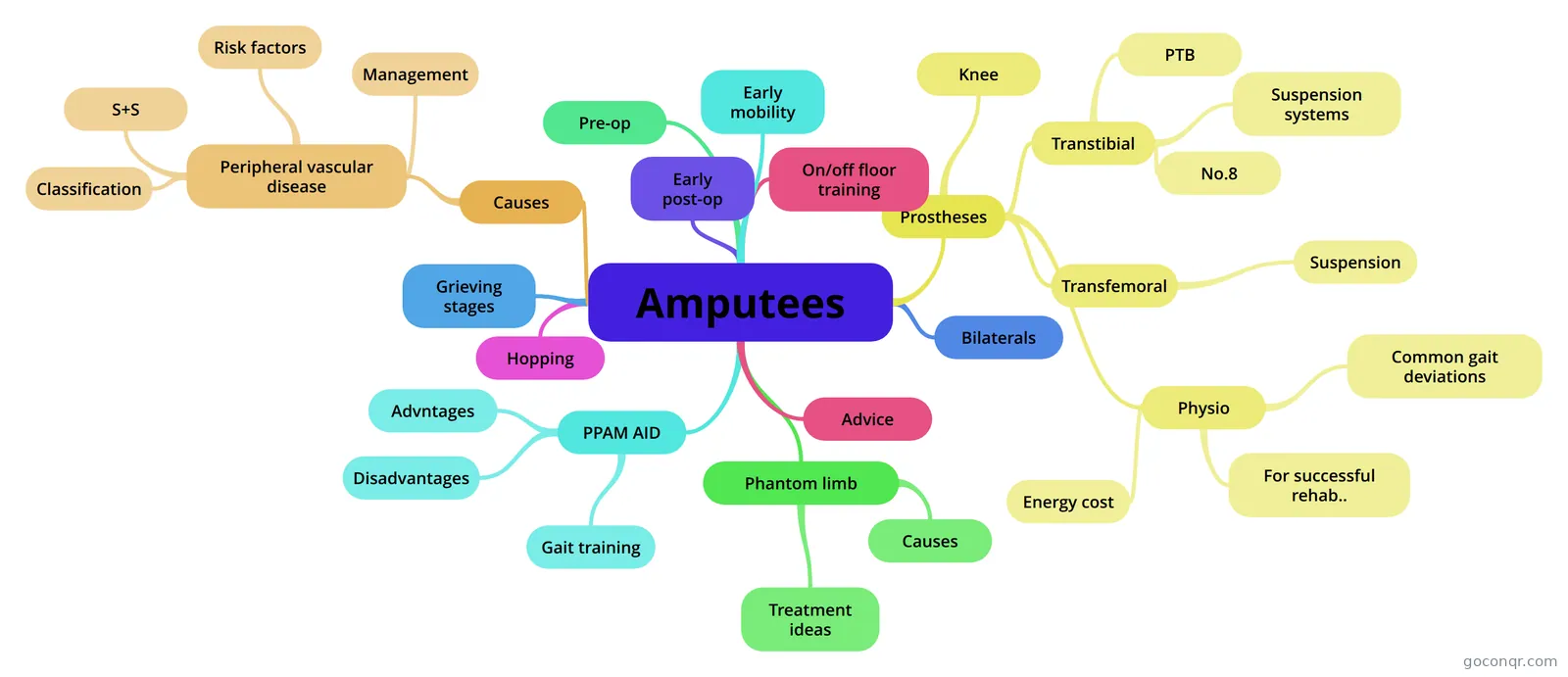
Mind map: Amputees
Inhalt der Mindmap
Amputees
Early mobility
Causes
- Peripheral vascular disease Infection Trauma Congenital Diabetes Mellitus
- Peripheral vascular disease
- Narrowing of the arteries caused by atherosclerosis.
- S+S
- Intermittent claudication (cramp) Rest pain Reduced mobility Poor peripheral pulses Sensory changes Necrosis
- Classification
- Fontaine: Stage 1 - assymptomatic Stage 2 - intermittent claudication Stage 3 - rest pain/nocturnal pain Stage 4 - Necrosis/gangrene
- Management
- Health promotion: - stop smoking - healthy diet - manage risk factors Medication: - aspirin - statins - blood glucose levels - peripheral VDs to maintain blood flow Surgery: - angioplasty - bypass surgery - amputation
- Risk factors
- Lifestyle: - overweight - diet - smoking - excess alcohol - lack of physical activity Treatable of partially treatable: - High BP - High cholesterol - Diabetes Fixed factors: - Gender - Age - Ethnic group
Pre-op
- Assessment Problem list Possible pre-op treatments: - resp techniques - strengthen muscles - preserve jt mobility - teach bed exercises, transfers, wheelchair mobility - walking if possible - discuss phantom limb sensation - treat any co-existing problems
Early post-op
- Assessment 1st day post op. Problem list and devise STGs and LTGs. Chest assessment Active movements Prevention of contractures Transfers WCs Dressing practice Compression dressings for the stump MAKE SURE THEY HAVE ENOUGH PAIN RELIEF (20MINS TO TAKE EFFECT).
Grieving stages
- 1. Shock, numbness, disbelief 2. Yearning and searching for lost leg, sense of pain 3. Discarding old patterns of living 4. Accepting the loss, letting go, adjusting to new life. Atypical grieving - Prolonged reaction - Delayed reaction - Increased and persistent feelings of guilt and self-blame.
Prostheses
- Knee
- SAKL - semi-automatic knee lock HOKL - hand operated knee lock or Fixed knee.
- Transtibial
- PTB
- Patella tendon bearing: - generally endoskeletal - easy to don, doff - hard to achieve a good consistent fit
- No.8
- Very rare Temporary prosthesis Ischial or patella WB For stumps that are unhealed, hypersensitive or if they have a knee flexion contracture.
- Suspension systems
- Tight socket ICEROSS (ICELANDIC ROLL ON SUCTION SOCKET) - need good hygiene Suprapatellar leather cuffs and buckle Secondary suspension: - Elastic stockings/suspenders - Leather thigh corset
- PTB
- Transfemoral
- Wt bear through ischial tuberosity. Minimum 12cm gap between bottom of socket and contralateral kn jt line Quadrilateral sockets
- Suspension
- Soft suspension - ICEROSS Self suspension - Total surface bearing sockets All transfemoral systems may require secondary suspension e.g. shoulder straps or belts.
- Physio
- Check how prosthesis works, check the fit, patients posture and gait analysis Decide if the cause of the problem is the prosthesis, the amputee or a combination
- Common gait deviations
- Abducted gait - prosthesis in abd, wide BOS Circumduction - prosthesis swung in arc Lateral trunk bending - thrunk side flex in stance - to or, away from the prosthetic side. Uneven step length Vaulting - contralateral tip-toeing to clear the ground.
- For successful rehab..
- the patient must: - be able to transfer independently - carry out ADLs - Have a well formed, healing stump - have no/minimal flexion contractures - be motivated and commited for long rehab - have sufficient eyesight.
- Energy cost
- Unilateral TTA - 9% more energy Unilateral TTF - 49% more energy Bilateral TFA - 280% more energy
- Knee
Bilaterals
- Very poor balance Need pressure care seating and set back wheels. Bed mobility taught Transfers taught via going forward onto things and coming backwards off of them. Lying to sitting using monkey bar or rocking. Specific exercises: rolling, bridging, hip hitching, trunk/core stability, mat work, balance training Gait re-education starts with short rocker pylons or bilateral femuretts. Then progress to longer prosthesis. The definitive limb is usually lower than the original height. Donning is difficult, have to sit on the edge of the bed and hip hitch into. Fixed knee gait - abd wide base of support.
Advice
- Care of residual limb - examine for marking, blistering, skin breaks No creams or ointments unless medically approved. Wash and dry well. Care of unaffected limb - esp toes. Elevate leg and protect heel at rest. Avoid tight fitting shoes. Care of prosthesis - no self alterations. If its damaged then must have a prosthetic review. Clean with damp cloth. Keep valves dust free. Care stump socks - wash regularly, carry extras in summer General advice - keep fit and healthy. Can fly and can drive with adaptations.
Phantom limb
- Phantom limb sensation = Non painful sensation/awareness of the presence of the amputated limb e.g. itching/ tingling Phantom limb pain = a painful feeling felt in the extremity that has been amputated. Includes burning, stabbing, cramps.
- Causes
- Physical - scar contracture - unhealed wounds - neuroma formation - previous and existing varicose veins - referred pain Psychological - anxiety - poor adjustment/delayed grieving process - compensation cases
- Treatment ideas
- Desensitisation - percussion/handling TENS - pain gait theory Ultrasound - adhesion/pain modulation Massage Active muscle exs Mirror boxes Early mobilisation - PPAM AID/femurett Early prosthetic use - acceptance hard socket Hydrotherapy - heat and circulation, mobility. Nerve blocks.
Hopping
- Pros: - improves mobility/ function and independence - could allow earlier discharge home Cons: - worsens PVD - safety issues
PPAM AID
- used on TTA/TFA. 4 days post op for trauma 6-10 days post op for vasuclar causes or any signs of PVD. Never use on bilaterals
- Advntages
- Early mob post amputation, increased CV fitness Huge boost to psychological recovery Reduces oedema by partial WBCan aid wound healing via increased circulation.
- Disadvantages
- Never use on ischaemic/necrotic stumps Usage should not cause pain Should not cause wound deterioration Only ever use PWB - use parallel bars, zimmer frame, elbow crutches - no sticks
- Gait training
- Takes place initially in the parallel bars. Start with equal WB and weight transference exercises in standing. Ensure good hip ext/pelvic control in stance. Progress to weight transference, in step stance Practice stepping and placement of PPAM AID. Combine weight transference with stepping and then onto gait. Emphasise equal step length. Progress to using zimmer frame.
On/off floor training
Informationen
- Beschreibung
- Cardiac Physiology Mindmap am Amputees, erstellt von jasminejohnson09 am 23/04/2013.
- Erstellt von
- jasminejohnson09
- Aufrufe
- 51
- Tags
- Bewertung