
Mindmap
Intonation
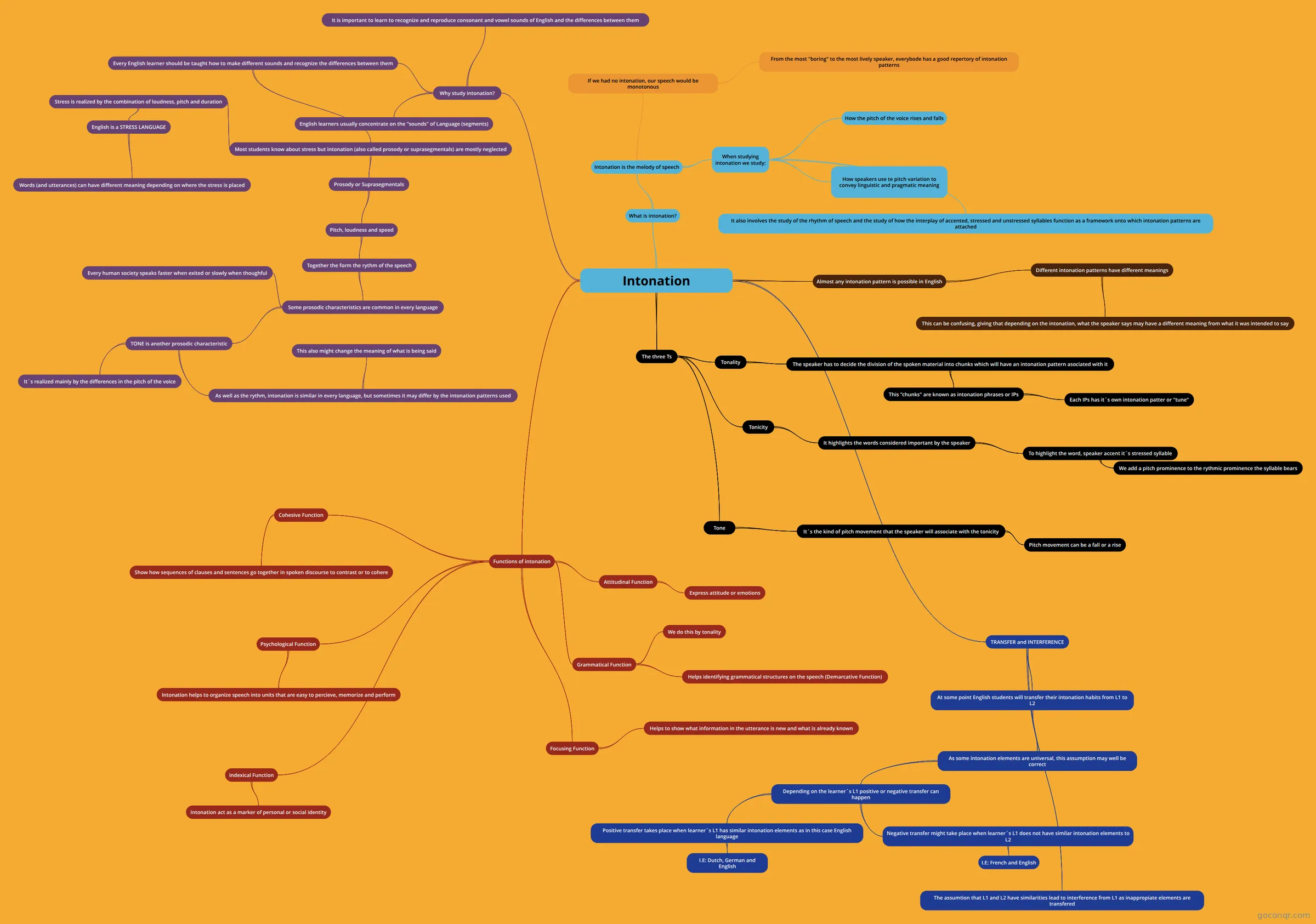
Mind map: Intonation: Functions and Language Learning
Inhalt der Mindmap
Intonation
What is intonation?
- Intonation is the melody of speech
- When studying intonation we study:
- How the pitch of the voice rises and falls
- How speakers use te pitch variation to convey linguistic and pragmatic meaning
- It also involves the study of the rhythm of speech and the study of how the interplay of accented, stressed and unstressed syllables function as a framework onto which intonation patterns are attached
- If we had no intonation, our speech would be monotonous
- From the most "boring" to the most lively speaker, everybode has a good repertory of intonation patterns
- When studying intonation we study:
- Intonation is the melody of speech
Why study intonation?
- It is important to learn to recognize and reproduce consonant and vowel sounds of English and the differences between them
- English learners usually concentrate on the "sounds" of Language (segments)
- Every English learner should be taught how to make different sounds and recognize the differences between them
- Most students know about stress but intonation (also called prosody or suprasegmentals) are mostly neglected
- Prosody or Suprasegmentals
- Pitch, loudness and speed
- Together the form the rythm of the speech
- Some prosodic characteristics are common in every language
- Every human society speaks faster when exited or slowly when thoughful
- TONE is another prosodic characteristic
- It´s realized mainly by the differences in the pitch of the voice
- As well as the rythm, intonation is similar in every language, but sometimes it may differ by the intonation patterns used
- This also might change the meaning of what is being said
- Some prosodic characteristics are common in every language
- Together the form the rythm of the speech
- Pitch, loudness and speed
- Stress is realized by the combination of loudness, pitch and duration
- English is a STRESS LANGUAGE
- Words (and utterances) can have different meaning depending on where the stress is placed
- English is a STRESS LANGUAGE
- Prosody or Suprasegmentals
- Most students know about stress but intonation (also called prosody or suprasegmentals) are mostly neglected
Almost any intonation pattern is possible in English
- Different intonation patterns have different meanings
- This can be confusing, giving that depending on the intonation, what the speaker says may have a different meaning from what it was intended to say
- Different intonation patterns have different meanings
The three Ts
- Tonality
- The speaker has to decide the division of the spoken material into chunks which will have an intonation pattern asociated with it
- This "chunks" are known as intonation phrases or IPs
- Each IPs has it´s own intonation patter or "tune"
- This "chunks" are known as intonation phrases or IPs
- The speaker has to decide the division of the spoken material into chunks which will have an intonation pattern asociated with it
- Tonicity
- It highlights the words considered important by the speaker
- To highlight the word, speaker accent it´s stressed syllable
- We add a pitch prominence to the rythmic prominence the syllable bears
- To highlight the word, speaker accent it´s stressed syllable
- It highlights the words considered important by the speaker
- Tone
- It´s the kind of pitch movement that the speaker will associate with the tonicity
- Pitch movement can be a fall or a rise
- It´s the kind of pitch movement that the speaker will associate with the tonicity
- Tonality
Functions of intonation
- Attitudinal Function
- Express attitude or emotions
- Grammatical Function
- Helps identifying grammatical structures on the speech (Demarcative Function)
- We do this by tonality
- Focusing Function
- Helps to show what information in the utterance is new and what is already known
- Cohesive Function
- Show how sequences of clauses and sentences go together in spoken discourse to contrast or to cohere
- Psychological Function
- Intonation helps to organize speech into units that are easy to percieve, memorize and perform
- Indexical Function
- Intonation act as a marker of personal or social identity
- Attitudinal Function
TRANSFER and INTERFERENCE
- At some point English students will transfer their intonation habits from L1 to L2
- As some intonation elements are universal, this assumption may well be correct
- Depending on the learner´s L1 positive or negative transfer can happen
- Positive transfer takes place when learner´s L1 has similar intonation elements as in this case English language
- I.E: Dutch, German and English
- Negative transfer might take place when learner´s L1 does not have similar intonation elements to L2
- I.E: French and English
- Positive transfer takes place when learner´s L1 has similar intonation elements as in this case English language
- Depending on the learner´s L1 positive or negative transfer can happen
- As some intonation elements are universal, this assumption may well be correct
- The assumtion that L1 and L2 have similarities lead to interference from L1 as inappropiate elements are transfered
- At some point English students will transfer their intonation habits from L1 to L2
Informationen
- Beschreibung
- Mindmap am Intonation, erstellt von Alain Averio am 23/05/2016.
- Erstellt von
- Alain Averio
- Aufrufe
- 54
- Bewertung
Mehr zu Intonation and Prosody