
Mindmap
Processes of Evolution - Revised
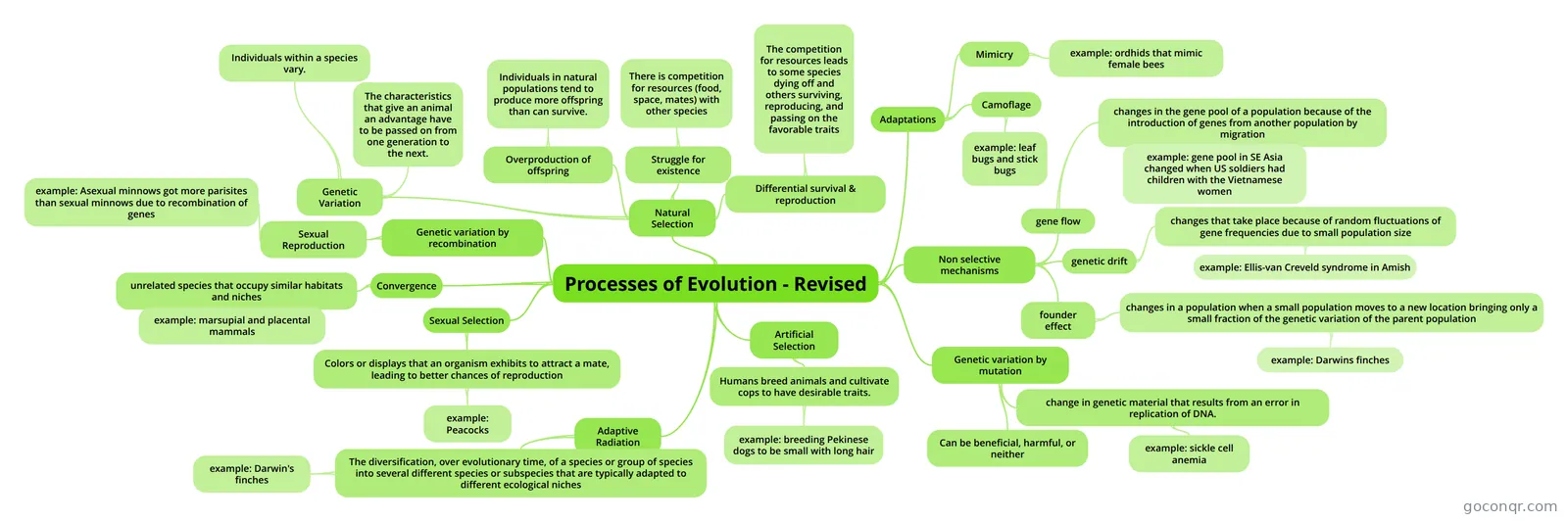
Mind map: Processes of evolution
Inhalt der Mindmap
Processes of Evolution - Revised
Natural Selection
- Genetic Variation
- Individuals within a species vary.
- The characteristics that give an animal an advantage have to be passed on from one generation to the next.
- Overproduction of offspring
- Individuals in natural populations tend to produce more offspring than can survive.
- Struggle for existence
- There is competition for resources (food, space, mates) with other species
- Differential survival & reproduction
- The competition for resources leads to some species dying off and others surviving, reproducing, and passing on the favorable traits
- Genetic Variation
Artificial Selection
- Humans breed animals and cultivate cops to have desirable traits.
- example: breeding Pekinese dogs to be small with long hair
- Humans breed animals and cultivate cops to have desirable traits.
Sexual Selection
- Colors or displays that an organism exhibits to attract a mate, leading to better chances of reproduction
- example: Peacocks
- Colors or displays that an organism exhibits to attract a mate, leading to better chances of reproduction
Adaptations
- Mimicry
- example: ordhids that mimic female bees
- Camoflage
- example: leaf bugs and stick bugs
- Mimicry
Genetic variation by mutation
- change in genetic material that results from an error in replication of DNA.
- example: sickle cell anemia
- Can be beneficial, harmful, or neither
- change in genetic material that results from an error in replication of DNA.
Genetic variation by recombination
- Sexual Reproduction
- example: Asexual minnows got more parisites than sexual minnows due to recombination of genes
- Sexual Reproduction
Non selective mechanisms
- gene flow
- changes in the gene pool of a population because of the introduction of genes from another population by migration
- example: gene pool in SE Asia changed when US soldiers had children with the Vietnamese women
- changes in the gene pool of a population because of the introduction of genes from another population by migration
- genetic drift
- changes that take place because of random fluctuations of gene frequencies due to small population size
- example: Ellis-van Creveld syndrome in Amish
- changes that take place because of random fluctuations of gene frequencies due to small population size
- founder effect
- changes in a population when a small population moves to a new location bringing only a small fraction of the genetic variation of the parent population
- example: Darwins finches
- changes in a population when a small population moves to a new location bringing only a small fraction of the genetic variation of the parent population
- gene flow
Adaptive Radiation
- The diversification, over evolutionary time, of a species or group of species into several different species or subspecies that are typically adapted to different ecological niches
- example: Darwin's finches
- The diversification, over evolutionary time, of a species or group of species into several different species or subspecies that are typically adapted to different ecological niches
Convergence
- unrelated species that occupy similar habitats and niches
- example: marsupial and placental mammals
- unrelated species that occupy similar habitats and niches
Informationen
- Beschreibung
- Mindmap am Processes of Evolution - Revised, erstellt von skjohns am 21/02/2014.
- Erstellt von
- skjohns
- Aufrufe
- 22
- Bewertung
Mehr zu Population Genetics and Evolutionary Mechanisms