
Mindmap
Physics: Kinematics
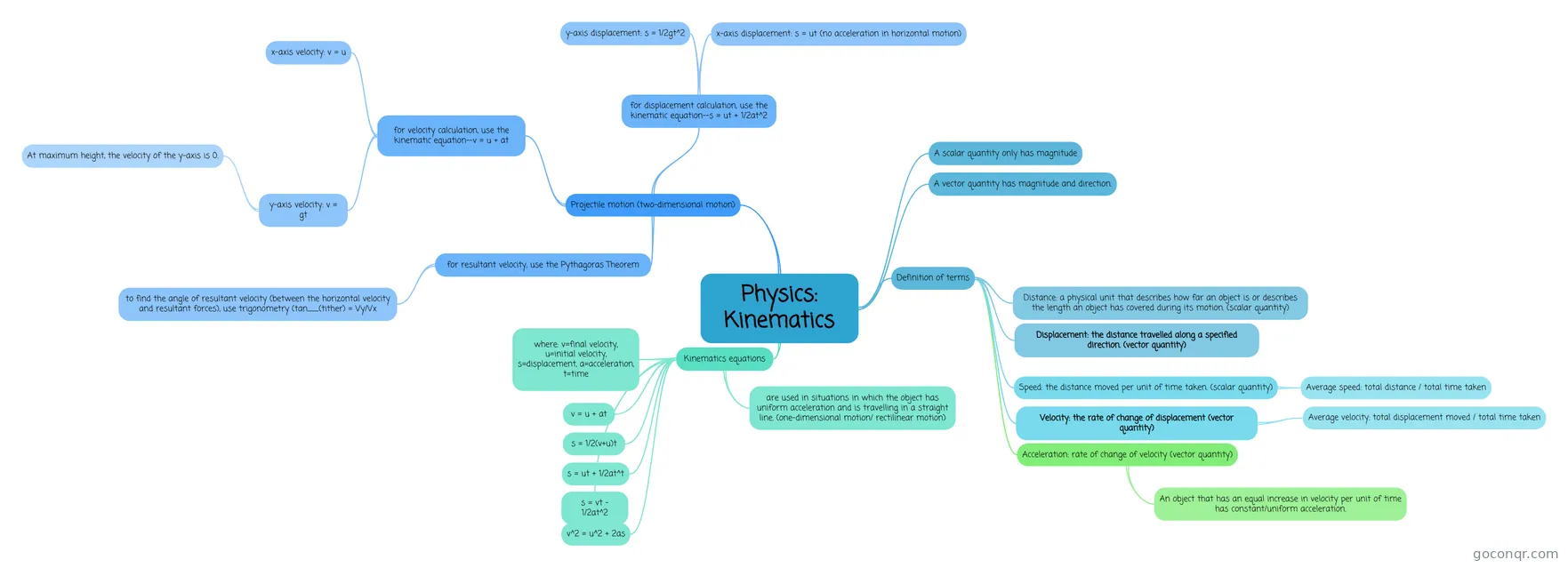
Mind map: physics kinematics
Inhalt der Mindmap
Physics: Kinematics
Definition of terms
- Distance: a physical unit that describes how far an object is or describes the length an object has covered during its motion. (scalar quantity)
- Displacement: the distance travelled along a specified direction. (vector quantity)
- Speed: the distance moved per unit of time taken. (scalar quantity)
- Average speed: total distance / total time taken
- Velocity: the rate of change of displacement (vector quantity)
- Average velocity: total displacement moved / total time taken
- Acceleration: rate of change of velocity (vector quantity)
- An object that has an equal increase in velocity per unit of time has constant/uniform acceleration.
A scalar quantity only has magnitude
A vector quantity has magnitude and direction.
Kinematics equations
- are used in situations in which the object has uniform acceleration and is travelling in a straight line. (one-dimensional motion/ rectilinear motion)
- v = u + at
- s = 1/2(v+u)t
- s = ut + 1/2at^t
- s = vt - 1/2at^2
- v^2 = u^2 + 2as
- where: v=final velocity, u=initial velocity, s=displacement, a=acceleration, t=time
Projectile motion (two-dimensional motion)
- for displacement calculation, use the kinematic equation--s = ut + 1/2at^2
- x-axis displacement: s = ut (no acceleration in horizontal motion)
- y-axis displacement: s = 1/2gt^2
- for velocity calculation, use the kinematic equation--v = u + at
- x-axis velocity: v = u
- y-axis velocity: v = gt
- At maximum height, the velocity of the y-axis is 0.
- for resultant velocity, use the Pythagoras Theorem
- to find the angle of resultant velocity (between the horizontal velocity and resultant forces), use trigonometry (tan__(tither) = Vy/Vx
- for displacement calculation, use the kinematic equation--s = ut + 1/2at^2