
Mindmap
Structure and Bonding
Inhalt der Mindmap
Structure and Bonding
Atomic Structure
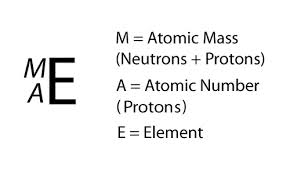
- The atomic number and Mass number describe different features of an atom.
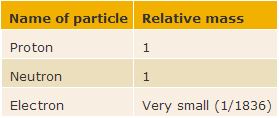
- Relative atomic masses
- An isotope is: ' A different atomic form of the same element, with the same number of protons and electrons, but a different number of neutrons.
- same atomic number- different mass number
Ionic Bonding
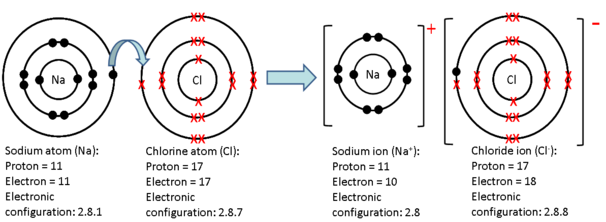
- Transferring Electrons
- Atoms lose or gain electrons to form charged particles (ions)- strongly attracted to each other
- Group 1 and 2 metals only have to lose one/two electrons to become stable ions (+ charge)
- Elements in Groups 6 and 7 only have to gain one/two electrons to become stable ions (- charge)
- Latch onto atoms that the gave/gained electron from
- Group 1 and 2 metals only have to lose one/two electrons to become stable ions (+ charge)
- Regular Giant Ionic Lattices
- Very Strong electrostatic forces of attraction between oppositely charged ions in all directions
- Properties
- High melting and boiling points- strong attraction between ions
- When molten, ions are free to move- will carry electric current
- Dissolve easily in water. Ions separate- free to move- carry electric current
- Ions and Formulas
- Ions have the structure of a noble gas
- Groups 1,2,6 and 7 most readily form ions.
- Group 1 and 2 elements = metals - form + ions Group 1 elements( alkali metals) form ions with non metals where metal has 1+ charge
- Group 6 and 7 elements = non-metals- gain electrons to form - ions Group 7 elements (halogens) form ionic compound with alkali metals where halide ion has 1- charge
- Charge on positive ions is the same as group number e.g. Group 1 + LI+ Group 7 = F-
- Charges must balance each other e.g. MgCl2
Covalent Bonding
- Sharing electrons
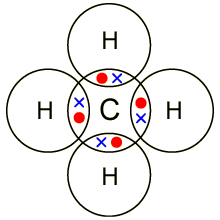
- Covalent Bond = shared pair of electrons
- Dot and Cross diagrams
- Simple Molecular Substances
- Very strong covalent bonds to form small molecules of several atoms.
- Intermolecular forces = very weak - Melting and boiling points are very lows - molecules easily parted
- Most molecular substances are gases/ liquids at room temperature but can be solids
- Don't conduct electricity - no ions, no electrical charge
- Giant Covalent (Macromolecules)
- Similar to giant ionic lattices except no charged ions
- All atoms bonded to each other by strong covalent bonds- very high melting/boiling points
- Don't conduct electricity- except graphite
- Main examples = Diamond and Graphite
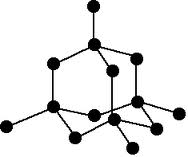
- Diamond- Each carbon atom forms four covalent bonds in a v. rigid giant covalent structure. Diamond = hardest natural substance -used for drill tips
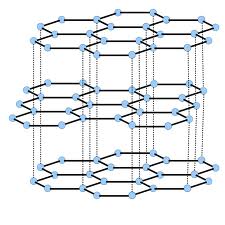
- Graphite- Each carbon atom has 3 covalent bonds. Creates layers- free to slide over each other. Graphite soft and slippery. Layers can be rubbed off onto paper e.g. a pencil. Weak intermolecular forces between layers. Only non-metal that's a good conductor of heat and electricity. Delocalised electrons that conduct heat and electricity
Metallic Structures
- Giant Structure
- Metallic bonds involve 'free electrons'- come from outer shell of the metal atoms and produce the properties of metals
- Electrons free to move- good conductors of heat and electricity
- These electrons hold atom together in regular structure- strong forces of electrostatic attraction between + metal atoms and - electrons
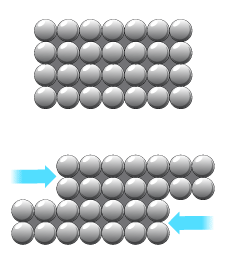
- Electrons allow layers of atoms to slide over each other - metals can be bent/shaped
- Alloys
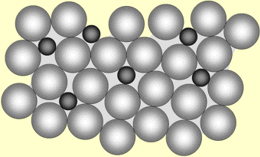
- Harder than pure metals-different sized atoms distorting layers- more difficult to slide over each other = harder
New Materials
- Smart Materials
- Behave differently depending on conditions e.g. temperature
- Nitinol = shape memory alloy- when cool bends and twist like rubber. When heatedit goes back to a 'remembered' shape- used for braces
- Nanoparticles
- Between 1-100 nanometres across 1nm=0.000000001m
- Contain roughly a few hundred atoms
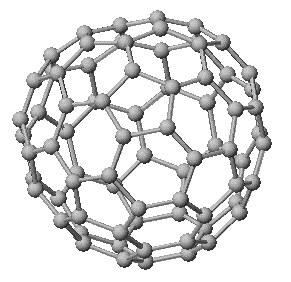
- Include fullerenes- molecules of carbon, shaped like hollow balls or closed tubes- arranged in hexagonal rings. Different fullerenes have different numbers of carbon atoms
- A nanoparticle has v. different properties from the bulk chemical e.g. fullerenes have different properties from big lumps of carbon
- Fullerens can be joined together to make nanotubes. All the covalent bonds make nanotubes v. strong- Can be used to reinforce graphite in tennis rackets
- Nanoscience
- Huge surface area to volume ratio- could help make new catalysts
- Nanotubes can make stronger, lighter building materials
- Sun cream can include nanoparticles- do't leave white marks
- Nanomedicine- fullerenes absorbed more easily by the body - could deliver drugs into the cells where they're needed
- Nanotubes conduct electricity
- Smart Materials
Bilder und Dateien der Mindmap
Informationen
- Beschreibung
- GCSE Chemistry Mindmap am Structure and Bonding, erstellt von rhea_popat am 02/03/2014.
- Erstellt von
- rhea_popat
- Aufrufe
- 448
- Tags
- Bewertung