
Mindmap
Daycare
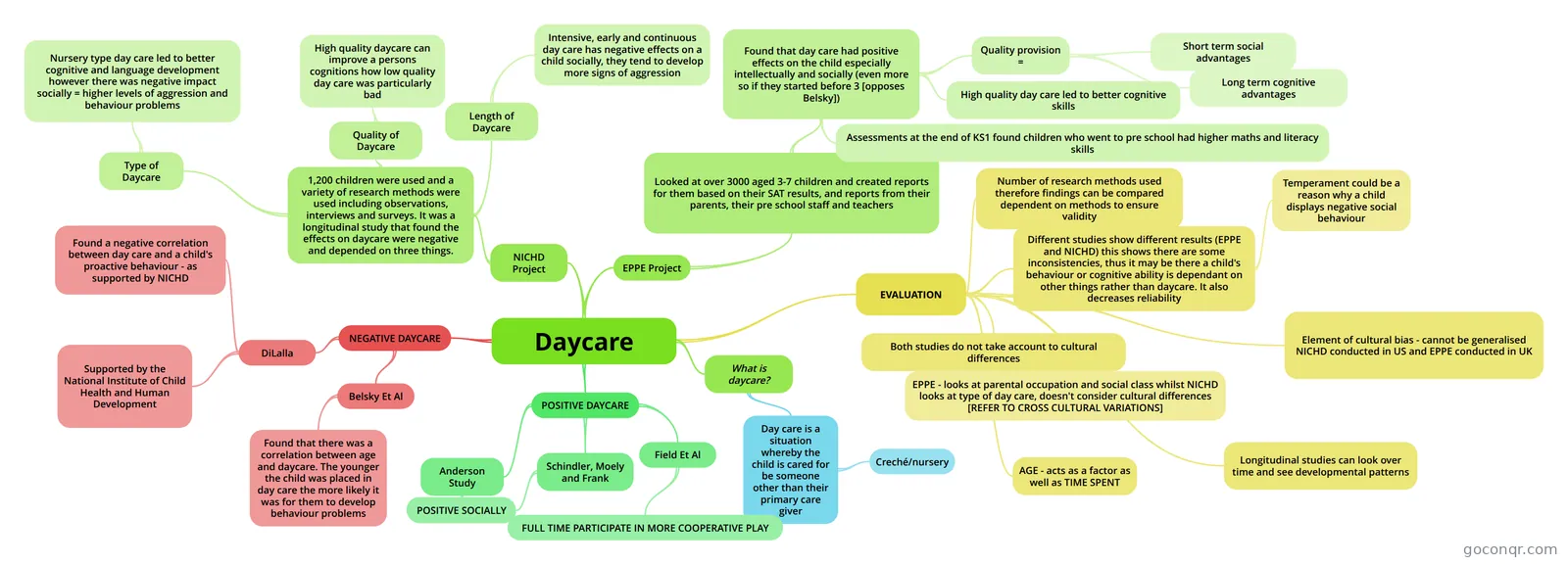
Mind map: Daycare psychology
Inhalt der Mindmap
Daycare
What is daycare?
- Day care is a situation whereby the child is cared for be someone other than their primary care giver
- Creché/nursery
- Day care is a situation whereby the child is cared for be someone other than their primary care giver
POSITIVE DAYCARE
- Field Et Al
- FULL TIME PARTICIPATE IN MORE COOPERATIVE PLAY
- Schindler, Moely and Frank
- POSITIVE SOCIALLY
- Anderson Study
- POSITIVE SOCIALLY
- Field Et Al
NEGATIVE DAYCARE
- Belsky Et Al
- Found that there was a correlation between age and daycare. The younger the child was placed in day care the more likely it was for them to develop behaviour problems
- DiLalla
- Supported by the National Institute of Child Health and Human Development
- Found a negative correlation between day care and a child's proactive behaviour - as supported by NICHD
- Belsky Et Al
NICHD Project
- 1,200 children were used and a variety of research methods were used including observations, interviews and surveys. It was a longitudinal study that found the effects on daycare were negative and depended on three things.
- Type of Daycare
- Nursery type day care led to better cognitive and language development however there was negative impact socially = higher levels of aggression and behaviour problems
- Quality of Daycare
- High quality daycare can improve a persons cognitions how low quality day care was particularly bad
- Length of Daycare
- Intensive, early and continuous day care has negative effects on a child socially, they tend to develop more signs of aggression
- Type of Daycare
- 1,200 children were used and a variety of research methods were used including observations, interviews and surveys. It was a longitudinal study that found the effects on daycare were negative and depended on three things.
EPPE Project
- Looked at over 3000 aged 3-7 children and created reports for them based on their SAT results, and reports from their parents, their pre school staff and teachers
- Found that day care had positive effects on the child especially intellectually and socially (even more so if they started before 3 [opposes Belsky])
- High quality day care led to better cognitive skills
- Assessments at the end of KS1 found children who went to pre school had higher maths and literacy skills
- Quality provision =
- Short term social advantages
- Long term cognitive advantages
- Found that day care had positive effects on the child especially intellectually and socially (even more so if they started before 3 [opposes Belsky])
- Looked at over 3000 aged 3-7 children and created reports for them based on their SAT results, and reports from their parents, their pre school staff and teachers
EVALUATION
- Number of research methods used therefore findings can be compared dependent on methods to ensure validity
- Different studies show different results (EPPE and NICHD) this shows there are some inconsistencies, thus it may be there a child's behaviour or cognitive ability is dependant on other things rather than daycare. It also decreases reliability
- Temperament could be a reason why a child displays negative social behaviour
- Both studies do not take account to cultural differences
- EPPE - looks at parental occupation and social class whilst NICHD looks at type of day care, doesn't consider cultural differences [REFER TO CROSS CULTURAL VARIATIONS]
- Element of cultural bias - cannot be generalised NICHD conducted in US and EPPE conducted in UK
- Longitudinal studies can look over time and see developmental patterns
- AGE - acts as a factor as well as TIME SPENT
Informationen
- Beschreibung
- A-Levels Child/Health Mindmap am Daycare, erstellt von aminalaoufi am 08/03/2014.
- Erstellt von
- aminalaoufi
- Aufrufe
- 24
- Tags
- Bewertung
Mehr zu Attachment and Parenting