
Mindmap
Bladder
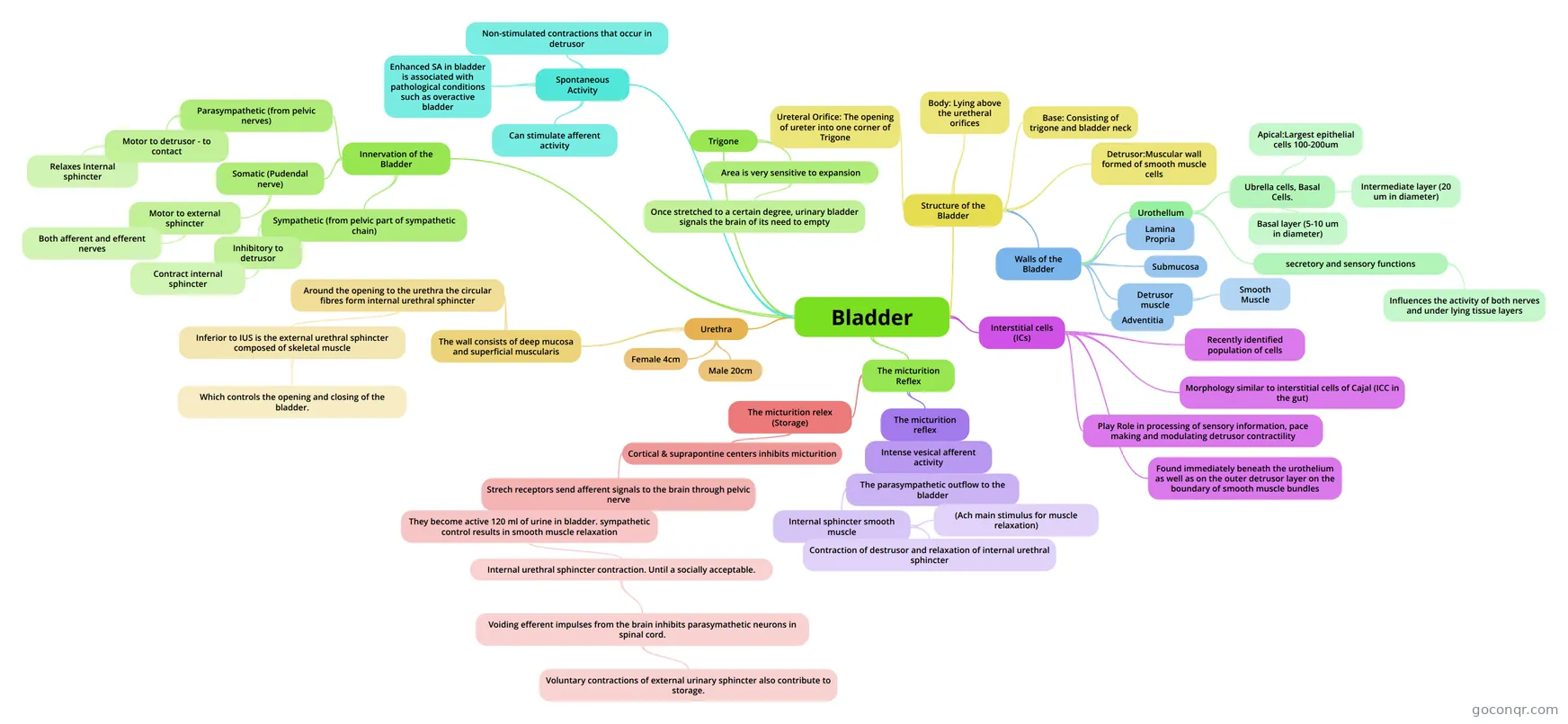
Mind map: Bladder
Inhalt der Mindmap
Bladder
Structure of the Bladder
- Body: Lying above the uretheral orifices
- Base: Consisting of trigone and bladder neck
- Detrusor:Muscular wall formed of smooth muscle cells
- Ureteral Orifice: The opening of ureter into one corner of Trigone
- Walls of the Bladder
- Urothellum
- Ubrella cells, Basal Cells.
- Apical:Largest epithelial cells 100-200um
- Intermediate layer (20 um in diameter)
- Basal layer (5-10 um in diameter)
- secretory and sensory functions
- Influences the activity of both nerves and under lying tissue layers
- Ubrella cells, Basal Cells.
- Lamina Propria
- Submucosa
- Detrusor muscle
- Smooth Muscle
- Adventitia
- Urothellum
Interstitial cells (ICs)
- Recently identified population of cells
- Morphology similar to interstitial cells of Cajal (ICC in the gut)
- Found immediately beneath the urothelium as well as on the outer detrusor layer on the boundary of smooth muscle bundles
- Play Role in processing of sensory information, pace making and modulating detrusor contractility
Spontaneous Activity
- Non-stimulated contractions that occur in detrusor
- Enhanced SA in bladder is associated with pathological conditions such as overactive bladder
- Can stimulate afferent activity
Trigone
- Area is very sensitive to expansion
- Once stretched to a certain degree, urinary bladder signals the brain of its need to empty
- Area is very sensitive to expansion
Urethra
- Male 20cm
- Female 4cm
- The wall consists of deep mucosa and superficial muscularis
- Around the opening to the urethra the circular fibres form internal urethral sphincter
- Inferior to IUS is the external urethral sphincter composed of skeletal muscle
- Which controls the opening and closing of the bladder.
- Inferior to IUS is the external urethral sphincter composed of skeletal muscle
- Around the opening to the urethra the circular fibres form internal urethral sphincter
Innervation of the Bladder
- Parasympathetic (from pelvic nerves)
- Motor to detrusor - to contact
- Relaxes Internal sphincter
- Motor to detrusor - to contact
- Sympathetic (from pelvic part of sympathetic chain)
- Inhibitory to detrusor
- Contract internal sphincter
- Inhibitory to detrusor
- Somatic (Pudendal nerve)
- Motor to external sphincter
- Both afferent and efferent nerves
- Motor to external sphincter
- Parasympathetic (from pelvic nerves)
The micturition Reflex
- The micturition relex (Storage)
- Cortical & suprapontine centers inhibits micturition
- Strech receptors send afferent signals to the brain through pelvic nerve
- They become active 120 ml of urine in bladder. sympathetic control results in smooth muscle relaxation
- Internal urethral sphincter contraction. Until a socially acceptable.
- Voiding efferent impulses from the brain inhibits parasymathetic neurons in spinal cord.
- Voluntary contractions of external urinary sphincter also contribute to storage.
- Voiding efferent impulses from the brain inhibits parasymathetic neurons in spinal cord.
- Internal urethral sphincter contraction. Until a socially acceptable.
- They become active 120 ml of urine in bladder. sympathetic control results in smooth muscle relaxation
- Strech receptors send afferent signals to the brain through pelvic nerve
- Cortical & suprapontine centers inhibits micturition
- The micturition reflex
- Intense vesical afferent activity
- The parasympathetic outflow to the bladder
- Internal sphincter smooth muscle
- (Ach main stimulus for muscle relaxation)
- Contraction of destrusor and relaxation of internal urethral sphincter
- Internal sphincter smooth muscle
- The parasympathetic outflow to the bladder
- Intense vesical afferent activity
- The micturition relex (Storage)
Informationen
- Beschreibung
- Degree Human Physiology (Bladder) Mindmap am Bladder, erstellt von David Bone am 20/03/2014.
- Erstellt von
- David Bone
- Aufrufe
- 37
- Tags
- Bewertung
Mehr zu Ureters, Bladder and Urethra