
Mindmap
Migration theories
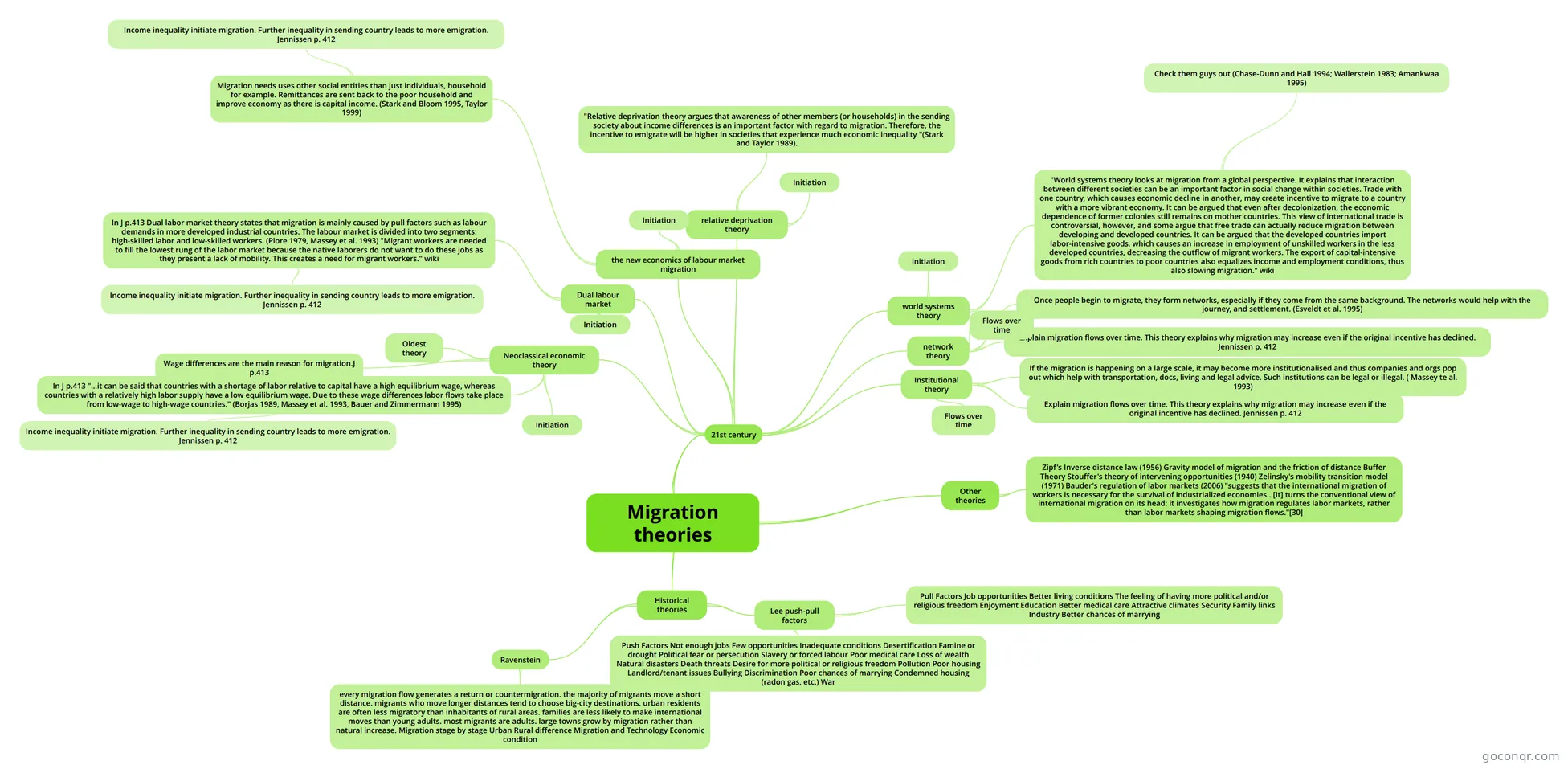
Mind map: Migration theories
Inhalt der Mindmap
Migration theories
21st century
- Neoclassical economic theory
- In J p.413 "...it can be said that countries with a shortage of labor relative to capital have a high equilibrium wage, whereas countries with a relatively high labor supply have a low equilibrium wage. Due to these wage differences labor flows take place from low-wage to high-wage countries." (Borjas 1989, Massey et al. 1993, Bauer and Zimmermann 1995)
- Income inequality initiate migration. Further inequality in sending country leads to more emigration. Jennissen p. 412
- Oldest theory
- Wage differences are the main reason for migration.J p.413
- Initiation
- In J p.413 "...it can be said that countries with a shortage of labor relative to capital have a high equilibrium wage, whereas countries with a relatively high labor supply have a low equilibrium wage. Due to these wage differences labor flows take place from low-wage to high-wage countries." (Borjas 1989, Massey et al. 1993, Bauer and Zimmermann 1995)
- Dual labour market
- In J p.413 Dual labor market theory states that migration is mainly caused by pull factors such as labour demands in more developed industrial countries. The labour market is divided into two segments: high-skilled labor and low-skilled workers. (Piore 1979, Massey et al. 1993) "Migrant workers are needed to fill the lowest rung of the labor market because the native laborers do not want to do these jobs as they present a lack of mobility. This creates a need for migrant workers." wiki
- Income inequality initiate migration. Further inequality in sending country leads to more emigration. Jennissen p. 412
- Initiation
- In J p.413 Dual labor market theory states that migration is mainly caused by pull factors such as labour demands in more developed industrial countries. The labour market is divided into two segments: high-skilled labor and low-skilled workers. (Piore 1979, Massey et al. 1993) "Migrant workers are needed to fill the lowest rung of the labor market because the native laborers do not want to do these jobs as they present a lack of mobility. This creates a need for migrant workers." wiki
- the new economics of labour market migration
- Migration needs uses other social entities than just individuals, household for example. Remittances are sent back to the poor household and improve economy as there is capital income. (Stark and Bloom 1995, Taylor 1999)
- Income inequality initiate migration. Further inequality in sending country leads to more emigration. Jennissen p. 412
- Initiation
- Migration needs uses other social entities than just individuals, household for example. Remittances are sent back to the poor household and improve economy as there is capital income. (Stark and Bloom 1995, Taylor 1999)
- relative deprivation theory
- "Relative deprivation theory argues that awareness of other members (or households) in the sending society about income differences is an important factor with regard to migration. Therefore, the incentive to emigrate will be higher in societies that experience much economic inequality "(Stark and Taylor 1989).
- Initiation
- world systems theory
- "World systems theory looks at migration from a global perspective. It explains that interaction between different societies can be an important factor in social change within societies. Trade with one country, which causes economic decline in another, may create incentive to migrate to a country with a more vibrant economy. It can be argued that even after decolonization, the economic dependence of former colonies still remains on mother countries. This view of international trade is controversial, however, and some argue that free trade can actually reduce migration between developing and developed countries. It can be argued that the developed countries import labor-intensive goods, which causes an increase in employment of unskilled workers in the less developed countries, decreasing the outflow of migrant workers. The export of capital-intensive goods from rich countries to poor countries also equalizes income and employment conditions, thus also slowing migration." wiki
- Check them guys out (Chase-Dunn and Hall 1994; Wallerstein 1983; Amankwaa 1995)
- Initiation
- "World systems theory looks at migration from a global perspective. It explains that interaction between different societies can be an important factor in social change within societies. Trade with one country, which causes economic decline in another, may create incentive to migrate to a country with a more vibrant economy. It can be argued that even after decolonization, the economic dependence of former colonies still remains on mother countries. This view of international trade is controversial, however, and some argue that free trade can actually reduce migration between developing and developed countries. It can be argued that the developed countries import labor-intensive goods, which causes an increase in employment of unskilled workers in the less developed countries, decreasing the outflow of migrant workers. The export of capital-intensive goods from rich countries to poor countries also equalizes income and employment conditions, thus also slowing migration." wiki
- network theory
- Explain migration flows over time. This theory explains why migration may increase even if the original incentive has declined. Jennissen p. 412
- Once people begin to migrate, they form networks, especially if they come from the same background. The networks would help with the journey, and settlement. (Esveldt et al. 1995)
- Flows over time
- Institutional theory
- Explain migration flows over time. This theory explains why migration may increase even if the original incentive has declined. Jennissen p. 412
- If the migration is happening on a large scale, it may become more institutionalised and thus companies and orgs pop out which help with transportation, docs, living and legal advice. Such institutions can be legal or illegal. ( Massey te al. 1993)
- Flows over time
- Neoclassical economic theory
Historical theories
- Ravenstein
- every migration flow generates a return or countermigration. the majority of migrants move a short distance. migrants who move longer distances tend to choose big-city destinations. urban residents are often less migratory than inhabitants of rural areas. families are less likely to make international moves than young adults. most migrants are adults. large towns grow by migration rather than natural increase. Migration stage by stage Urban Rural difference Migration and Technology Economic condition
- Lee push-pull factors
- Push Factors Not enough jobs Few opportunities Inadequate conditions Desertification Famine or drought Political fear or persecution Slavery or forced labour Poor medical care Loss of wealth Natural disasters Death threats Desire for more political or religious freedom Pollution Poor housing Landlord/tenant issues Bullying Discrimination Poor chances of marrying Condemned housing (radon gas, etc.) War
- Pull Factors Job opportunities Better living conditions The feeling of having more political and/or religious freedom Enjoyment Education Better medical care Attractive climates Security Family links Industry Better chances of marrying
- Ravenstein
Other theories
- Zipf's Inverse distance law (1956) Gravity model of migration and the friction of distance Buffer Theory Stouffer's theory of intervening opportunities (1940) Zelinsky's mobility transition model (1971) Bauder's regulation of labor markets (2006) "suggests that the international migration of workers is necessary for the survival of industrialized economies...[It] turns the conventional view of international migration on its head: it investigates how migration regulates labor markets, rather than labor markets shaping migration flows."[30]
Informationen
- Beschreibung
- Mindmap am Migration theories, erstellt von lauradavisonline am 01/04/2014.
- Erstellt von
- lauradavisonline
- Aufrufe
- 29
- Bewertung