
Mindmap
Globalisation
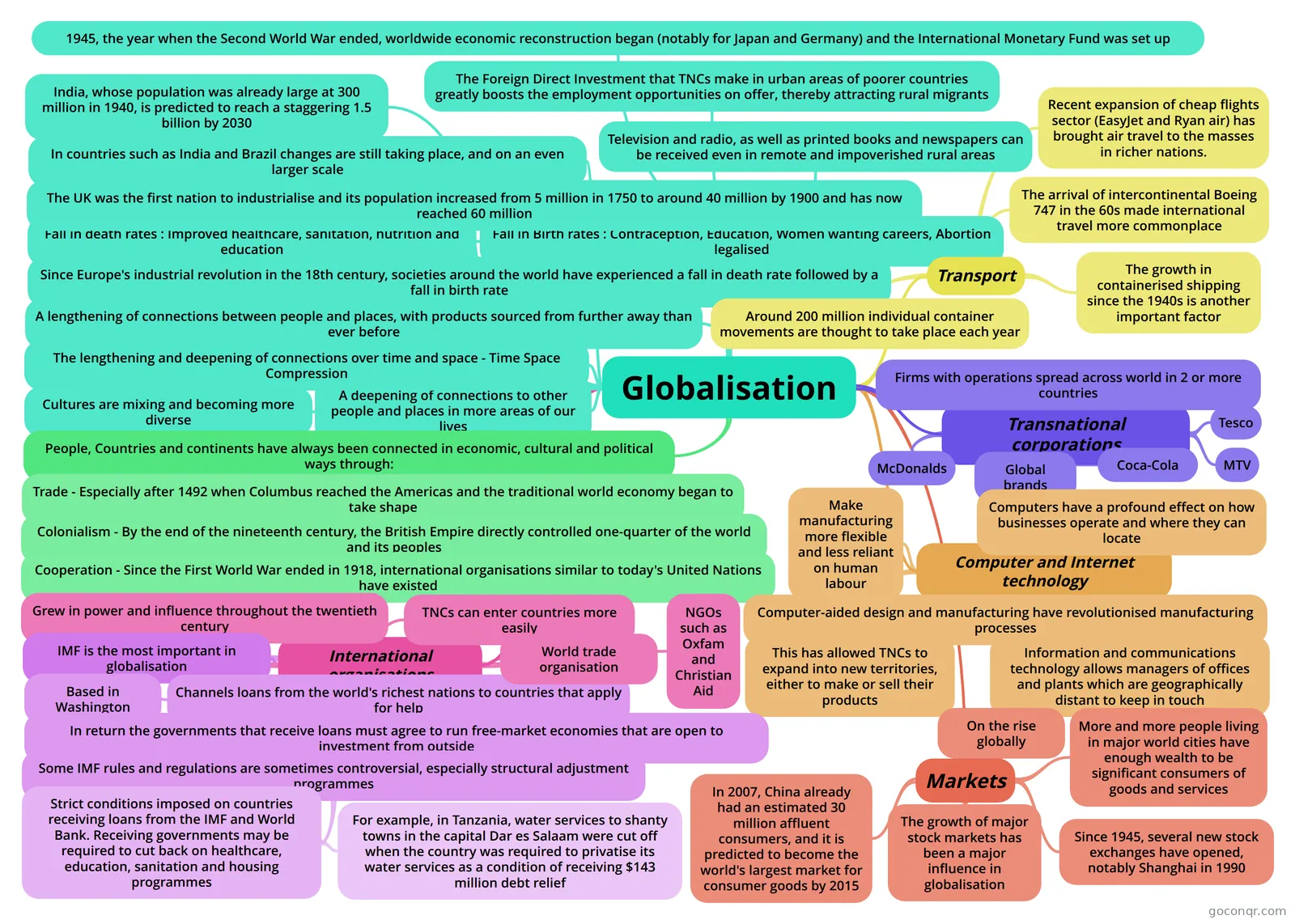
Mind map: Globalisation
Inhalt der Mindmap
Globalisation
A lengthening of connections between people and places, with products sourced from further away than ever before
A deepening of connections to other people and places in more areas of our lives
The lengthening and deepening of connections over time and space - Time Space Compression
Cultures are mixing and becoming more diverse
People, Countries and continents have always been connected in economic, cultural and political ways through:
- Trade - Especially after 1492 when Columbus reached the Americas and the traditional world economy began to take shape
- Colonialism - By the end of the nineteenth century, the British Empire directly controlled one-quarter of the world and its peoples
- Cooperation - Since the First World War ended in 1918, international organisations similar to today's United Nations have existed
Since Europe's industrial revolution in the 18th century, societies around the world have experienced a fall in death rate followed by a fall in birth rate
Fall in death rates : Improved healthcare, sanitation, nutrition and education
Fall in Birth rates : Contraception, Education, Women wanting careers, Abortion legalised
The UK was the first nation to industrialise and its population increased from 5 million in 1750 to around 40 million by 1900 and has now reached 60 million
In countries such as India and Brazil changes are still taking place, and on an even larger scale
India, whose population was already large at 300 million in 1940, is predicted to reach a staggering 1.5 billion by 2030
1945, the year when the Second World War ended, worldwide economic reconstruction began (notably for Japan and Germany) and the International Monetary Fund was set up
Transnational corporations
- Firms with operations spread across world in 2 or more countries
- Global brands
- Tesco
- Coca-Cola
- McDonalds
- MTV
Transport
- The arrival of intercontinental Boeing 747 in the 60s made international travel more commonplace
- Recent expansion of cheap flights sector (EasyJet and Ryan air) has brought air travel to the masses in richer nations.
- The growth in containerised shipping since the 1940s is another important factor
- Around 200 million individual container movements are thought to take place each year
Computer and Internet technology
- Computers have a profound effect on how businesses operate and where they can locate
- Computer-aided design and manufacturing have revolutionised manufacturing processes
- Make manufacturing more flexible and less reliant on human labour
- Information and communications technology allows managers of offices and plants which are geographically distant to keep in touch
- This has allowed TNCs to expand into new territories, either to make or sell their products
International organisations
- Grew in power and influence throughout the twentieth century
- IMF is the most important in globalisation
- Based in Washington
- Channels loans from the world's richest nations to countries that apply for help
- In return the governments that receive loans must agree to run free-market economies that are open to investment from outside
- Some IMF rules and regulations are sometimes controversial, especially structural adjustment programmes
- Strict conditions imposed on countries receiving loans from the IMF and World Bank. Receiving governments may be required to cut back on healthcare, education, sanitation and housing programmes
- For example, in Tanzania, water services to shanty towns in the capital Dar es Salaam were cut off when the country was required to privatise its water services as a condition of receiving $143 million debt relief
- Strict conditions imposed on countries receiving loans from the IMF and World Bank. Receiving governments may be required to cut back on healthcare, education, sanitation and housing programmes
- TNCs can enter countries more easily
- World trade organisation
- NGOs such as Oxfam and Christian Aid
Markets
- On the rise globally
- More and more people living in major world cities have enough wealth to be significant consumers of goods and services
- In 2007, China already had an estimated 30 million affluent consumers, and it is predicted to become the world's largest market for consumer goods by 2015
- Since 1945, several new stock exchanges have opened, notably Shanghai in 1990
- The growth of major stock markets has been a major influence in globalisation
Television and radio, as well as printed books and newspapers can be received even in remote and impoverished rural areas
The Foreign Direct Investment that TNCs make in urban areas of poorer countries greatly boosts the employment opportunities on offer, thereby attracting rural migrants
Informationen
- Beschreibung
- A-Levels Geography (Going Global) Mindmap am Globalisation, erstellt von Jodie Goodacre am 05/05/2013.
- Erstellt von
- Jodie Goodacre
- Aufrufe
- 217
- Tags
- Bewertung