
Mindmap
Exceeding Topics
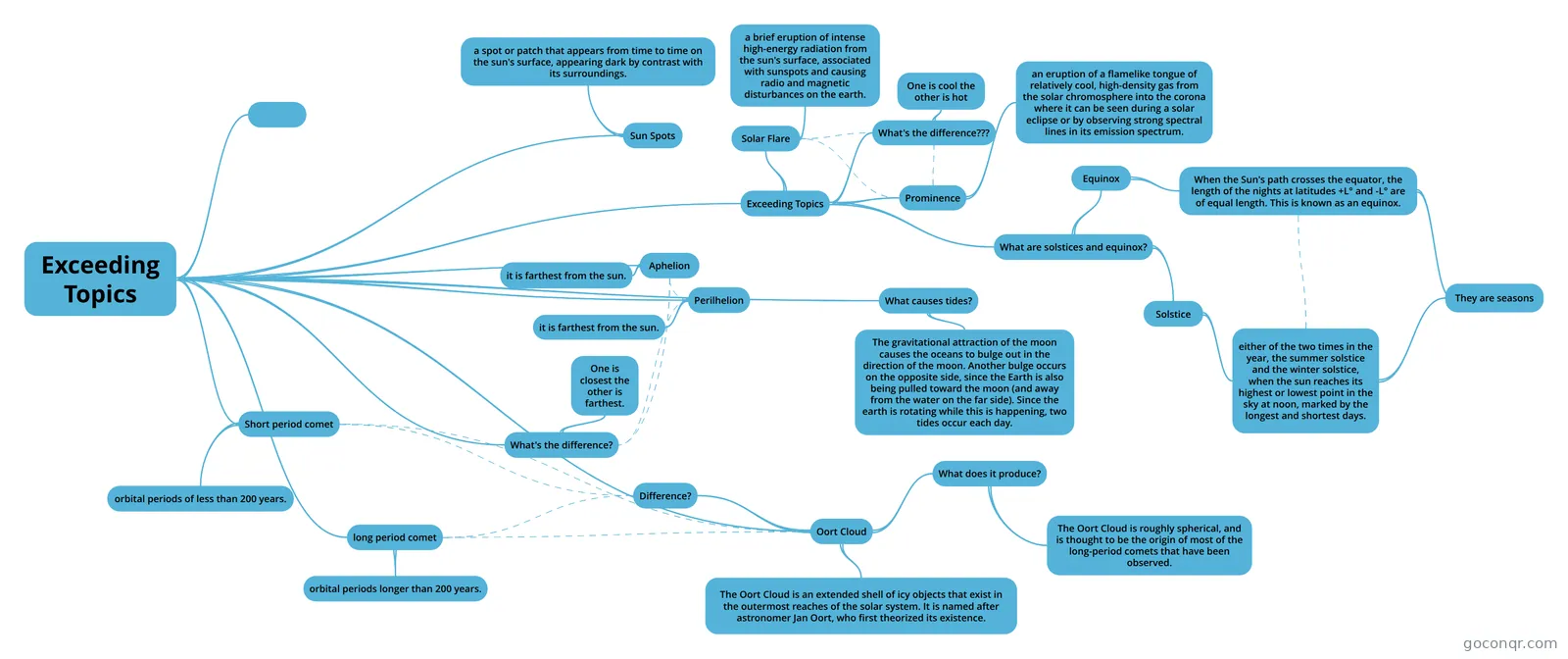
Mind map: Exceeding Topics
Inhalt der Mindmap
Exceeding Topics
Exceeding Topics
- Solar Flare
- a brief eruption of intense high-energy radiation from the sun's surface, associated with sunspots and causing radio and magnetic disturbances on the earth.
- Prominence
- an eruption of a flamelike tongue of relatively cool, high-density gas from the solar chromosphere into the corona where it can be seen during a solar eclipse or by observing strong spectral lines in its emission spectrum.
- What's the difference???
- One is cool the other is hot
- What are solstices and equinox?
- Equinox
- When the Sun's path crosses the equator, the length of the nights at latitudes +L° and -L° are of equal length. This is known as an equinox.
- When the Sun's path crosses the equator, the length of the nights at latitudes +L° and -L° are of equal length. This is known as an equinox.
- Solstice
- either of the two times in the year, the summer solstice and the winter solstice, when the sun reaches its highest or lowest point in the sky at noon, marked by the longest and shortest days.
- They are seasons
- either of the two times in the year, the summer solstice and the winter solstice, when the sun reaches its highest or lowest point in the sky at noon, marked by the longest and shortest days.
- Equinox
- Solar Flare
Sun Spots
- a spot or patch that appears from time to time on the sun's surface, appearing dark by contrast with its surroundings.
Aphelion
- it is farthest from the sun.
Perilhelion
- it is farthest from the sun.
What's the difference?
- One is closest the other is farthest.
What causes tides?
- The gravitational attraction of the moon causes the oceans to bulge out in the direction of the moon. Another bulge occurs on the opposite side, since the Earth is also being pulled toward the moon (and away from the water on the far side). Since the earth is rotating while this is happening, two tides occur each day.
Oort Cloud
- What does it produce?
- The Oort Cloud is roughly spherical, and is thought to be the origin of most of the long-period comets that have been observed.
- Difference?
- The Oort Cloud is an extended shell of icy objects that exist in the outermost reaches of the solar system. It is named after astronomer Jan Oort, who first theorized its existence.
- What does it produce?
Short period comet
- orbital periods of less than 200 years.
long period comet
- orbital periods longer than 200 years.