
Mindmap
Changing Urban Environments
Inhalt der Mindmap
Changing Urban Environments
Urbanisation
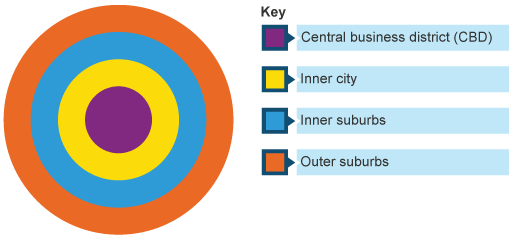
- Parts of a city
- CENTRAL BUSINESS DISTRICT: Its the commercial centre where shops are- It is where all transport links meet - Buildings are packed and tall - Not many people live in this area as/so there is a lot of competition for houses.
- INNER CITY: Its the area surrounding the CBD. It consists of run down housing and old factories. Thus the area tends to be deprived. There is also,however, new housing and industry as redevelopment continues to attract more people.
- SUBURBS: Consists of mostly housing and it is where most families choose to live. Mainly because housing is cheaper here but also because there is less crime and pollution in this area. It is also a Suitable distance from the CBD so one can commute to work easily
- RURAL URBAN FRINGE: This is right at the edge of the city. Both urban and rural land uses can be observed here. Housing in this area tend to be widespread detached houses.
- Issues
- HOUSING: As population increase so does the demand for more housing. One method used in the past is investment in new housing by the government. Another is building towns to contain the overspill from urban areas e.g. Milton Keynes. Another is enticing people who live in Urban area who don't need to ,like the elderly, to move to the country side by giving them money.
- REVITALISING THE CBD: CBD is entering decline due to out-of-town shopping and business parks providing cheaper parking and more space. methods of solving this issue include: Pedestrianising - Improving access - Improve public transport- Renovating old shops.
- TRAFFIC: More traffic means more pollution which can damage buildings and health. Also can cause more road accidents. Solutions to this include- Pedestrianisation - Improve public transport - Create bus priority lanes - Increase car park charges.
- CULTURE MIX: Many members of ethnic groups prefer to live together as they have similar backgrounds, language, to be close to a mutual service e.g. mosque as well as their situation. However this can be solved by:.Printing out public information in different languages - Involving different community leaders in important decisions- Providing interpreters at places like police station - Catering for their specific cultural needs - such as being seen by a doctor who is of the same sex
- Urbanisation is mostly occurring in poorer countries as more people move out from rural areas looking for a better quality of life. They are attracted by factor such as better work force and better infrastructure. Urbanisation doesn't happen in richer countries as it occurred in the 19th century when there was the agricultural and industrial revolution took place.
- Parts of a city
Squatter settlements
- Squatter settlements are settlement built on the edges of cities usually illegally. they are also called fevelas in Brazil. They often consist of people who have migrated from rural area and can't afford proper housing. they have no running water, electricity nor sewers. the also don't have services like policing and firefighter. Most of the employment is on the informal sector which means people don't have to pay taxes however it does mean that most of the time they work long hours with little pay.
- Improvement
- SELF-HELP SCHEMES: This involves the government supplying local people with building resources so that they can improve their living situation. If there is any leftover then it can be used to improve infrastructure.
- SITE AND SERVICE SCHEME: Residents can pay a small amount to rent for a site which they can choose to improve and build. the rent paid can be used to pay for basic purposes.
- LOCAL AUTHORITY SCHEMES: This is when the local government fund the are to improve the temporary living accommodation of the residents
- Case study: Kibera
- ISSUES: Education is a problem as the government doesn't provide schools for the area as it is an illegal settlement. Housing is another problem as houses are poorly built often with corrugated iron and cardboard. these houses usually don't have running water, electricity and little sanitation. Work is also an issue as most people work in the informal sector meaning that it's unreliable and often low paid. these jobs can include selling food emptying toilets and general house work. Living standard is also another issue as most people live in a one room house and there is no Street lighting as well as no public transport.
- Solution: Dondora scheme is a system where residents can apply for a night course on construction. once they finish this they can ask to burrow money to buy building resources to improve their houses. - A 15 year project was set up by the UK habitat as well as by the government to rehouse 700 families to flats with running water and electricity. 650 million shillings have been set aside for this. - Charities have bought large plastic washing machines so that people can get paid for collecting plastic and getting it washed, then selling this for a profit.
- Located in Nairobi, Kenya. around 0.8 to 1 million people live in Kibera. Kibera is the size of 285 football pitches.
Sustainable Cities
- SAFELY DISPOSING OF WASTE: By recyciing we are reusing valuable raw materials like metals ans plastics this way less water is produced and land fill sites don't fill up as quickly. this also means less of the waste goes into the air or to water sources to pollute them
- BUILDING ON BROWNFIELD SITES: Building on brown field sites reduces building that is done on greenfield sites which ensures their existence in the future. Also developing brown field sites makes the area look nice.
- PUBLIC TRANSPORT: Better public transport means less people on cars which reduces pollution and this can be further reduced by having trams which use less fuel and emit less harmful waste..
- CONSERVING NATURAL AND HISTORICAL HERITAGE: Places like Historical building and natural environments are all resources that can all get used up which means they may not be present in the future. Thus these area can be protected by restoring historical building and protecting natural areas like parks.
- Case Study: Curitiba Located in southern Brazil which has a population of 1.8 million people
- REDUCING CAR USE: They have good bus systems and it is used by 1.4 million passengers every day. They have special prepay boarding stations that reduced boarding and bus only lanes. There is also over 200km of bike path in the city. these systems are so popular that the average car use in curitiba is 25% lowere than the national average.
- OPEN SPACES: Green space has increased from 0.5m per person to 52m in 1990 in that 20 year period. there are also over 1000 parks and natural areas. Residents planted 1.5 million trees along the city streets. Builders in curitiba are given tax breaks if their projects include green spaces.
- GOOD RECYCLING SCHEMES: 70% of rubbish is recycled their paper recycling saves up to 120 trees per day. Poor residents are given food for collecting waste to recycle at local collection centres.