
Mindmap
Chapter 6 - Learning
Inhalt der Mindmap
Chapter 6 - Learning
- Learning is any relatively durable change in behaviour or knowledge that is due to experience. -Superstitions are a result of obtaining a reward after engaging in some behaviour , even when the behaviour and the reward are not linked. -Phobias are irrational fears of specific objects or situations. -are often the result of another learning process termed classical conditioning. -Phobias are a type of anxiety -Conditioning involves learning connections between events that occur in an organization' environemnts
Classical Conditioning
- Classical conditioning is a type of learning in which a stimulus acquires the capacity to evoke a response that was originally evoked by another stimulus.
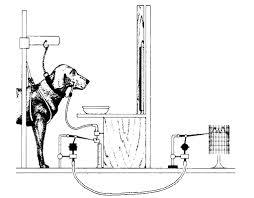
- Pavlov's Demonstration: " Psychic Refexes"
- -Pavlov was the one responsible for turning psychology from research focusing on subjective accounts of experience, introspection, to a more objective, rigorous, scientific approach. -his worked showed how stimuli in the external world controlled our actions and behaviour -Pavlov was studying the role of saliva in the digestive process of dogs when he stumbled onto what he called psychic reflexes
- Terminology and Procedures
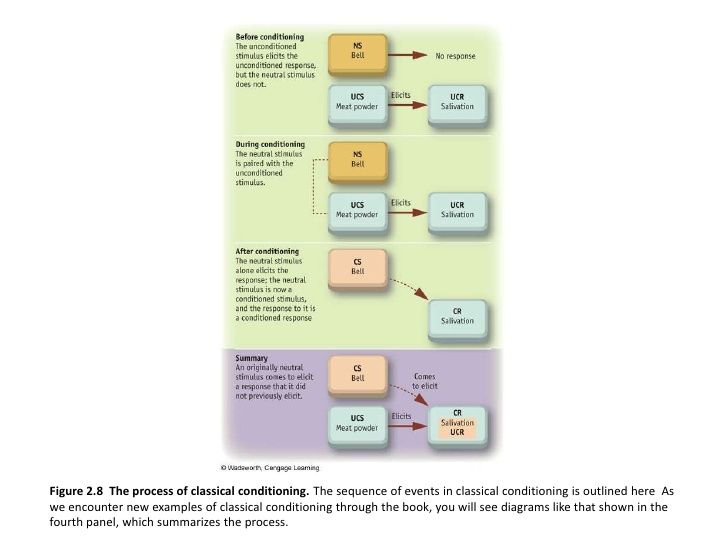
- -a special vocabulary is associated with classical conditioning -Unconditioned stimulus is a stimulus that evokes an unconditional response without previous conditioning. The unconditional response is an unlearned reaction to an unconditioned stimulus that occurs without previous conditioning. -Conditioned stimulus is a previously neutral stimulus that has, through conditioning acquired the capacity to evoke a conditioned response. The conditioned response is a learned reaction to a conditioned stimulus that occur because of previous conditioning.
- Classical Conditioning in Everyday Life
- Conditioned Fear and Anxiety -studies of patients suffering from phobias suggest that many irrational fears that can be traced to experiences that involve classical conditioning. Evaluate Conditioning of Attitudes -Evaluative Conditioning refers to changes in the liking of a stimulus that result from pairing that stimulus with other positive or negative stimuli Conditioning and Physiological Responses -classical conditioning affects not only overt behaviours but physiological processes also. -research suggests that the functioning of the immune system can be influenced by psychological factors, including conditioning. Conditioning and Drug Effects -Drug tolerance is largely attributed to physiological changes in the user.
- Basic Processes in Classical Conditioning
- -most conditioned responses are reflexive and difficult to control Acquisition is the initial stage of learning something. -Pavlov theorized that the acquistion of a conditioned response depends on stimulus contiguity Extinction is the gradual weakening and disappearance of conditioned response tendency. Spontaneous Recovery is a reappearance of an extinguished response after a period of nonexposure to the conditioned stimulus. Renewal effect is if a response is extinguished in a different environment than it was acquired, the extinguished response will reappear if the animal is returned to the original environment where aquistion took place.
- Stimulus Generalization and the Mysterious Case of Little Albert
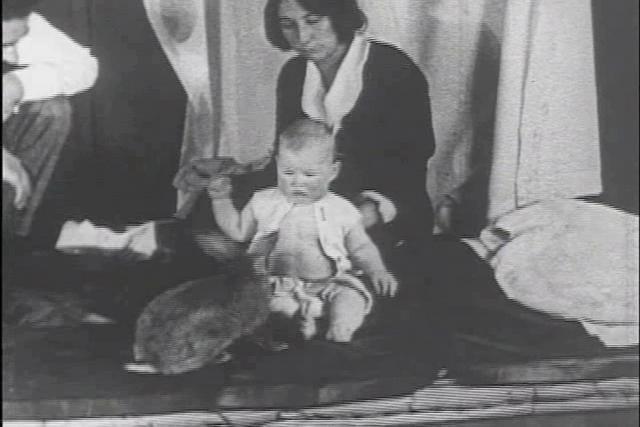
- Stimulus generalization occurs when an organism that has learned a response to a specific stimulus responds in the same way to new stimuli that are similar to the original stimulus. -process of generalization can have important implications and it appears to contribute to the development of panic disorder, which involves recurrent, overwhelming anxiety attacks Stimulus Discrimination occurs when an organism that has learned a response to a specific does not respond in the same way to a new stimuli tha are similar to the original stimulus. Higher-Order Conditioning is when a conditioned stimulus functions as if it were an unconditioned stimulus.
- Evolutionary and Biological Effects on Conditioning
- -findings in recent decades have demonstrated that there are limits to the generality of conditioning principals - limits imposed by an organism's biological/evolutionary heritage.
- Cognition and Classical Conditioning
- -Rescorla assets the environmental stimuli serve as signals and that stimuli are better, or more dependable, signals than others.
Operant Conditioning
- Operant conditioning is a form of learning in which responses come to be controlled by their consequences.
- Thorndike's Law of Effect
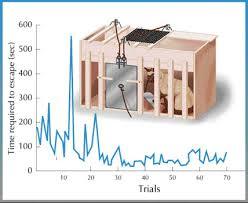
- Instrumental learning is obtaining some desired outcome. Law of Effect is a response in the presence of a stimulus leads to satisfying effects, the associaion between stimulus and the response is strengthened
- Skinner's Demonstation: It's All a Matter of Consequences
- Skinner demonstrated that organisms tend to repeat those responses that are followed by favourable consequences. Reinforcement occurs when an event following a response increases an organism's tendancy to make that response. The principal of reinforcement may be simple, but it is very powerful. -much of everyday behaviour is regulated by reinforcement.
- Basic Processes in Operant Conditioning
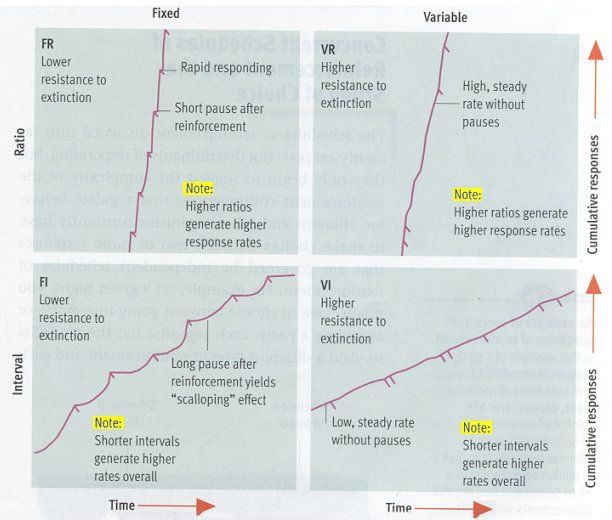
- Operant responses are ussually established through a gradual precess called shaping -Shaping is he reinforcement of closer and closer approximations of a desired response -Shaping is necessary when an organism does not on its own emit the desired response -The mechanism of shaping is the key to training animals to perform impressive tricks Extinction is the gradual weakening and disappearance of response tendency because the response is no longer followed by a reinforcer. -Key issue in operant conditioning is how much resistance to extinction an organism will display with reinforcement is halted. -Resistance to extinction occurs when an organism continues to make a response after delivery of the reinforcer has been terminated. Stimulus Control: Generalization and Discrimination -Operant conditioning is ultimately controlled by its consequences as organisms learn response-outcome associations. -Stimuli that precede a response they can also exert considerable influence over operant behaviour. -Discriminative stimuli are cues that influence operant behaviour by indicating the probable consequences -discriminative stimuli play a key role in the regulation of operant behaviour. -Reactions to a discriminative stimulus are governed by the processes of stimulus generalization and stimulus discrimination.
- Terminology and Procedures
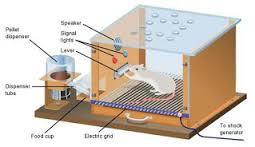
- -Operant chamber is a small enclosure in which an animal can make a specific response that is recorded while consequences of the response that is recorded while the consequences of the response are sytematically controlled. Reinforcement contingencies are the circumstances or rules that determine whether responses lead to the presentation of reinforcers. Cummulative recorder creates a graphic record of responding and reinforcement in a Skinner box as a function of time. Primary reinforcers are events that are inherently reinforcing because they satisfy biological needs. Secondary or conditioned, reinforcers are events that acquire reinforcing qualities by being associated with primary reinforcers.
- Reinforcement and Superstitious Behaviour
- -Reinforcement of course is key to the development of the kinds of superstitious behaviours exhibited by elite athletes as well as others. -reinforcement is likely accidental Skinner's theory that non-contingent reinforcement is the basis for superstitious behaviour held sway for many years
- Punishment: Consequences That Weaken Responses
- -Punishment occurs when an event following a response weakens the tendency to make that response. Side Effects of Physical Punishment -its argued that it produces many unintended and undesirable side effects.
- Positive Reinforcement versus Negative Reinforcement
- Positive Reinforcement occurs when a response is strengthened because it is followed by the presentation of rewarding stimulus Negative Reinforcement occurs when a response is strengthened because it is followed by the removal of an aversive stimulus. -everyday human behaviour is regulated extensively by negative reinforcement -Negative reinforcement plays a key role in both escape an avoidance learning. Escape learning is when an organism acquires a response that decreases or ends some aversive stimulation and is the roots of avoidance. Avoidance learning is when an organism acquires a response that prevents some aversive stimulation from occurring.
- Cognitive Processes in Conditioning: Latent Learning and Cognitive Maps
- Skinner viewed conditioning as a mechanical process in which stimulus-response associations are stamped in by experience. latent learning is learning that is not apparent from behaviour when it first occurs
- Evolutionary and Biological Effects on Conditioning
- Instinctive drift occurs when an animal's innate response tendencies interfere with conditioning processes. Evolutionary Perspectives on Learning -predominant view among learning theorists seems to be that the basic mechanisms of learning are similar across species. Response-Outcome Relations and Reinforcement -reinforcement is not automatic when favourable consequences follow a response.
Observational Learning
- Observational learning occurs wen an organism's responding is influenced by the observation of others, who are called models -observational learning involves being conditioned indirectly by virtue of observing another's conditioning.
- Basic Processes
- Bandura has identified four key processes that are crucial in observational learning. 1)attention 2)retention 3)reproduction 4)motivation Observational learning has proven especially valuable in explaining complex human behaviours -Bandura distinguishes between acquisition of a learned response an the performance of that response.
- Observational Learning and the Media Violence Controversy
- -Bandura was an early advocate of the application of learning principals to explain aggression in children. -Young children are especially impressionable and extensive evidence indicated that they pick up many responses including aggressive behaviours from viewing models on TV
Bilder und Dateien der Mindmap
Informationen
- Beschreibung
- Psychology 104 Mindmap am Chapter 6 - Learning, erstellt von Natasha Livingston am 29/03/2017.
- Erstellt von
- Natasha Livingston
- Aufrufe
- 1
- Bewertung