
Mindmap
Chromatography
Inhalt der Mindmap
Chromatography
Definition
- Techniques to separate mixtures based on physical properties such as size or charge
2 Phases
- Stationary
- A substance that the compounds to be separated pass by or interact with
- Mobile
- The carrier for the compounds to be separated
- Stationary
Mixed Samples
- Need to have variable affinity
- Some may have higher affinity in stationary/mobile phases.
- Different Affinities= Different Rates
- Some may have higher affinity in stationary/mobile phases.
- Need to have variable affinity
Basic Steps
- Pouring
- A glass tube with a valve at the bottom is filled with a mixture of stationary and mobile phases.
- Packing
- Opening the stopper and letting some liquid run out to make the stationary phase more densely and evenly packed.
- Loading
- The sample of interest is placed on top of the stationary phase.
- Running/ Eluting
- The sample flows into the column and more mobile phase is added on top to keep the column from drying out.
- Collecting
- Samples of defined volumes are caught into tubes at the bottom and saved/tested.
- Pouring
Size Exclusion Chromatography
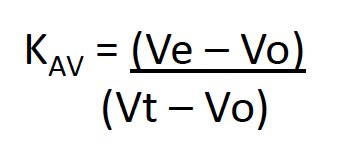
- Partition Coeffiecient
- To get reproducible results from variable columns we need a way to standardize elution measurements.
- Partition coeffiecient is the fraction of the volume of the column available to the sample.
- We can use this to compare on experiment to another.
- Partition coeffiecient is the fraction of the volume of the column available to the sample.
- Ve= Elution Volume
- Vo= Void Volume
- If Vo only, then Vt and Vo will be the same and Vt- Vo= 0
- Vt= Total Volume
- Always between 0 and 1
- To get reproducible results from variable columns we need a way to standardize elution measurements.
- Sizes
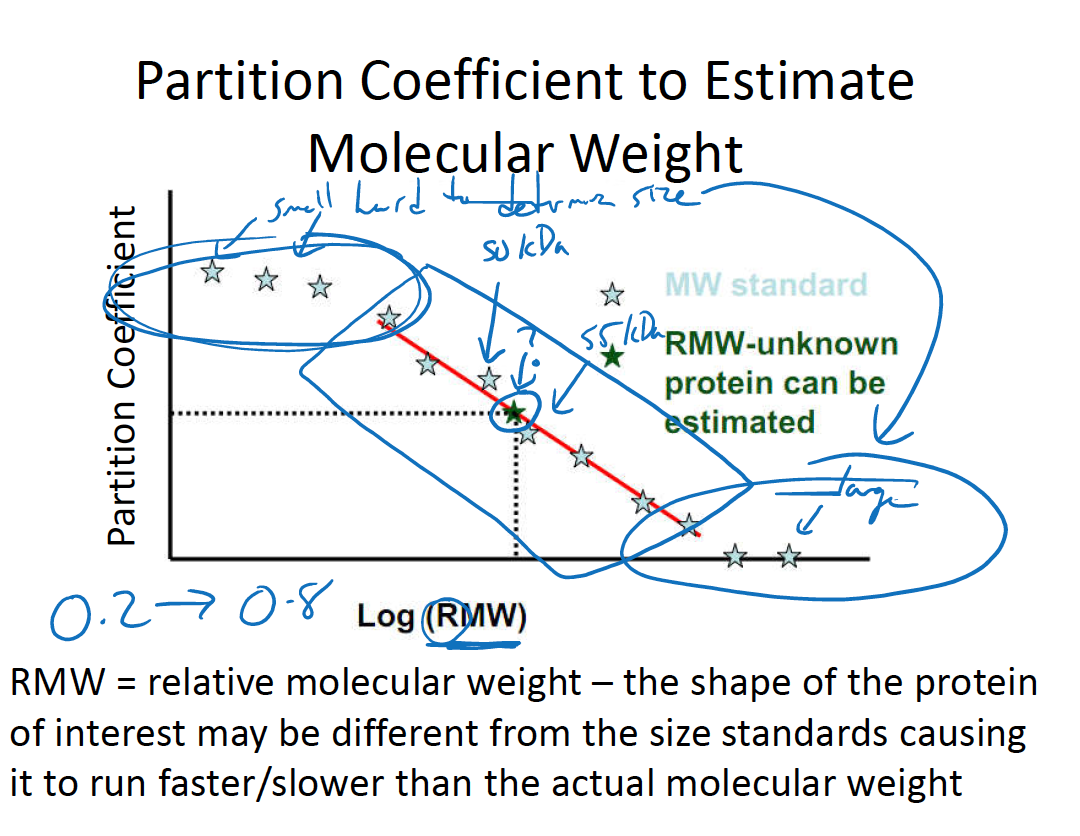
- Large proteins can not enter the beads so they will migrate around them.
- Moderate Sized proteins enter beads some times which increases the volume available and move more slowly.
- Small proteins do not interact with the beads and move the slowest.
- Limitations
- If Kav is >0.8 or <0.2 , poor separation of proteins.
- Samples can become diluted as:
- Turbulence from layering sample over gel.
- Diffusion during travel
- Friction differences along the glass tube wall.
- Partition Coeffiecient
Ion Exchange Chromatography
- A column of positively or negatively charged beads forms the stationary phase.
- Anion Exchange
- Column is +, Targets are -
- Cation Exchange
- Column is -, Targets are +
- Proteins in solution get carried down by gravity and will get slowed down by the beads proportionally based on charge
- Specific combination of mobile and stationary phases chose to retain protein of interest.
- Rates
- Like charge or neutral molecules will elute quickly
- The greater the charge on a protein, the slower it will travel down the column.
- Stepwise/ Gradient Elution
- Alter the pH to reduce the charge of the proteins bound to the column
- Increase salt concentration to increase the competition for binding the stationary phase.
- Anion Exchange
- Give a fast/ clean method to extract DNA from cleared bacterial lysate.
- A column of positively or negatively charged beads forms the stationary phase.
Affinity Chromatography
- Specific trap for protein of interest attached to stationary phase.
- Enzyme
- Substrate
- Receptor
- Hormone
- Antigen
- Antibody
- Enzyme
- High purity can be achieved.
- Specific trap for protein of interest attached to stationary phase.
How to Choose a Chromatography Method
- Order of Specificity
- Affinity
- High Specificity
- Ion Exchange
- High Specificity
- Size Exclusion
- Simplest
- Affinity
- For better yield and purity more specific methods should be chosen
- Order of Specificity
Bilder und Dateien der Mindmap
Informationen
- Beschreibung
- Mindmap am Chromatography, erstellt von Hadi Darras am 02/04/2017.
- Erstellt von
- Hadi Darras
- Aufrufe
- 0
- Bewertung