
Mindmap
Children's Language - Phonology
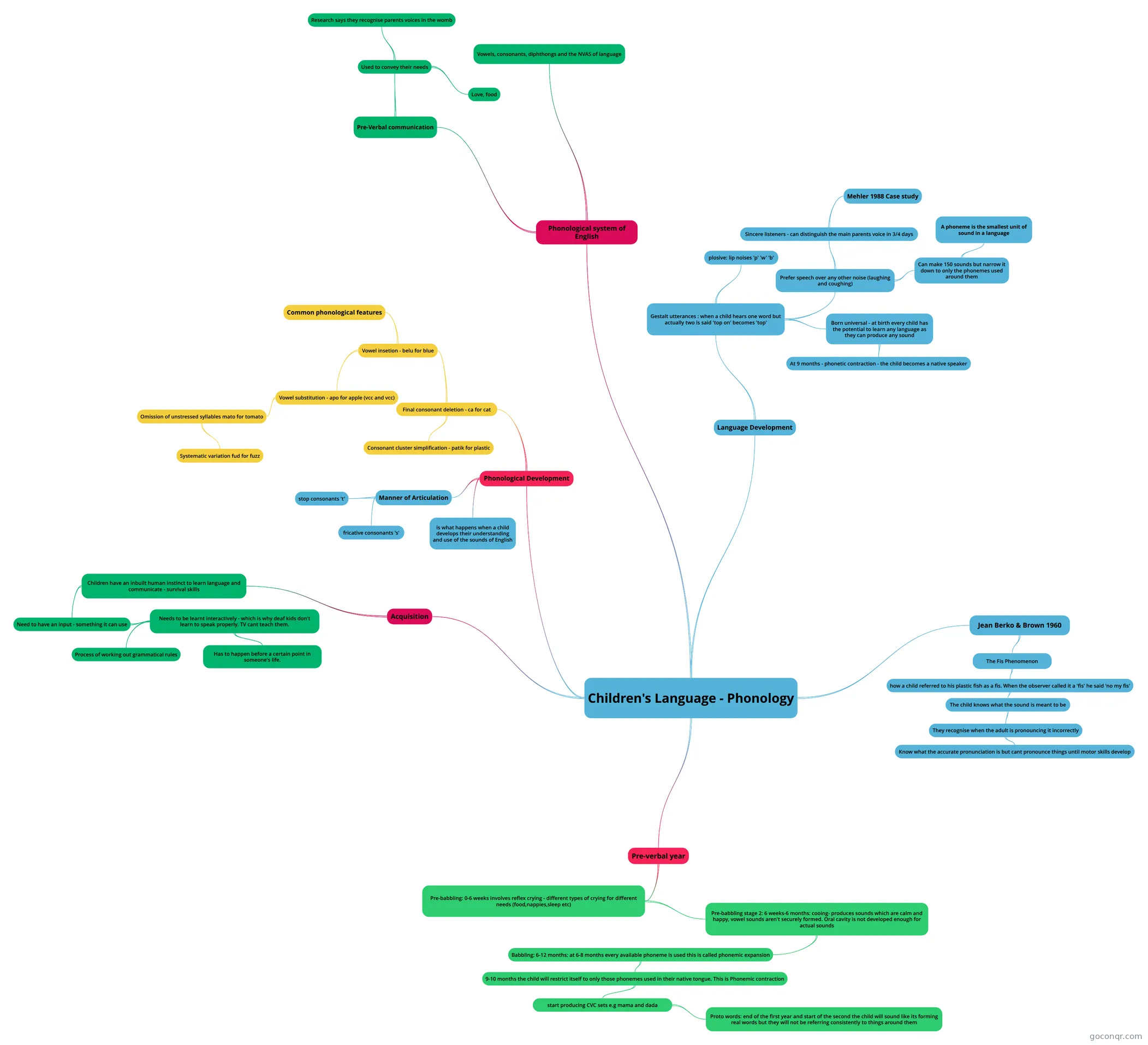
Mind map: Children's language phonology
Inhalt der Mindmap
Children's Language - Phonology
Acquisition
- Children have an inbuilt human instinct to learn language and communicate - survival skills
- Need to have an input - something it can use
- Needs to be learnt interactively - which is why deaf kids don't learn to speak properly. TV cant teach them.
- Process of working out grammatical rules
- Has to happen before a certain point in someone's life.
- Needs to be learnt interactively - which is why deaf kids don't learn to speak properly. TV cant teach them.
- Need to have an input - something it can use
- Children have an inbuilt human instinct to learn language and communicate - survival skills
Phonological system of English
- Vowels, consonants, diphthongs and the NVAS of language
- Pre-Verbal communication
- Used to convey their needs
- Love, food
- Research says they recognise parents voices in the womb
- Used to convey their needs
Phonological Development
- Final consonant deletion - ca for cat
- Consonant cluster simplification - patik for plastic
- Vowel insetion - belu for blue
- Vowel substitution - apo for apple (vcc and vcc)
- Omission of unstressed syllables mato for tomato
- Systematic variation fud for fuzz
- Omission of unstressed syllables mato for tomato
- Common phonological features
- Vowel substitution - apo for apple (vcc and vcc)
- Manner of Articulation
- fricative consonants 's'
- stop consonants 't'
- is what happens when a child develops their understanding and use of the sounds of English
- Final consonant deletion - ca for cat
Language Development
- Gestalt utterances : when a child hears one word but actually two is said 'top on' becomes 'top'
- plosive: lip noises 'p' 'w' 'b'
- Born universal - at birth every child has the potential to learn any language as they can produce any sound
- At 9 months - phonetic contraction - the child becomes a native speaker
- Prefer speech over any other noise (laughing and coughing)
- Sincere listeners - can distinguish the main parents voice in 3/4 days
- Mehler 1988 Case study
- Can make 150 sounds but narrow it down to only the phonemes used around them
- A phoneme is the smallest unit of sound in a language
- Sincere listeners - can distinguish the main parents voice in 3/4 days
- Gestalt utterances : when a child hears one word but actually two is said 'top on' becomes 'top'
Pre-verbal year
- Pre-babbling: 0-6 weeks involves reflex crying - different types of crying for different needs (food,nappies,sleep etc)
- Pre-babbling stage 2: 6 weeks-6 months: cooing- produces sounds which are calm and happy, vowel sounds aren't securely formed. Oral cavity is not developed enough for actual sounds
- Babbling: 6-12 months: at 6-8 months every available phoneme is used this is called phonemic expansion
- 9-10 months the child will restrict itself to only those phonemes used in their native tongue. This is Phonemic contraction
- start producing CVC sets e.g mama and dada
- Proto words: end of the first year and start of the second the child will sound like its forming real words but they will not be referring consistently to things around them
- start producing CVC sets e.g mama and dada
- 9-10 months the child will restrict itself to only those phonemes used in their native tongue. This is Phonemic contraction
- Babbling: 6-12 months: at 6-8 months every available phoneme is used this is called phonemic expansion
- Pre-babbling stage 2: 6 weeks-6 months: cooing- produces sounds which are calm and happy, vowel sounds aren't securely formed. Oral cavity is not developed enough for actual sounds
- Pre-babbling: 0-6 weeks involves reflex crying - different types of crying for different needs (food,nappies,sleep etc)
Jean Berko & Brown 1960
- The Fis Phenomenon
- how a child referred to his plastic fish as a fis. When the observer called it a 'fis' he said 'no my fis'
- The child knows what the sound is meant to be
- They recognise when the adult is pronouncing it incorrectly
- Know what the accurate pronunciation is but cant pronounce things until motor skills develop
- They recognise when the adult is pronouncing it incorrectly
- The child knows what the sound is meant to be
- how a child referred to his plastic fish as a fis. When the observer called it a 'fis' he said 'no my fis'
- The Fis Phenomenon
Informationen
- Beschreibung
- English Paper 1 Mindmap am Children's Language - Phonology, erstellt von Abbie Jones am 19/04/2017.
- Erstellt von
- Abbie Jones
- Aufrufe
- 3
- Bewertung