
Mindmap
BIO 189
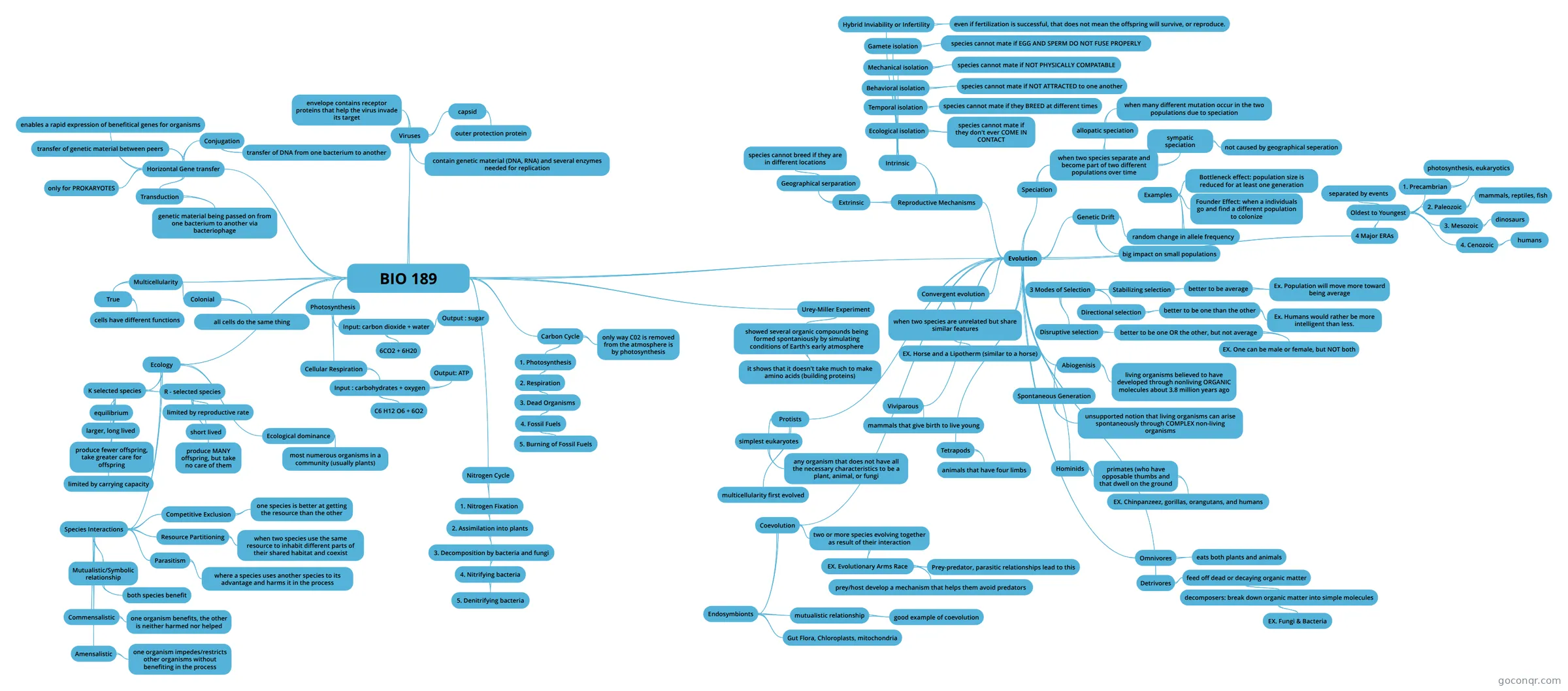
Mind map: BIO 189 biology
Inhalt der Mindmap
BIO 189
Evolution
- Genetic Drift
- random change in allele frequency
- Examples
- Bottleneck effect: population size is reduced for at least one generation
- Founder Effect: when a individuals go and find a different population to colonize
- Examples
- big impact on small populations
- random change in allele frequency
- 3 Modes of Selection
- Stabilizing selection
- better to be average
- Ex. Population will move more toward being average
- better to be average
- Directional selection
- better to be one than the other
- Ex. Humans would rather be more intelligent than less.
- better to be one than the other
- Disruptive selection
- better to be one OR the other, but not average
- EX. One can be male or female, but NOT both
- better to be one OR the other, but not average
- Stabilizing selection
- Speciation
- when two species separate and become part of two different populations over time
- allopatic speciation
- when many different mutation occur in the two populations due to speciation
- sympatic speciation
- not caused by geographical seperation
- allopatic speciation
- when two species separate and become part of two different populations over time
- Reproductive Mechanisms
- Extrinsic
- Geographical serparation
- species cannot breed if they are in different locations
- Geographical serparation
- Intrinsic
- Ecological isolation
- species cannot mate if they don't ever COME IN CONTACT
- Temporal isolation
- species cannot mate if they BREED at different times
- Behavioral isolation
- species cannot mate if NOT ATTRACTED to one another
- Mechanical isolation
- species cannot mate if NOT PHYSICALLY COMPATABLE
- Gamete isolation
- species cannot mate if EGG AND SPERM DO NOT FUSE PROPERLY
- Hybrid Inviability or Infertility
- even if fertilization is successful, that does not mean the offspring will survive, or reproduce.
- Ecological isolation
- Extrinsic
- Convergent evolution
- when two species are unrelated but share similar features
- EX. Horse and a Lipotherm (similar to a horse)
- when two species are unrelated but share similar features
- Abiogenisis
- living organisms believed to have developed through nonliving ORGANIC molecules about 3.8 million years ago
- Spontaneous Generation
- unsupported notion that living organisms can arise spontaneously through COMPLEX non-living organisms
- 4 Major ERAs
- Oldest to Youngest
- 1. Precambrian
- photosynthesis, eukaryotics
- 2. Paleozoic
- mammals, reptiles, fish
- 3. Mesozoic
- dinosaurs
- 4. Cenozoic
- humans
- separated by events
- 1. Precambrian
- Oldest to Youngest
- Viviparous
- mammals that give birth to live young
- Tetrapods
- animals that have four limbs
- Hominids
- primates (who have opposable thumbs and that dwell on the ground
- EX. Chinpanzeez, gorillas, orangutans, and humans
- primates (who have opposable thumbs and that dwell on the ground
- Protists
- simplest eukaryotes
- any organism that does not have all the necessary characteristics to be a plant, animal, or fungi
- multicellularity first evolved
- simplest eukaryotes
- Coevolution
- two or more species evolving together as result of their interaction
- EX. Evolutionary Arms Race
- Prey-predator, parasitic relationships lead to this
- prey/host develop a mechanism that helps them avoid predators
- EX. Evolutionary Arms Race
- Endosymbionts
- mutualistic relationship
- good example of coevolution
- Gut Flora, Chloroplasts, mitochondria
- mutualistic relationship
- two or more species evolving together as result of their interaction
- Omnivores
- eats both plants and animals
- Detrivores
- feed off dead or decaying organic matter
- decomposers: break down organic matter into simple molecules
- EX. Fungi & Bacteria
- decomposers: break down organic matter into simple molecules
- feed off dead or decaying organic matter
- Genetic Drift
Urey-Miller Experiment
- showed several organic compounds being formed spontaniously by simulating conditions of Earth's early atmosphere
- it shows that it doesn't take much to make amino acids (building proteins)
- showed several organic compounds being formed spontaniously by simulating conditions of Earth's early atmosphere
Viruses
- capsid
- outer protection protein
- contain genetic material (DNA, RNA) and several enzymes needed for replication
- envelope contains receptor proteins that help the virus invade its target
- capsid
Horizontal Gene transfer
- Transduction
- genetic material being passed on from one bacterium to another via bacteriophage
- Conjugation
- transfer of DNA from one bacterium to another
- transfer of genetic material between peers
- enables a rapid expression of benefitical genes for organisms
- only for PROKARYOTES
- Transduction
Multicellularity
- Colonial
- all cells do the same thing
- True
- cells have different functions
- Colonial
Photosynthesis
- Input: carbon dioxide + water
- Output : sugar
- 6CO2 + 6H20
- Cellular Respiration
- Input : carbohydrates + oxygen
- Output: ATP
- C6 H12 O6 + 6O2
- Input : carbohydrates + oxygen
- Input: carbon dioxide + water
Ecology
- K selected species
- R - selected species
- limited by reproductive rate
- short lived
- produce MANY offspring, but take no care of them
- equilibrium
- larger, long lived
- produce fewer offspring, take greater care for offspring
- limited by carrying capacity
- R - selected species
- Ecological dominance
- most numerous organisms in a community (usually plants)
- Species Interactions
- Competitive Exclusion
- one species is better at getting the resource than the other
- Resource Partitioning
- when two species use the same resource to inhabit different parts of their shared habitat and coexist
- Parasitism
- where a species uses another species to its advantage and harms it in the process
- Mutualistic/Symbolic relationship
- both species benefit
- Commensalistic
- one organism benefits, the other is neither harmed nor helped
- Amensalistic
- one organism impedes/restricts other organisms without benefiting in the process
- Competitive Exclusion
- K selected species
Carbon Cycle
- 1. Photosynthesis
- 2. Respiration
- 3. Dead Organisms
- 4. Fossil Fuels
- 5. Burning of Fossil Fuels
- 4. Fossil Fuels
- 3. Dead Organisms
- 2. Respiration
- only way C02 is removed from the atmosphere is by photosynthesis
- 1. Photosynthesis
Nitrogen Cycle
- 1. Nitrogen Fixation
- 2. Assimilation into plants
- 3. Decomposition by bacteria and fungi
- 4. Nitrifying bacteria
- 5. Denitrifying bacteria
- 4. Nitrifying bacteria
- 3. Decomposition by bacteria and fungi
- 2. Assimilation into plants
- 1. Nitrogen Fixation
Informationen
- Beschreibung
- BIO 189 FINAL EXAM - Cumulative - Mindmap am BIO 189, erstellt von Kurtis Oriez am 04/05/2017.
- Erstellt von
- Kurtis Oriez
- Aufrufe
- 1
- Bewertung