
Mindmap
Euthanasia
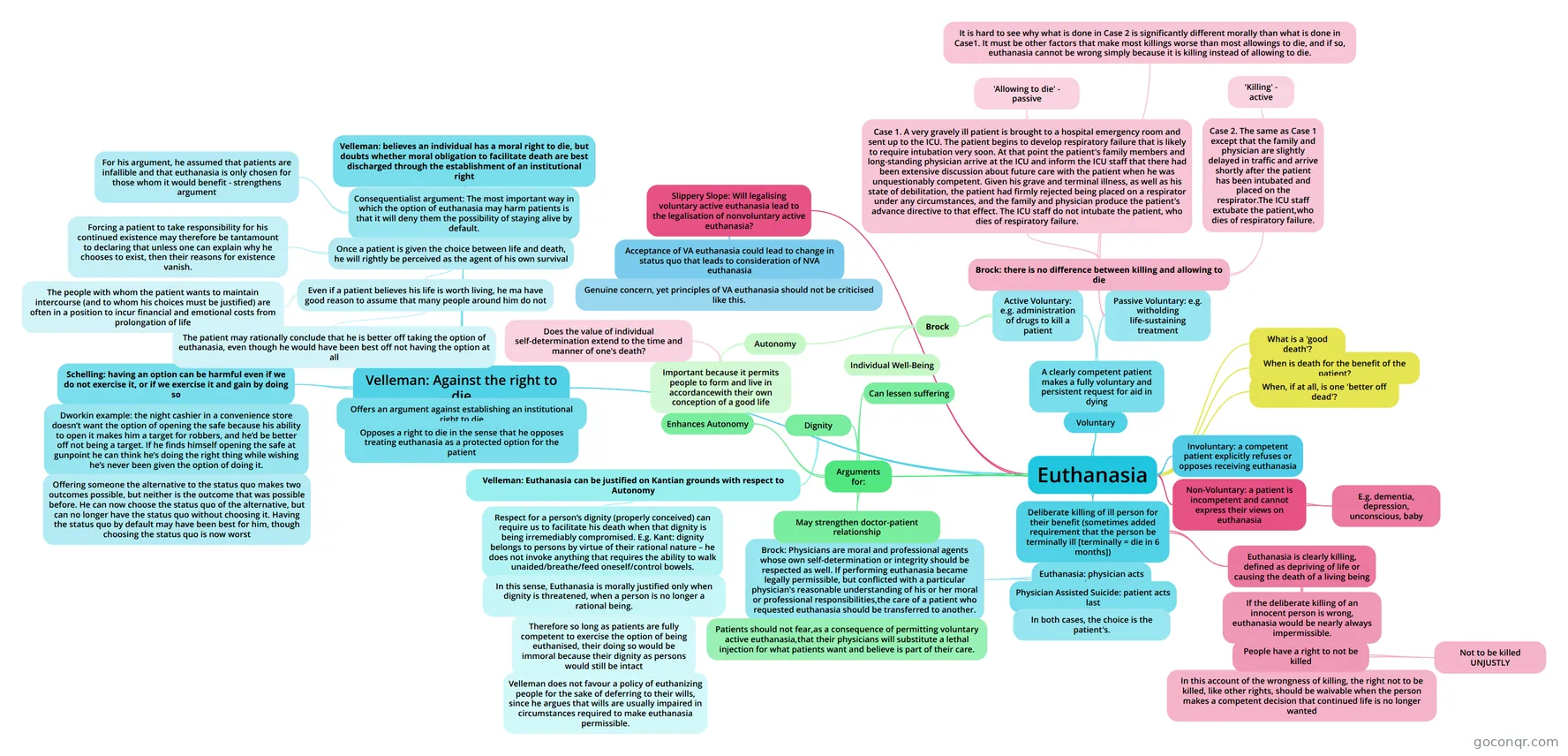
Mind map: Euthanasia
Inhalt der Mindmap
Euthanasia
Deliberate killing of ill person for their benefit (sometimes added requirement that the person be terminally ill [terminally = die in 6 months])
- Euthanasia: physician acts last
- Brock: Physicians are moral and professional agents whose own self-determination or integrity should be respected as well. If performing euthanasia became legally permissible, but conflicted with a particular physician's reasonable understanding of his or her moral or professional responsibilities,the care of a patient who requested euthanasia should be transferred to another.
- Physician Assisted Suicide: patient acts last
- In both cases, the choice is the patient's.
- Euthanasia is clearly killing, defined as depriving of life or causing the death of a living being
- If the deliberate killing of an innocent person is wrong, euthanasia would be nearly always impermissible.
- People have a right to not be killed
- In this account of the wrongness of killing, the right not to be killed, like other rights, should be waivable when the person makes a competent decision that continued life is no longer wanted
- Not to be killed UNJUSTLY
- Euthanasia: physician acts last
Voluntary
- A clearly competent patient makes a fully voluntary and persistent request for aid in dying
- Active Voluntary: e.g. administration of drugs to kill a patient
- Brock
- Autonomy
- Important because it permits people to form and live in accordancewith their own conception of a good life
- Does the value of individual self-determination extend to the time and manner of one's death?
- Important because it permits people to form and live in accordancewith their own conception of a good life
- Individual Well-Being
- Autonomy
- Brock
- Passive Voluntary: e.g. witholding life-sustaining treatment
- Brock: there is no difference between killing and allowing to die
- Case 1. A very gravely ill patient is brought to a hospital emergency room and sent up to the ICU. The patient begins to develop respiratory failure that is likely to require intubation very soon. At that point the patient's family members and long-standing physician arrive at the ICU and inform the ICU staff that there had been extensive discussion about future care with the patient when he was unquestionably competent. Given his grave and terminal illness, as well as his state of debilitation, the patient had firmly rejected being placed on a respirator under any circumstances, and the family and physician produce the patient's advance directive to that effect. The ICU staff do not intubate the patient, who dies of respiratory failure.
- 'Allowing to die' - passive
- Case 2. The same as Case 1 except that the family and physician are slightly delayed in traffic and arrive shortly after the patient has been intubated and placed on the respirator.The ICU staff extubate the patient,who dies of respiratory failure.
- 'Killing' - active
- It is hard to see why what is done in Case 2 is significantly different morally than what is done in Case1. It must be other factors that make most killings worse than most allowings to die, and if so, euthanasia cannot be wrong simply because it is killing instead of allowing to die.
- Case 1. A very gravely ill patient is brought to a hospital emergency room and sent up to the ICU. The patient begins to develop respiratory failure that is likely to require intubation very soon. At that point the patient's family members and long-standing physician arrive at the ICU and inform the ICU staff that there had been extensive discussion about future care with the patient when he was unquestionably competent. Given his grave and terminal illness, as well as his state of debilitation, the patient had firmly rejected being placed on a respirator under any circumstances, and the family and physician produce the patient's advance directive to that effect. The ICU staff do not intubate the patient, who dies of respiratory failure.
- Brock: there is no difference between killing and allowing to die
- Active Voluntary: e.g. administration of drugs to kill a patient
- A clearly competent patient makes a fully voluntary and persistent request for aid in dying
Involuntary: a competent patient explicitly refuses or opposes receiving euthanasia
Non-Voluntary: a patient is incompetent and cannot express their views on euthanasia
- E.g. dementia, depression, unconscious, baby
Arguments for:
- Enhances Autonomy
- Can lessen suffering
- May strengthen doctor-patient relationship
- Patients should not fear,as a consequence of permitting voluntary active euthanasia,that their physicians will substitute a lethal injection for what patients want and believe is part of their care.
- Dignity
- Velleman: Euthanasia can be justified on Kantian grounds with respect to Autonomy
- Respect for a person’s dignity (properly conceived) can require us to facilitate his death when that dignity is being irremediably compromised. E.g. Kant: dignity belongs to persons by virtue of their rational nature – he does not invoke anything that requires the ability to walk unaided/breathe/feed oneself/control bowels.
- In this sense, Euthanasia is morally justified only when dignity is threatened, when a person is no longer a rational being.
- Therefore so long as patients are fully competent to exercise the option of being euthanised, their doing so would be immoral because their dignity as persons would still be intact
- Velleman does not favour a policy of euthanizing people for the sake of deferring to their wills, since he argues that wills are usually impaired in circumstances required to make euthanasia permissible.
- In this sense, Euthanasia is morally justified only when dignity is threatened, when a person is no longer a rational being.
- Respect for a person’s dignity (properly conceived) can require us to facilitate his death when that dignity is being irremediably compromised. E.g. Kant: dignity belongs to persons by virtue of their rational nature – he does not invoke anything that requires the ability to walk unaided/breathe/feed oneself/control bowels.
- Velleman: Euthanasia can be justified on Kantian grounds with respect to Autonomy
What is a 'good death'?
When is death for the benefit of the patient?
When, if at all, is one 'better off dead'?
Slippery Slope: Will legalising voluntary active euthanasia lead to the legalisation of nonvoluntary active euthanasia?
- Acceptance of VA euthanasia could lead to change in status quo that leads to consideration of NVA euthanasia
- Genuine concern, yet principles of VA euthanasia should not be criticised like this.
- Acceptance of VA euthanasia could lead to change in status quo that leads to consideration of NVA euthanasia
Velleman: Against the right to die
- Offers an argument against establishing an institutional right to die
- Velleman: believes an individual has a moral right to die, but doubts whether moral obligation to facilitate death are best discharged through the establishment of an institutional right
- Consequentialist argument: The most important way in which the option of euthanasia may harm patients is that it will deny them the possibility of staying alive by default.
- For his argument, he assumed that patients are infallible and that euthanasia is only chosen for those whom it would benefit - strengthens argument
- Once a patient is given the choice between life and death, he will rightly be perceived as the agent of his own survival
- Forcing a patient to take responsibility for his continued existence may therefore be tantamount to declaring that unless one can explain why he chooses to exist, then their reasons for existence vanish.
- Even if a patient believes his life is worth living, he ma have good reason to assume that many people around him do not
- The people with whom the patient wants to maintain intercourse (and to whom his choices must be justified) are often in a position to incur financial and emotional costs from prolongation of life
- The patient may rationally conclude that he is better off taking the option of euthanasia, even though he would have been best off not having the option at all
- Consequentialist argument: The most important way in which the option of euthanasia may harm patients is that it will deny them the possibility of staying alive by default.
- Opposes a right to die in the sense that he opposes treating euthanasia as a protected option for the patient
- Schelling: having an option can be harmful even if we do not exercise it, or if we exercise it and gain by doing so
- Dworkin example: the night cashier in a convenience store doesn’t want the option of opening the safe because his ability to open it makes him a target for robbers, and he’d be better off not being a target. If he finds himself opening the safe at gunpoint he can think he’s doing the right thing while wishing he’s never been given the option of doing it.
- Offering someone the alternative to the status quo makes two outcomes possible, but neither is the outcome that was possible before. He can now choose the status quo of the alternative, but can no longer have the status quo without choosing it. Having the status quo by default may have been best for him, though choosing the status quo is now worst
- Dworkin example: the night cashier in a convenience store doesn’t want the option of opening the safe because his ability to open it makes him a target for robbers, and he’d be better off not being a target. If he finds himself opening the safe at gunpoint he can think he’s doing the right thing while wishing he’s never been given the option of doing it.
Informationen
- Beschreibung
- Mindmap am Euthanasia, erstellt von giuliahsimone am 18/05/2014.
- Erstellt von
- giuliahsimone
- Aufrufe
- 26
- Bewertung
Mehr zu Euthanasia and Assisted Suicide