
Mindmap
Psychology: Memory
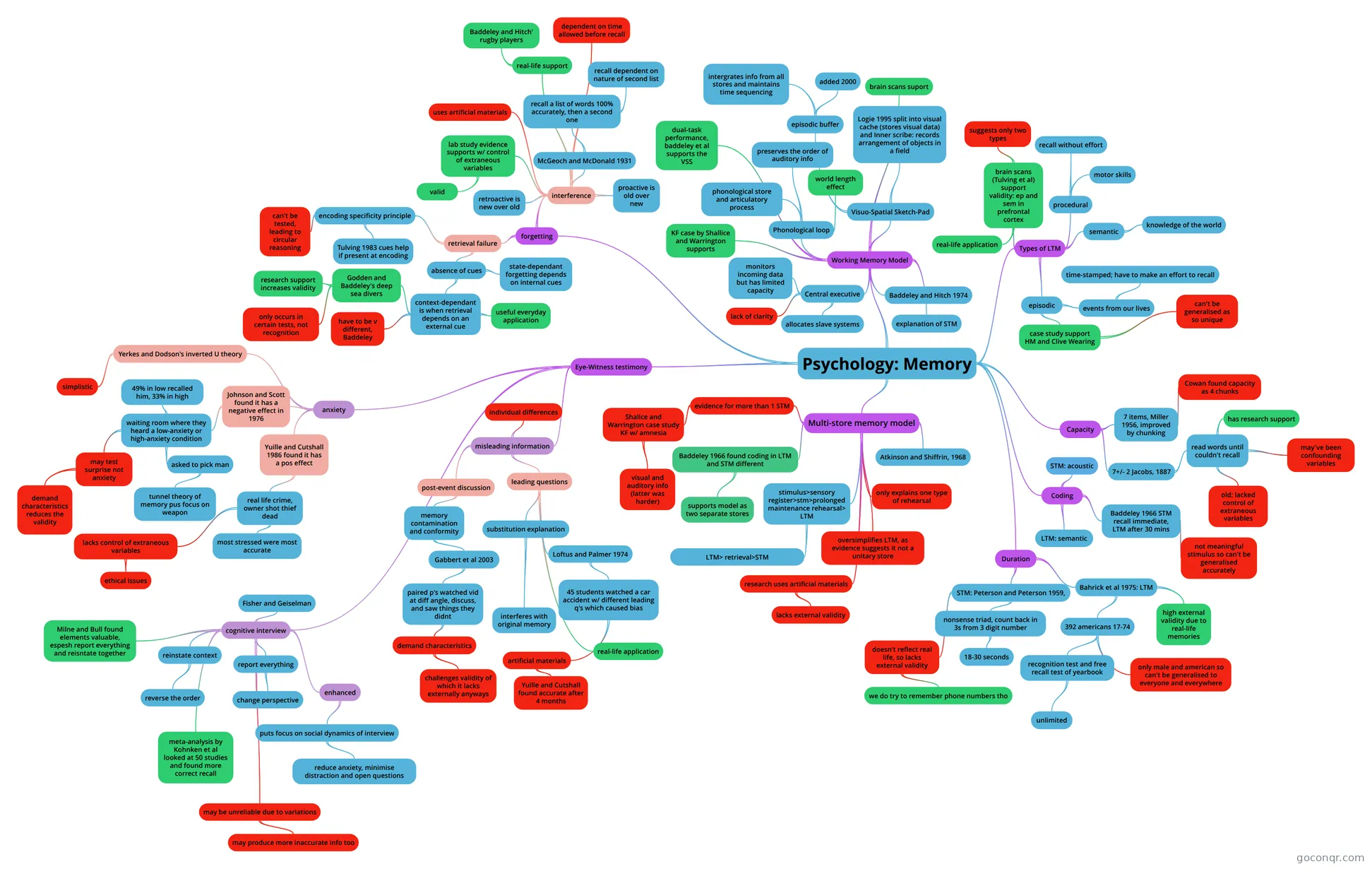
Mind map: Psychology memory
Inhalt der Mindmap
Psychology: Memory
Multi-store memory model
- Atkinson and Shiffrin, 1968
- stimulus>sensory register>stm>prolonged maintenance rehearsal> LTM
- LTM> retrieval>STM
- evidence for more than 1 STM
- Shalice and Warrington case study KF w/ amnesia
- visual and auditory info (latter was harder)
- Shalice and Warrington case study KF w/ amnesia
- only explains one type of rehearsal
- research uses artificial materials
- lacks external validity
- oversimplifies LTM, as evidence suggests it not a unitary store
- Baddeley 1966 found coding in LTM and STM different
- supports model as two separate stores
Coding
- STM: acoustic
- LTM: semantic
- Baddeley 1966 STM recall immediate, LTM after 30 mins
- not meaningful stimulus so can't be generalised accurately
Capacity
- 7+/- 2 Jacobs, 1887
- read words until couldn't recall
- old; lacked control of extraneous variables
- may've been confounding variables
- has research support
- read words until couldn't recall
- 7 items, Miller 1956, improved by chunking
- Cowan found capacity as 4 chunks
- 7+/- 2 Jacobs, 1887
Duration
- STM: Peterson and Peterson 1959,
- nonsense triad, count back in 3s from 3 digit number
- 18-30 seconds
- doesn't reflect real life, so lacks external validity
- we do try to remember phone numbers tho
- nonsense triad, count back in 3s from 3 digit number
- Bahrick et al 1975: LTM
- 392 americans 17-74
- recognition test and free recall test of yearbook
- unlimited
- only male and american so can't be generalised to everyone and everywhere
- recognition test and free recall test of yearbook
- high external validity due to real-life memories
- 392 americans 17-74
- STM: Peterson and Peterson 1959,
Types of LTM
- episodic
- events from our lives
- time-stamped; have to make an effort to recall
- case study support HM and Clive Wearing
- can't be generalised as so unique
- events from our lives
- semantic
- knowledge of the world
- procedural
- motor skills
- recall without effort
- brain scans (Tulving et al) support validity: ep and sem in prefrontal cortex
- real-life application
- suggests only two types
- episodic
Working Memory Model
- Baddeley and Hitch 1974
- Central executive
- allocates slave systems
- monitors incoming data but has limited capacity
- lack of clarity
- explanation of STM
- Phonological loop
- phonological store and articulatory process
- preserves the order of auditory info
- world length effect
- Visuo-Spatial Sketch-Pad
- Logie 1995 split into visual cache (stores visual data) and Inner scribe: records arrangement of objects in a field
- episodic buffer
- added 2000
- intergrates info from all stores and maintains time sequencing
- KF case by Shallice and Warrington supports
- dual-task performance, baddeley et al supports the VSS
- brain scans suport
forgetting
- interference
- McGeoch and McDonald 1931
- recall a list of words 100% accurately, then a second one
- recall dependent on nature of second list
- recall a list of words 100% accurately, then a second one
- proactive is old over new
- retroactive is new over old
- lab study evidence supports w/ control of extraneous variables
- valid
- uses artificial materials
- real-life support
- Baddeley and Hitch' rugby players
- dependent on time allowed before recall
- McGeoch and McDonald 1931
- retrieval failure
- absence of cues
- context-dependant is when retrieval depends on an external cue
- Godden and Baddeley's deep sea divers
- research support increases validity
- only occurs in certain tests, not recognition
- have to be v different, Baddeley
- useful everyday application
- Godden and Baddeley's deep sea divers
- state-dependant forgetting depends on internal cues
- context-dependant is when retrieval depends on an external cue
- encoding specificity principle
- Tulving 1983 cues help if present at encoding
- can't be tested, leading to circular reasoning
- absence of cues
- interference
Eye-Witness testimony
- misleading information
- leading questions
- substitution explanation
- interferes with original memory
- Loftus and Palmer 1974
- 45 students watched a car accident w/ different leading q's which caused bias
- artificial materials
- Yuille and Cutshall found accurate after 4 months
- artificial materials
- 45 students watched a car accident w/ different leading q's which caused bias
- real-life application
- substitution explanation
- post-event discussion
- memory contamination and conformity
- Gabbert et al 2003
- paired p's watched vid at diff angle, discuss, and saw things they didnt
- demand characteristics
- challenges validity of which it lacks externally anyways
- demand characteristics
- paired p's watched vid at diff angle, discuss, and saw things they didnt
- Gabbert et al 2003
- memory contamination and conformity
- individual differences
- leading questions
- anxiety
- Johnson and Scott found it has a negative effect in 1976
- waiting room where they heard a low-anxiety or high-anxiety condition
- asked to pick man
- tunnel theory of memory pus focus on weapon
- 49% in low recalled him, 33% in high
- may test surprise not anxiety
- demand characteristics reduces the validity
- asked to pick man
- waiting room where they heard a low-anxiety or high-anxiety condition
- Yuille and Cutshall 1986 found it has a pos effect
- real life crime, owner shot thief dead
- most stressed were most accurate
- lacks control of extraneous variables
- ethical issues
- real life crime, owner shot thief dead
- Yerkes and Dodson's inverted U theory
- simplistic
- Johnson and Scott found it has a negative effect in 1976
- cognitive interview
- report everything
- change perspective
- reinstate context
- reverse the order
- Fisher and Geiselman
- enhanced
- puts focus on social dynamics of interview
- reduce anxiety, minimise distraction and open questions
- puts focus on social dynamics of interview
- Milne and Bull found elements valuable, espesh report everything and reisntate together
- meta-analysis by Kohnken et al looked at 50 studies and found more correct recall
- may be unreliable due to variations
- may produce more inaccurate info too
- report everything
- misleading information
Informationen
- Beschreibung
- Mindmap am Psychology: Memory, erstellt von Megan West am 15/05/2017.
- Erstellt von
- Megan West
- Aufrufe
- 0
- Bewertung