
Mindmap
Victimology
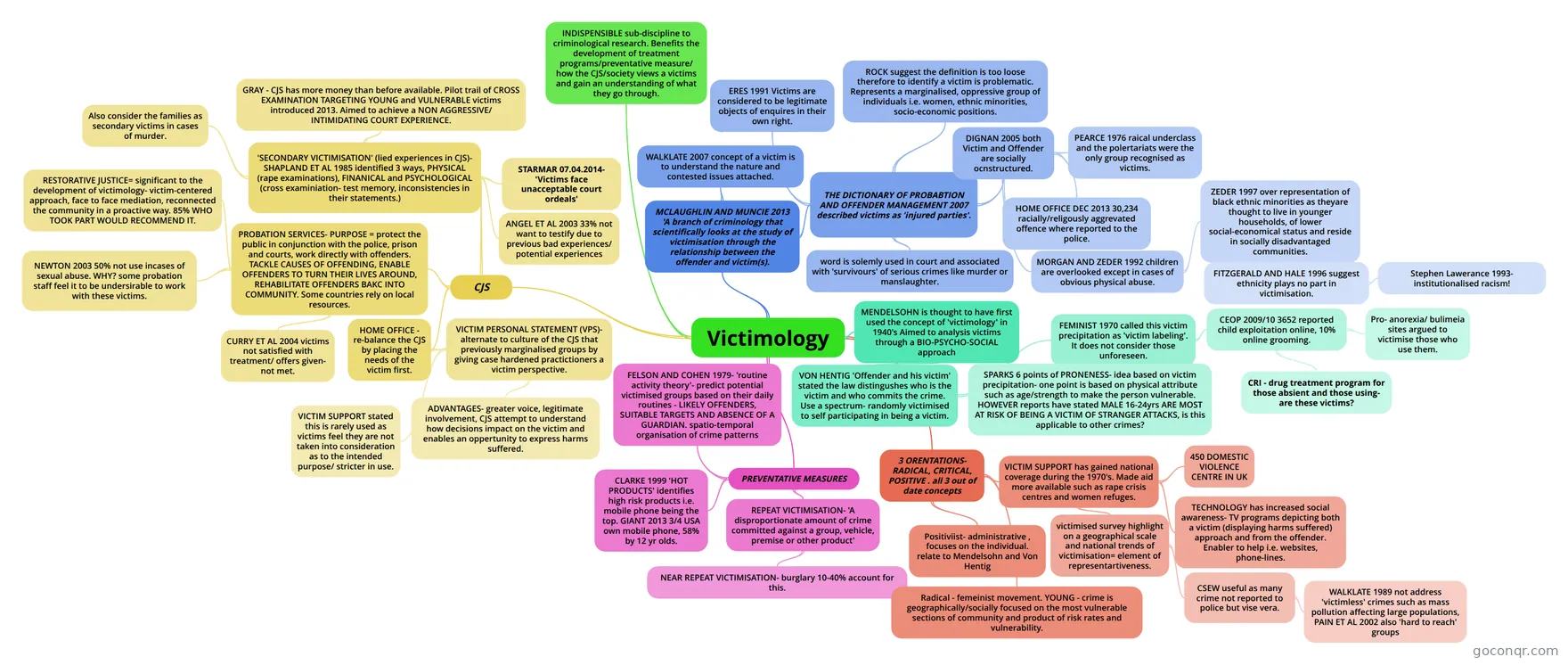
Mind map: Victimology
Inhalt der Mindmap
Victimology
MCLAUGHLIN AND MUNCIE 2013 'A branch of criminology that scientifically looks at the study of victimisation through the relationship between the offender and victim(s).
- THE DICTIONARY OF PROBABTION AND OFFENDER MANAGEMENT 2007 described victims as 'injured parties'.
- word is solemly used in court and associated with 'survivours' of serious crimes like murder or manslaughter.
- ERES 1991 Victims are considered to be legitimate objects of enquires in their own right.
- ROCK suggest the definition is too loose therefore to identify a victim is problematic. Represents a marginalised, oppressive group of individuals i.e. women, ethnic minorities, socio-economic positions.
- DIGNAN 2005 both Victim and Offender are socially ocnstructured.
- PEARCE 1976 raical underclass and the polertariats were the only group recognised as victims.
- MORGAN AND ZEDER 1992 children are overlooked except in cases of obvious physical abuse.
- ZEDER 1997 over representation of black ethnic minorities as theyare thought to live in younger households, of lower social-economical status and reside in socially disadvantaged communities.
- FITZGERALD AND HALE 1996 suggest ethnicity plays no part in victimisation.
- Stephen Lawerance 1993- institutionalised racism!
- FITZGERALD AND HALE 1996 suggest ethnicity plays no part in victimisation.
- ZEDER 1997 over representation of black ethnic minorities as theyare thought to live in younger households, of lower social-economical status and reside in socially disadvantaged communities.
- HOME OFFICE DEC 2013 30,234 racially/religously aggrevated offence where reported to the police.
- WALKLATE 2007 concept of a victim is to understand the nature and contested issues attached.
- THE DICTIONARY OF PROBABTION AND OFFENDER MANAGEMENT 2007 described victims as 'injured parties'.
MENDELSOHN is thought to have first used the concept of 'victimology' in 1940's Aimed to analysis victims through a BIO-PSYCHO-SOCIAL approach
- VON HENTIG 'Offender and his victim' stated the law distingushes who is the victim and who commits the crime. Use a spectrum- randomly victimised to self participating in being a victim.
- FEMINIST 1970 called this victim precipitation as 'victim labeling'. It does not consider those unforeseen.
- CEOP 2009/10 3652 reported child exploitation online, 10% online grooming.
- Pro- anorexia/ bulimeia sites argued to victimise those who use them.
- CRI - drug treatment program for those absient and those using- are these victims?
- SPARKS 6 points of PRONENESS- idea based on victim precipitation- one point is based on physical attribute such as age/strength to make the person vulnerable. HOWEVER reports have stated MALE 16-24yrs ARE MOST AT RISK OF BEING A VICTIM OF STRANGER ATTACKS, is this applicable to other crimes?
- CEOP 2009/10 3652 reported child exploitation online, 10% online grooming.
- FEMINIST 1970 called this victim precipitation as 'victim labeling'. It does not consider those unforeseen.
- VON HENTIG 'Offender and his victim' stated the law distingushes who is the victim and who commits the crime. Use a spectrum- randomly victimised to self participating in being a victim.
3 ORENTATIONS- RADICAL, CRITICAL, POSITIVE . all 3 out of date concepts
- VICTIM SUPPORT has gained national coverage during the 1970's. Made aid more available such as rape crisis centres and women refuges.
- 450 DOMESTIC VIOLENCE CENTRE IN UK
- TECHNOLOGY has increased social awareness- TV programs depicting both a victim (displaying harms suffered) approach and from the offender. Enabler to help i.e. websites, phone-lines.
- victimised survey highlight on a geographical scale and national trends of victimisation= element of representartiveness.
- CSEW useful as many crime not reported to police but vise vera.
- WALKLATE 1989 not address 'victimless' crimes such as mass pollution affecting large populations, PAIN ET AL 2002 also 'hard to reach' groups
- CSEW useful as many crime not reported to police but vise vera.
- Positiviist- administrative , focuses on the individual. relate to Mendelsohn and Von Hentig
- Radical - femeinist movement. YOUNG - crime is geographically/socially focused on the most vulnerable sections of community and product of risk rates and vulnerability.
- VICTIM SUPPORT has gained national coverage during the 1970's. Made aid more available such as rape crisis centres and women refuges.
PREVENTATIVE MEASURES
- FELSON AND COHEN 1979- 'routine activity theory'- predict potential victimised groups based on their daily routines - LIKELY OFFENDERS, SUITABLE TARGETS AND ABSENCE OF A GUARDIAN. spatio-temporal organisation of crime patterns
- CLARKE 1999 'HOT PRODUCTS' identifies high risk products i.e. mobile phone being the top. GIANT 2013 3/4 USA own mobile phone, 58% by 12 yr olds.
- REPEAT VICTIMISATION- 'A disproportionate amount of crime committed against a group, vehicle, premise or other product'
- NEAR REPEAT VICTIMISATION- burglary 10-40% account for this.
CJS
- 'SECONDARY VICTIMISATION' (lied experiences in CJS)- SHAPLAND ET AL 1985 identified 3 ways, PHYSICAL (rape examinations), FINANICAL and PSYCHOLOGICAL (cross examiniation- test memory, inconsistencies in their statements.)
- ANGEL ET AL 2003 33% not want to testify due to previous bad experiences/ potential experiences
- STARMAR 07.04.2014- 'Victims face unacceptable court ordeals'
- GRAY - CJS has more money than before available. Pilot trail of CROSS EXAMINATION TARGETING YOUNG and VULNERABLE victims introduced 2013. Aimed to achieve a NON AGGRESSIVE/ INTIMIDATING COURT EXPERIENCE.
- Also consider the families as secondary victims in cases of murder.
- HOME OFFICE - re-balance the CJS by placing the needs of the victim first.
- VICTIM PERSONAL STATEMENT (VPS)- alternate to culture of the CJS that previously marginalised groups by giving case hardened practictioners a victim perspective.
- ADVANTAGES- greater voice, legitimate involvement, CJS attempt to understand how decisions impact on the victim and enables an oppertunity to express harms suffered.
- VICTIM SUPPORT stated this is rarely used as victims feel they are not taken into consideration as to the intended purpose/ stricter in use.
- VICTIM PERSONAL STATEMENT (VPS)- alternate to culture of the CJS that previously marginalised groups by giving case hardened practictioners a victim perspective.
- PROBATION SERVICES- PURPOSE = protect the public in conjunction with the police, prison and courts, work directly with offenders. TACKLE CAUSES OF OFFENDING, ENABLE OFFENDERS TO TURN THEIR LIVES AROUND, REHABILITATE OFFENDERS BAKC INTO COMMUNITY. Some countries rely on local resources.
- CURRY ET AL 2004 victims not satisfied with treatment/ offers given- not met.
- NEWTON 2003 50% not use incases of sexual abuse. WHY? some probation staff feel it to be undersirable to work with these victims.
- RESTORATIVE JUSTICE= significant to the development of victimology- victim-centered approach, face to face mediation, reconnected the community in a proactive way. 85% WHO TOOK PART WOULD RECOMMEND IT.
- 'SECONDARY VICTIMISATION' (lied experiences in CJS)- SHAPLAND ET AL 1985 identified 3 ways, PHYSICAL (rape examinations), FINANICAL and PSYCHOLOGICAL (cross examiniation- test memory, inconsistencies in their statements.)
INDISPENSIBLE sub-discipline to criminological research. Benefits the development of treatment programs/preventative measure/ how the CJS/society views a victims and gain an understanding of what they go through.
Informationen
- Beschreibung
- Mindmap am Victimology, erstellt von millsv am 19/05/2014.
- Erstellt von
- millsv
- Aufrufe
- 35
- Bewertung