
Crime and Deviance
215 resources created by 146 users
This Crime and Deviance page on GoConqr gathers community-made mind maps, flashcards, quizzes and notes, from functionalist and labelling theory to ethnicity, gender and white collar crime. It's built for school students, university students and professional candidates revising theories and key terms, and for teachers after ready-made material. There are over 1,200 resources here, including more than 800 mind maps, more than 300 flashcards and more than 50 quizzes, with GCSE and A-level Sociology material alongside university study guides. Pick a theory, then test yourself.
Top Crime and Deviance resources
-
77 cardsCrime and Deviance key Words
-
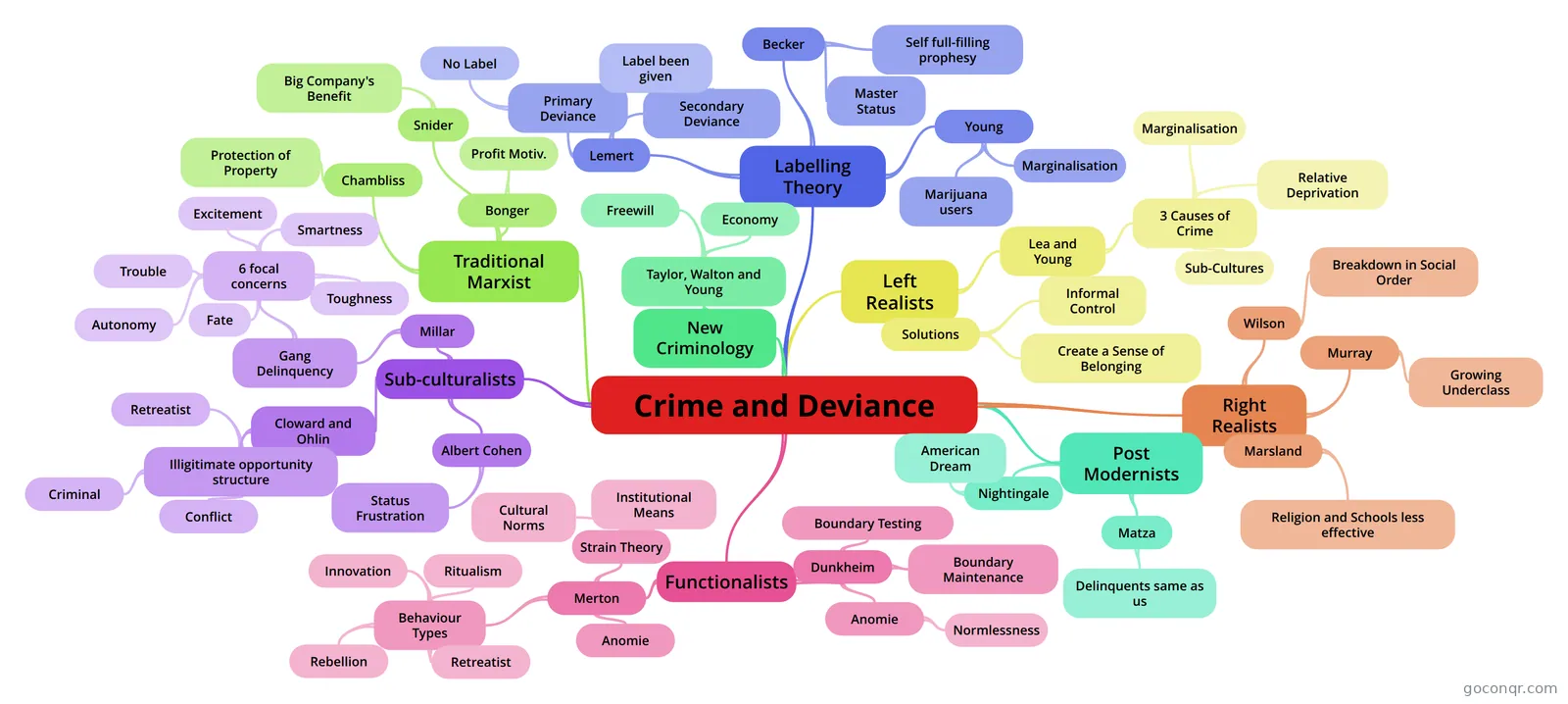 Mind map Crime and Deviance
-
73 cardsFlashcards on Gender and Crime (1.7) Which two sociologists point out that official statistics on gender and crime have remained largely the sam...
-
60 cardsFlashcards on Functionalist, Strain and Subcultural Theories (1.1) Emile Durkheim was of the opinion that every society shares a set of core values. How does he refer to this?
-
38 cards6. Realist Explanations of Crime and Deviance What are the two branches of realism?
-
34 cardsCrime and Deviance Quiz What is the difference between crime and deviance?
-
33 cardsModule 3: Study Guide SOC 3043.50 Deviant Behavior and Social Control Module 3: Study Guide
-
 Mind map Sociological Positivism: Anomie, the Chicago School and Subcultures
Quizzes
See all 15 quizzes-
33 questionsSexuality & Deviance in Society
-
20 questionsIntro to Sociology - Module 3 Ally's father was sent to prison when she was 12 for the trafficking of narcotics; her brother was arrested...
-
33 questionsWeek One Chapters 1-5 Social scientists have survey research, experimental design, historical methods, official statistics, and f...
-
8 questionsfunctionalist responses to crime and deviance Who was the founding father of Functionalism?
-
8 questionsFunctionalist perspective on crime and deviance - SUMMARY The Functionalist perspective of crime and deviance is:
-
14 questionsGender and Crime Questions Who came up with the concepts of 'Class Deals' and 'Gender Deals?'
-
5 questionsDeviance Quiz Is dying one's hair green considered an act of deviance?
-
50 questionsLabelling Theory & Action Theories SCLY4 Labelling theorists believe that 'deviance' is a social construction - Becker (1963) E.G. killing an indivi...
Mind maps
See all 117 mind maps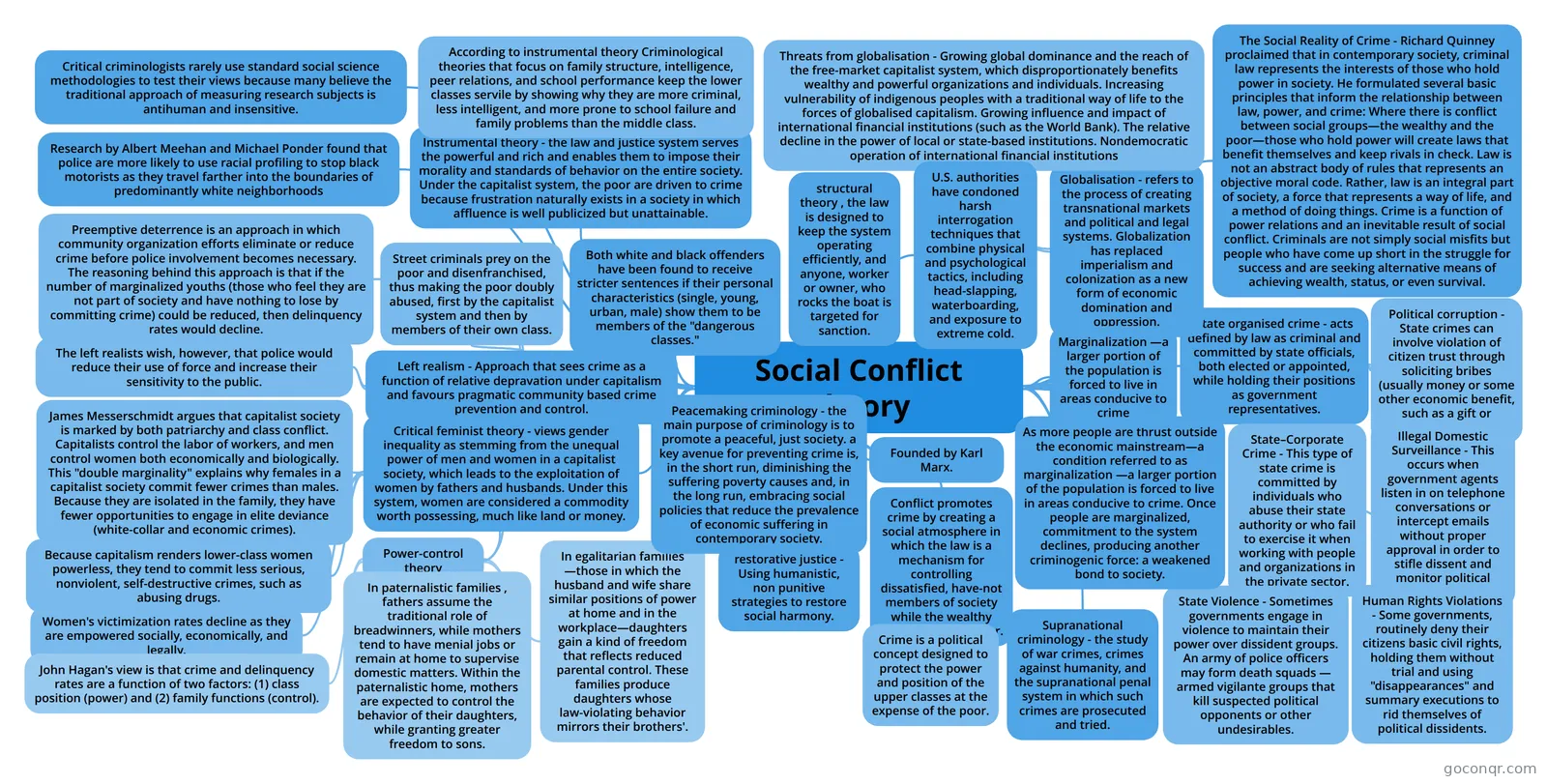
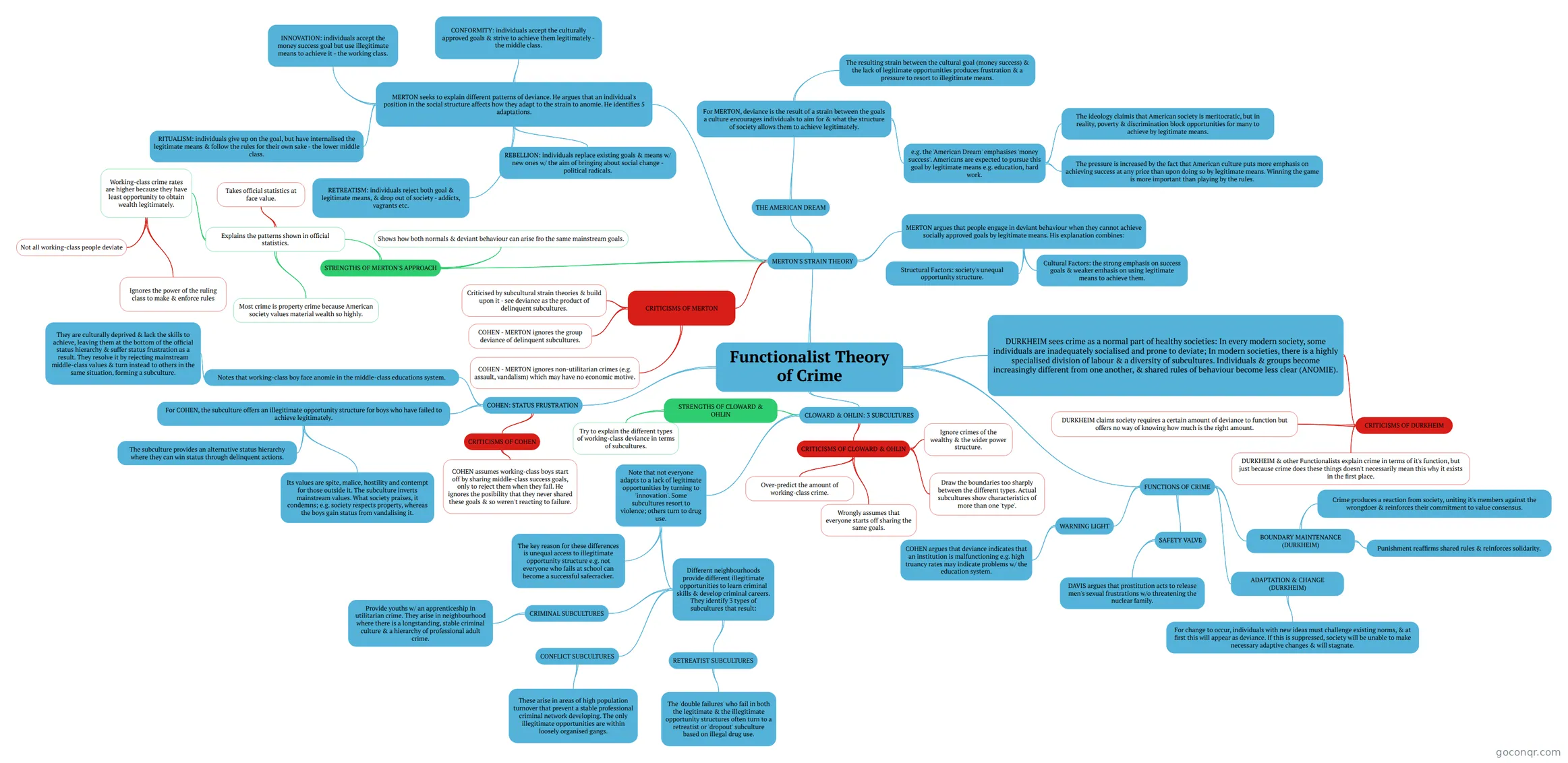
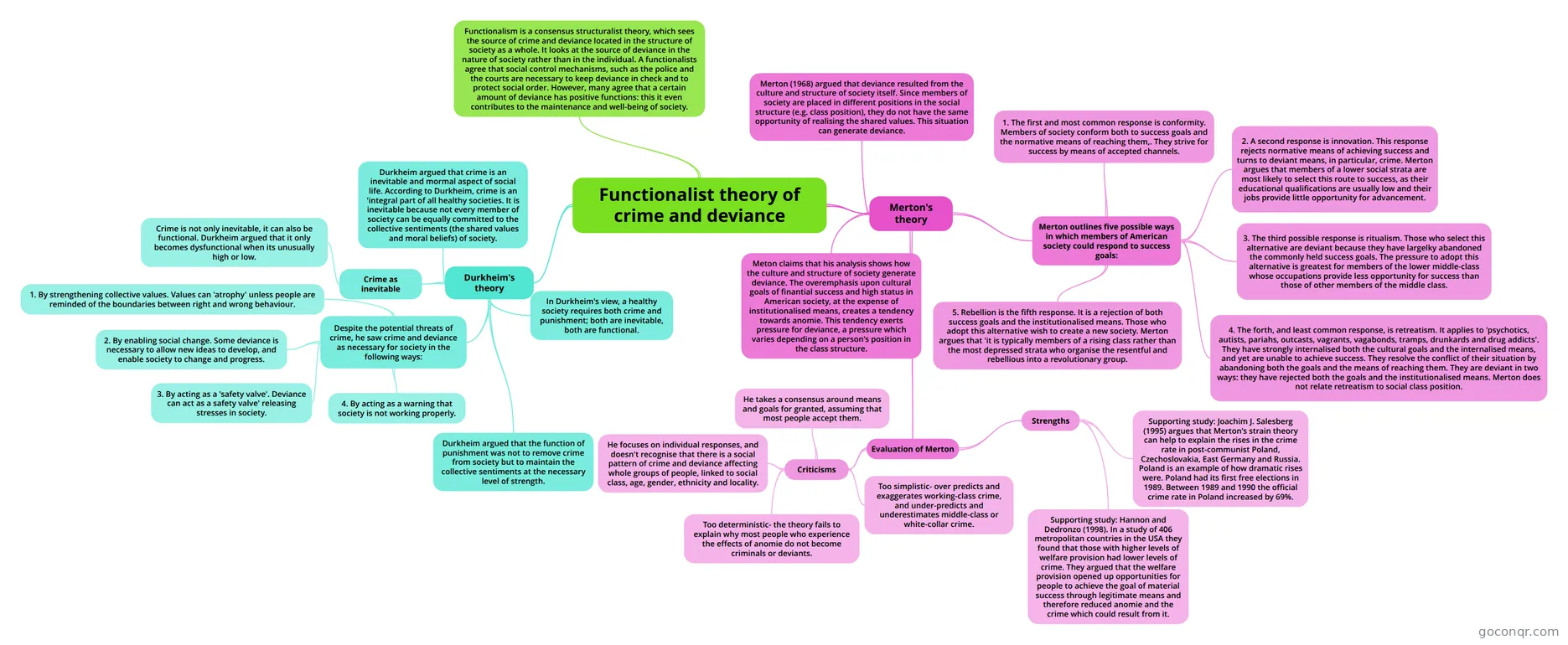
Flashcards
See all 66 flashcards-
77 cardsCrime and Deviance key Words
-
73 cardsFlashcards on Gender and Crime (1.7) Which two sociologists point out that official statistics on gender and crime have remained largely the sam...
-
60 cardsFlashcards on Functionalist, Strain and Subcultural Theories (1.1) Emile Durkheim was of the opinion that every society shares a set of core values. How does he refer to this?
-
38 cards6. Realist Explanations of Crime and Deviance What are the two branches of realism?
-
34 cardsCrime and Deviance Quiz What is the difference between crime and deviance?
-
33 cardsModule 3: Study Guide SOC 3043.50 Deviant Behavior and Social Control Module 3: Study Guide
-
34 cardsGCSE Sociology-Crime and Deviance What is crime?
-
39 cards(e) Ch. 9 Terms Deviance
Notes
See all 16 notes-
Marxist and Neo-Marxist Theories of Crime Key Words capitalism - economic system in which the means of production are privately owned and workers exploited criminogenic capitalism - capitalism causes crime by exploiting and alienating the working class select...
-
CAGE and Crime Gender and CrimeGender Patterns in CrimeMost crimes appear to be committed by males.4/5 convicted offenders are male.Among offenders, a higher proportion of females are convicted of property offences (except burglary)...
-
Deviant Behavior and Social Control Chapters 2-5 Chapter 2Becker wrote:"Social groups constitute deviance by making rules who infractions constitute deviance, and by applying those rules to particular people and labeling them as outsiders."ABC's of DevianceAttitudes...
-
Youth Crime ETHNICITY AND YOUTH CRIME The statistics on crime indicate that ethnic minorities in the UK are hugely overrepresented in the CJS.Ethnic minorities make up about 12.5% of the UK population but commit over 30...
-
Marxist explanation of crime and deviance essay plan IntroductionThe Marxist theory of crime was first developed from Karl Marx's writings by Bonger; and later developed by sociologists such as Chambliss, Snider and Reiman. It is a top down approach that looks at how so...
-
Class and Gender causes of crime essay Working class cause most crime - usually associated with young unemployed males from less well of backgrounds. - &nb...
-
Topic 2: Interactionism and Labelling Theory The Social Construction of Crime: *Labelling theorists argues that deviance is a social construction. *Becker: a deviant simply someone to whom the label has been successfully applied, and deviant be...
-
Theories of Crime/Deviance - created from Mind Map Functionalism DURKHEIM MERTON Inevitable, Universal, Relative, Functional (reinforces boundaries preventing anomie. - Doesn't explain causes. Crime exists because society shares American Dream. + Messner & Rosenheld: ...
Slides
More Sociology topics
About Crime and Deviance
GoConqr OriginalWhat this unit covers
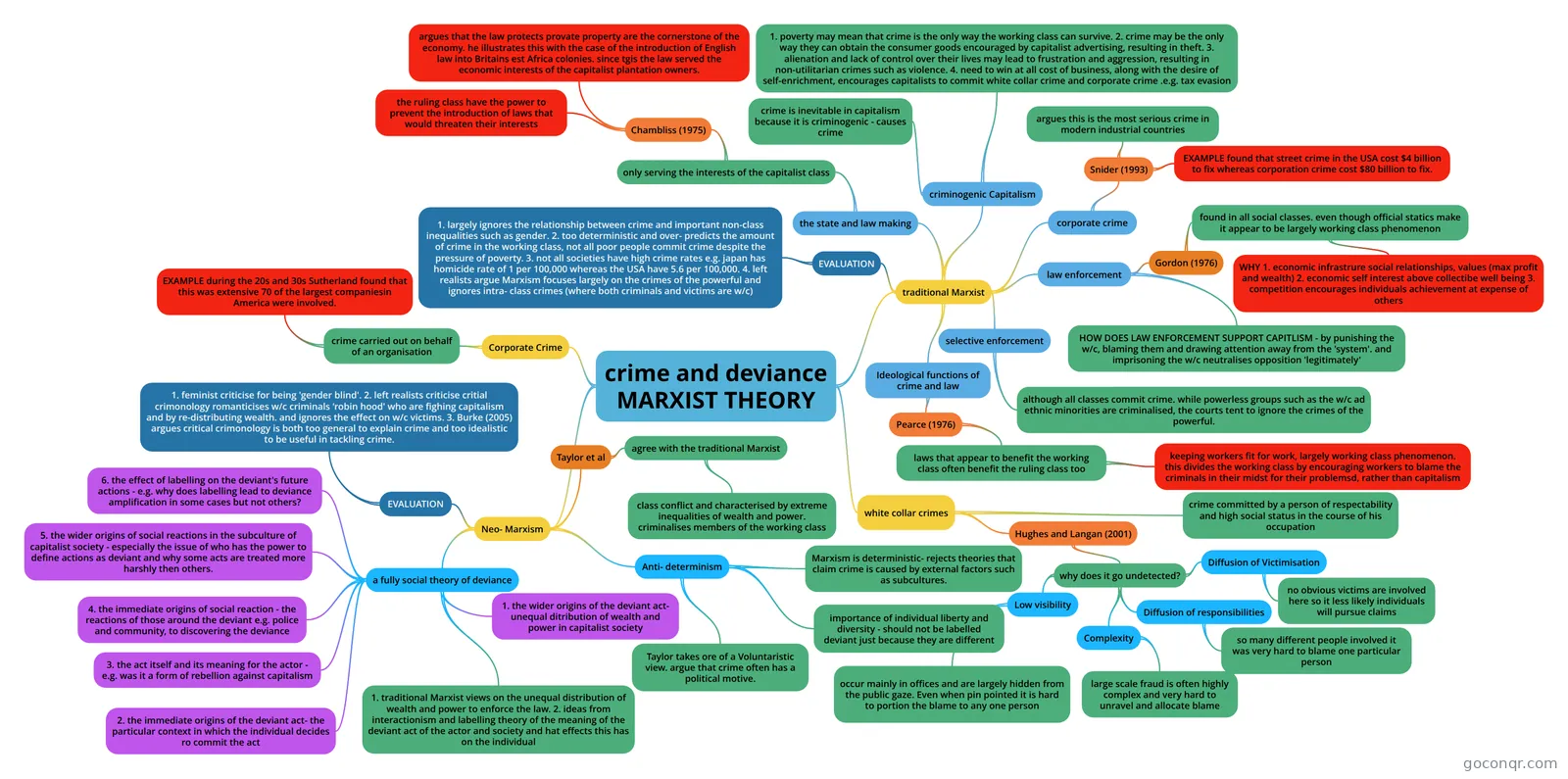
This page sits in the Crime, Power and Politics strand of Sociology. Most of what it lists is made up of mind maps, and they cover the main theories of crime and deviance. The Functionalist Theory of Crime map explains Durkheim's view that crime is a normal part of healthy societies. The first map on the page adds Merton, strain theory and anomie. Other maps cover Labelling theory, Right Realism, Left Realism, Social Conflict Theory and Marxist explanations.
Where to start
Begin with the mind map called Crime and Deviance for a quick overview of functionalist ideas. Then open the Crime and Deviance key Words flashcards, which list terms such as anomie, chivalry thesis, control theory and corporate crime. If you are preparing for GCSE, the GCSE Sociology-Crime and Deviance deck starts with what crime and deviance are, and with formal and informal social control.
Patterns of crime
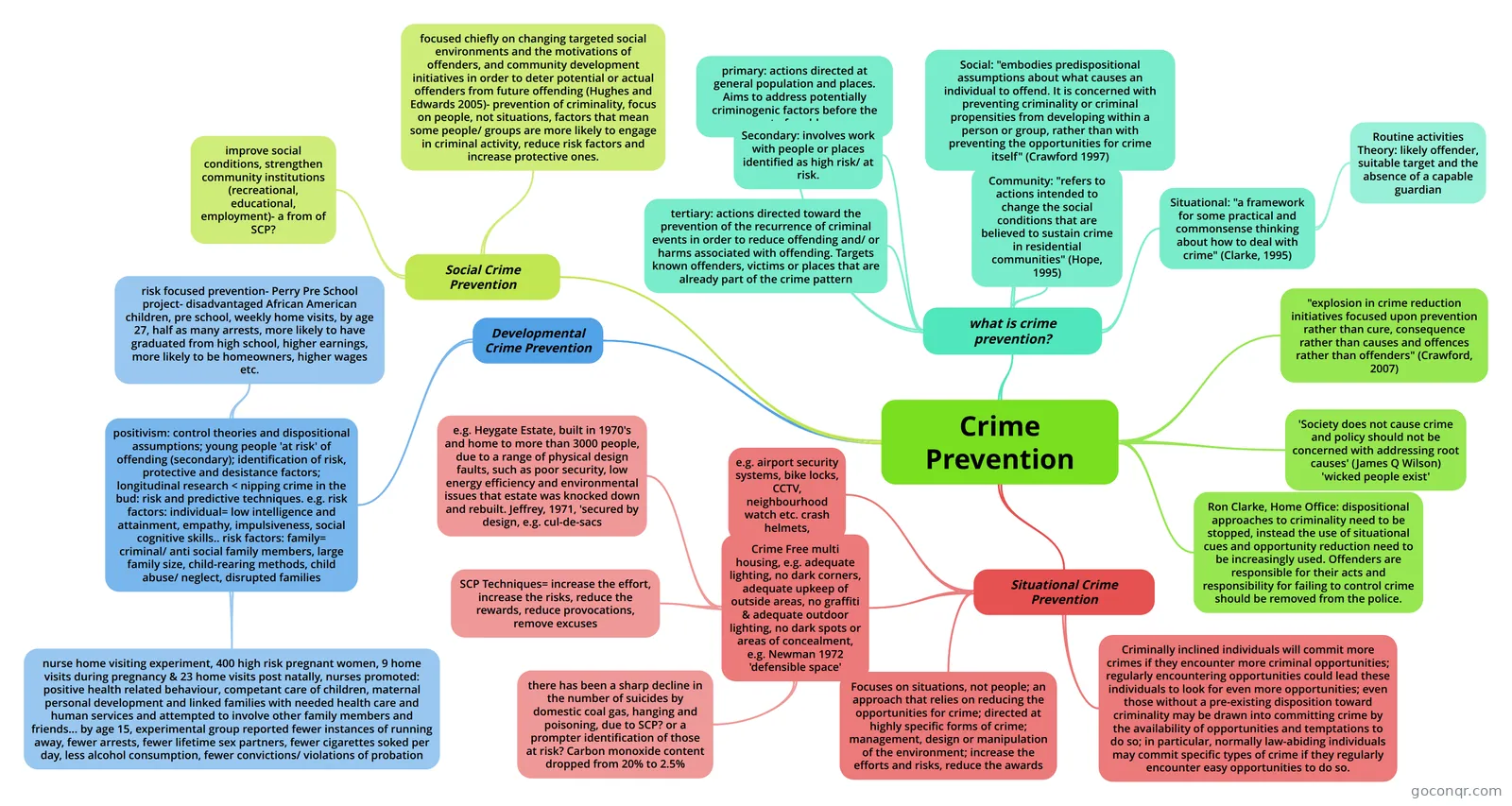
Once the theories make sense, move to who commits crime and who is affected. The Ethnicity & Crime map draws on the British Crime Survey and looks at victims and reporting. There are also maps on gender and crime, delinquent girls, social class, youth deviance, the media and crime, and crime prevention.
Using quizzes and maps together
- Read a map on one theory, such as labelling theory.
- Take a quiz, for instance the one on functionalist responses to crime and deviance.
- Note the questions you missed and go back to that branch of the map.
- Finish with a flashcard deck to fix the key terms.
The resources were made by GoConqr users, so styles differ. Compare a few maps on the same theory and keep the one that fits your course.
Make it your own
When you have found a map or deck you like, try writing your own summary of a theory, then turn it into a short quiz to check what stuck.
Frequently asked questions
Which resource should I open first?
Start with the mind map called Crime and Deviance, which gives an overview of functionalist ideas including Durkheim, Merton, strain theory and anomie. After that, the Crime and Deviance key Words flashcards help you learn the vocabulary before you move on to other theories.
Which theories do the mind maps cover?
The maps cover functionalism, labelling theory, Marxist and Neo-Marxist ideas, Right Realism, Left Realism, Social Conflict Theory and social constructionism. There are also maps on deviant subcultures, moral panics, white collar crime, formal agencies of social control and ways of preventing crime.
Are these resources suitable for GCSE and A-level?
Many are. The page lists material that mentions GCSE Sociology and A-level Sociology, including a GCSE AQA deck and an A Level summary map on functionalism and crime. Other resources are university study guides, so check the title before you start.
Do I need to pay or sign up to use them?
No. Every resource listed here is free to open, study and take, with no account needed. A free account is only needed if you want to save quiz scores or make your own quizzes, maps, flashcards and notes.
Who made these resources?
They were made by GoConqr users, not by GoConqr itself. Over 600 contributors have added maps, decks, quizzes and notes, so wording and depth vary. It is worth comparing two or three on the same topic.
What if I cannot find my topic?
Try a nearby title first. Ethnicity, gender, age and social class each have their own maps or decks, and several theories appear in more than one format. If something is still missing, you can build your own map or flashcards from your class notes.