
Mindmap
Data structure
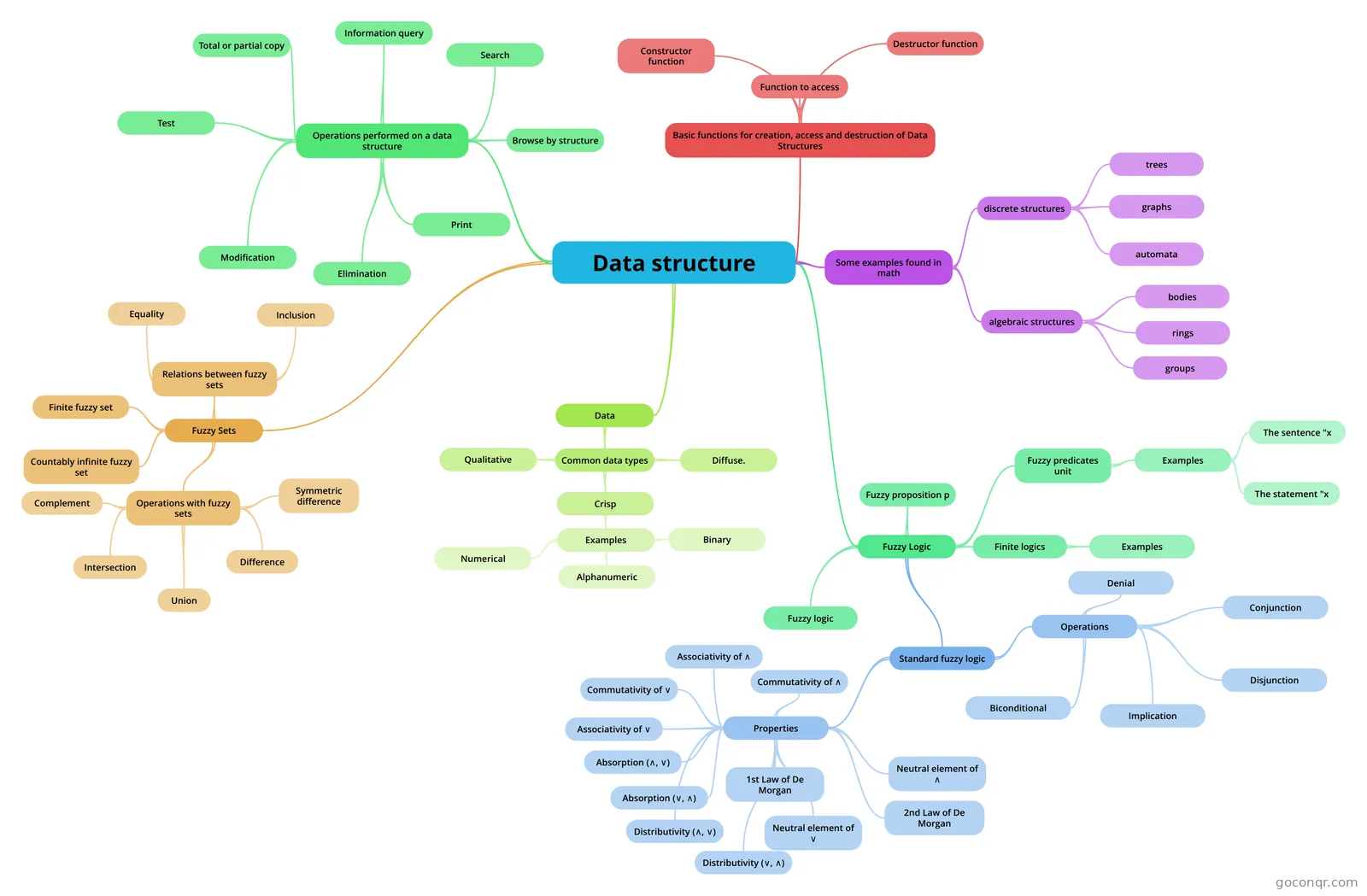
Mind map: Data structure
Inhalt der Mindmap
Data structure
- characteristics of data structures
- are sets of variables, of different types connected together in various ways and with a set of defined operations on such structures.
Some examples found in math
- algebraic structures
- groups
- rings
- bodies
- discrete structures
- trees
- automata
- graphs
- algebraic structures
Operations performed on a data structure
- Browse by structure
- Make a tour of the structure in order to retrieve the stored information.
- Search
- Determines whether an item is or is not in the structure.
- Total or partial copy
- Acquired wholly or partly with a structure similar to the original features.
- Information query
- Get information of one or more elements of the structure
- Test
- Check if one or more elements meet certain conditions
- Modification
- Varies partially or totally the contents of the information elements of the structure
- Print
- Enter the information contained in the structure.
- Elimination
- Deletes elements of the structure
- Browse by structure
Basic functions for creation, access and destruction of Data Structures
- Constructor function
- Create the structure, ie, define the characteristics, delimitation, relationships and allocate the space, leaving to the user the structure to proceed to place the information.
- Function to access
- Facilitate the arrival of an element belonging to the structure.
- Destructor function
- Return to system resources allocated to the data structure so that they are available to the payee
- Constructor function
Data
- Are associated with qualities or quantities and events or objects that are processed by the computer
- Common data types
- Qualitative
- Crisp
- not possible to describe phenomena that manifest some imprecision and / or uncertainty, both in representation and an inquiry
- Examples
- Numerical
- Alphanumeric
- Binary
- Diffuse.
- formalizes vague or fuzzy concepts that people handled daily and naturally.
Fuzzy Logic
- Finite logics
- Examples
- • Irrational number π. • The sequence of rational numbers are approximate values of π. • Closed interval [3, π] as domain approach. • The order of approximation required.
- Examples
- Fuzzy logic
- It is a pair (U, g), where U is the universe of discourse of the propositions diffuse, and g: U → R is a real function of propositional variable, being I the closed interval [0, 1]. In this case, we say that g is veritative fuzzy logic function (U, g).
- Standard fuzzy logic
- Properties
- Commutativity of ∨
- (p ∨ q) ≡ (q ∨ p)
- Commutativity of ∧
- p ∧ q) ≡ (q ∧ p)
- Associativity of ∨
- ((p ∨ q) ∨ r) ≡ (p ∨ (q ∨ r))
- Associativity of ∧
- ((p ∧ q) ∧ r) ≡ (p ∧ (q ∧ r))
- Distributivity (∨, ∧)
- (p ∨ (q ∧ r)) ≡ ((p ∨ q) ∧ (p ∨ r))
- Neutral element of ∨
- (p ∨ 0) ≡ p
- Distributivity (∧, ∨)
- (p ∧ (q ∨ r)) ≡ ((p ∧ q) ∨ (p ∧ r))
- 2nd Law of De Morgan
- [ ∼ (p ∨ q) ] ≡ (∼p ∧ ∼q)
- Neutral element of ∧
- (p ∧ 1) ≡ p
- Absorption (∧, ∨)
- (p ∧ (p ∨ q)) ≡ p
- 1st Law of De Morgan
- [∼ (p ∧ q) ] ≡ (∼p ∨ ∼q)
- Absorption (∨, ∧)
- (p ∨ (p ∧ q)) ≡ p
- Commutativity of ∨
- Operations
- Denial
- Conjunction
- Disjunction
- Biconditional
- Implication
- Properties
- Fuzzy predicates unit
- We call fuzzy predicate unit in the universe X to a function propositional P: X → U, that is, to correspond to each element x ∈ X, associates a unique proposition P (x) ∈ U
- Examples
- The sentence "x
- It is a rational number irrational number approximately equal to π "variable Single xy individual constant π, is the specification of a fuzzy predicate P Unit set Q of all rational numbers in the universe of discourse of the fuzzy propositions U. Such specification is denoted by the expression P (x) "x ≈ π ". The degrees of truth of propositions P (3), P (3.1), P (3.14), P (3,141), P (3.1415), ..., constitute a series, infinite and growing of rational numbers between 0 and 1.
- The statement "x
- It is a rational number irrational number approximately equal to π "variable Single xy individual constant π, is the specification of a fuzzy predicate P Unit set Q of all rational numbers in the universe of discourse of the fuzzy propositions U. Such specification is denoted by the expression P (x) "x ≈ π ". The degrees of truth of propositions P (3), P (3.1), P (3.14), P (3,141), P (3.1415), ..., constitute a series, infinite and growing of rational numbers between 0 and 1.
- The sentence "x
- Fuzzy proposition p
- Finite logics
Fuzzy Sets
- There are sets in which is not clearly determined whether an element belongs or not to the set. Sometimes, an element in the set with a certain degree, called membership degree.
- Finite fuzzy set
- A = {a1 | uA (a1), a2 | uA (a2), a3 | uA (a3), ..., an | uA (n)}
- Countably infinite fuzzy set
- B = {b1|µB(b1), b2|µB(b2), b3|µB(b3), …}
- Relations between fuzzy sets
- Equality
- The fuzzy set A is equal to the fuzzy set B if and only if for each element x ∈ X, the number uA (x) equals the number μB (x). We denote A = B. In compact form: A = B ⇔ (∀ x ∈ X) [uA (x) = μB (x)].
- Inclusion
- The fuzzy set A is a subset of the fuzzy set B if and only if for all x ∈ X, the number uA (x) is less than or equal to the number μB (x). Denoted A ⊂ B. In compact form: A ⊂ B ⇔ (∀ x ∈ X) [uA (x) ≤ μB (x)].
- Equality
- Operations with fuzzy sets
- Complement
- The complement of a fuzzy set A is a second fuzzy set B of generic element x ∈ X such that μB (x) equals the number number 1 - uA (x). Denoted Ac. In compact form: Ac = B ⇔ (∀ x ∈ X) [μB (x) = 1 - uA (x)].
- Union
- The union of two fuzzy sets A and B is another fuzzy set C of generic element x ∈ X such that μC (x) equals the maximum between uA (x) and μB (x) numbers. It is denoted A ∪ B. In compact form: A ∪ B = C ⇔ (∀ x ∈ X) μC (x) = max {uA (x), μB (x)}.
- Difference
- The difference of two fuzzy sets A and B is a third fuzzy set, denoted by A-B, and defined by the following equality: A - B = A ∩ Bc
- Symmetric difference
- The symmetric difference of two fuzzy sets A and B is a third fuzzy set AΔB denoted by, and defined as follows: AΔB = (A ∩ Bc) ∪ (Ac ∩ B).
- Intersection
- The intersection of two fuzzy sets A and B is another fuzzy set C of generic element x ∈ X such that μC (x) is equal to the minimum between uA (x) and μB (x) numbers. It is denoted A ∩ B. In compact form: A ∩ B = C ⇔ (∀ x ∈ X) μC (x) = min {uA (x), μB (x)}.
- Complement