
Data Structures
521 resources created by 340 users
This Data Structures page on GoConqr gathers community-made quizzes, mind maps, flashcards and notes, from arrays, tuples and dictionaries to hashing, binary trees, splay trees and graph theory. It's built for university students and professional candidates, school students, and teachers after ready-made material, all practising how structures work and how they are used. There are over 500 resources here, including more than 60 quizzes, over 220 mind maps and more than 170 flashcards. Open a quiz to spot your gaps, then make your own maps.
Select topic
Top Data Structures resources
-
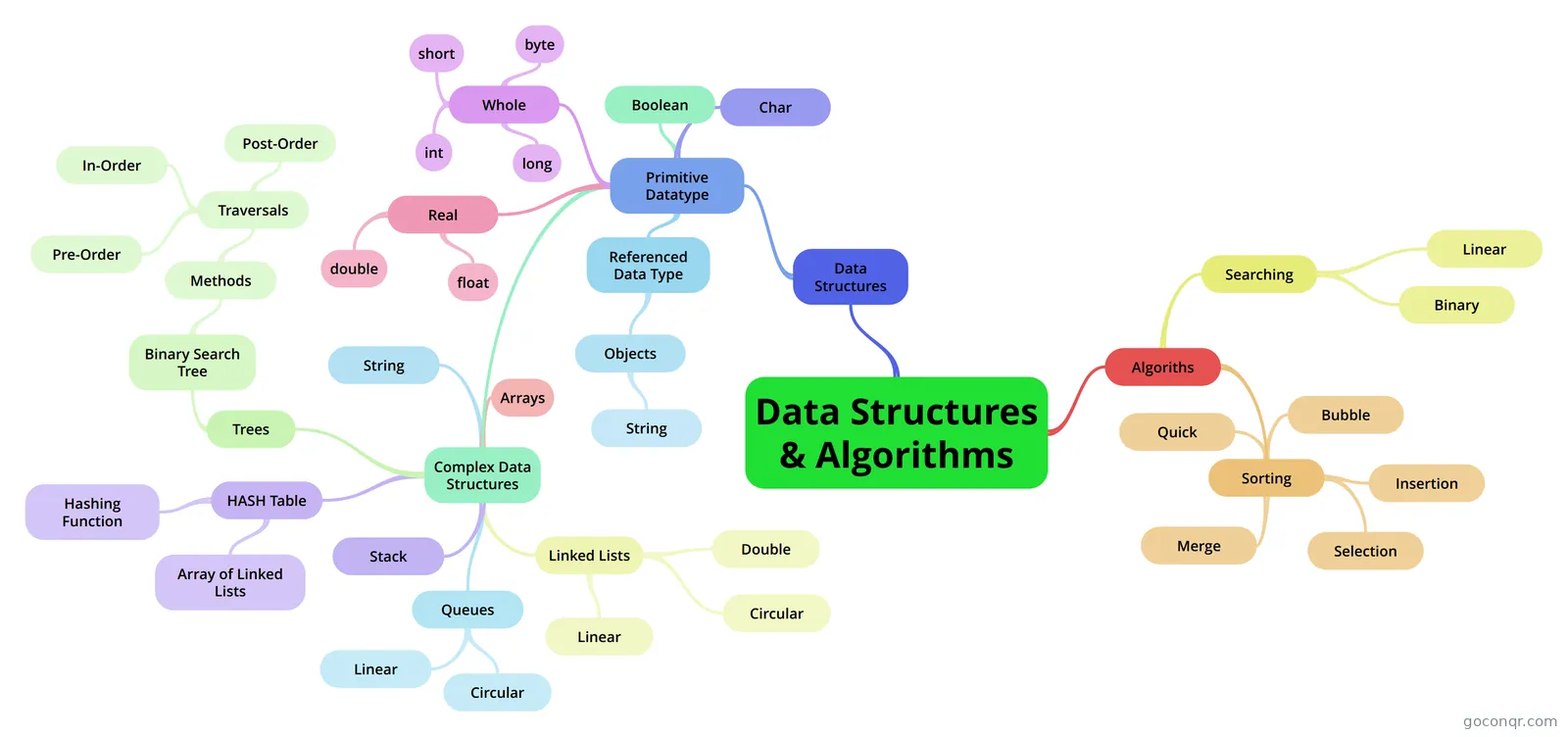 Mind map Data Structures & Algorithms
-
200 questionsAdvanced Algorithm (Eldan) 1 (200) What does the following function do for a given Linked List with first node as head? void fun1(struct node*...
-
182 questionsD
-
152 questionssdp4 Re-balancing of AVL tree costs
-
73 questionsGraph Theory What is the formal name for the points on a graph?
-
15 questionsSets in Python
-
22 cardsF453 Data Structures - Stacks and Queues What is a static data structure?
-
15 questions12. Graph Traversal When you have a cycle in a graph and you are trying to implement a traversal, what is the most common metho...
Quizzes
See all 64 quizzes-
200 questionsAdvanced Algorithm (Eldan) 1 (200) What does the following function do for a given Linked List with first node as head? void fun1(struct node*...
-
182 questionsD
-
152 questionssdp4 Re-balancing of AVL tree costs
-
73 questionsGraph Theory What is the formal name for the points on a graph?
-
15 questionsSets in Python
-
15 questions12. Graph Traversal When you have a cycle in a graph and you are trying to implement a traversal, what is the most common metho...
-
20 questions1. Trees Splay Trees Splay trees use AVL rotation by taking nodes that not have been accessed and move them toward the leaves.
-
40 questions2_COP 4530 Exam 1 practice quiz Write a traversal loop for an fsu::Vector object v .
Mind maps
See all 232 mind maps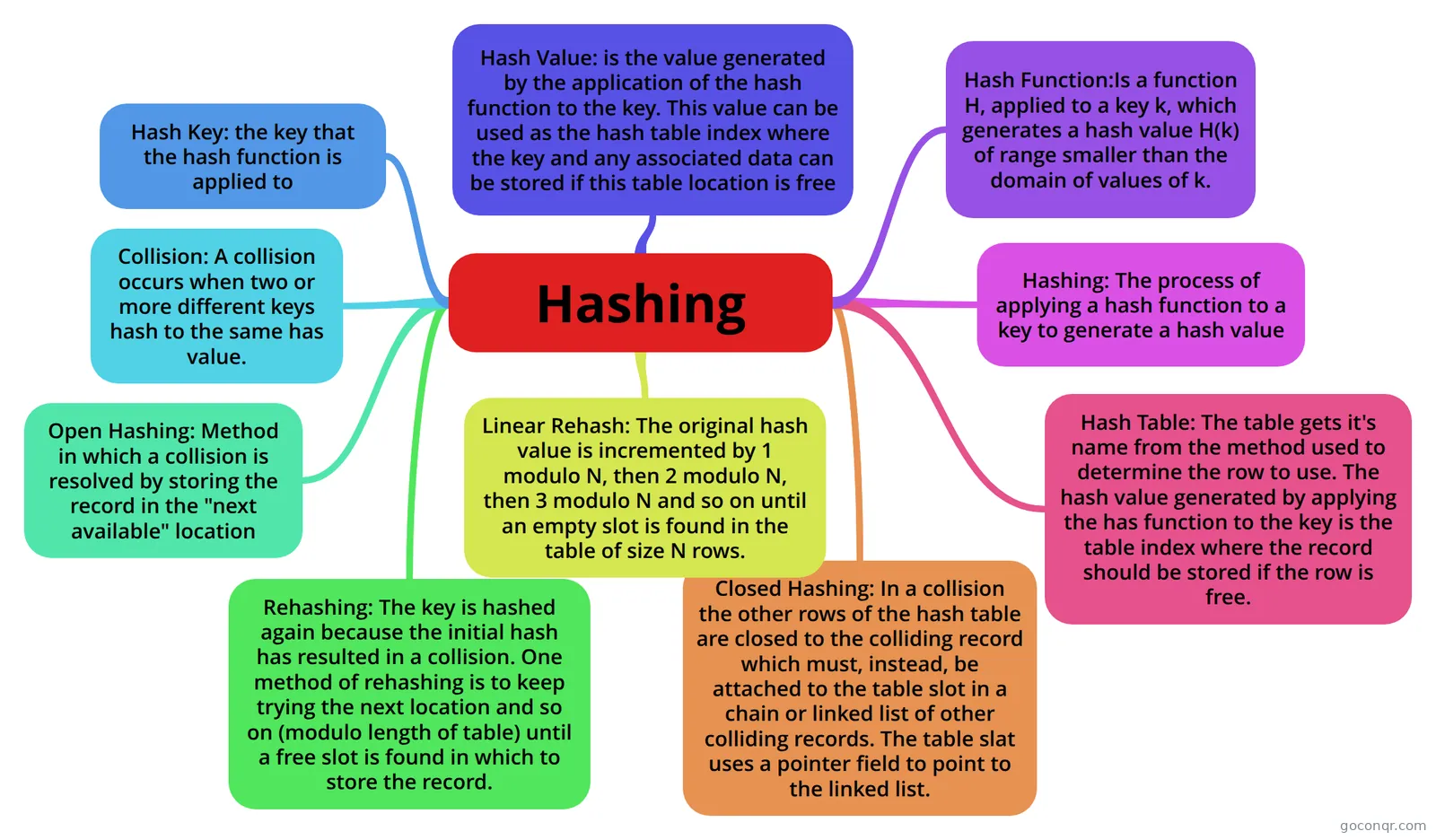
Flashcards
See all 177 flashcards-
22 cardsF453 Data Structures - Stacks and Queues What is a static data structure?
-
11 cardsArrays
-
25 cardsChapter 8 (Arrays) This appears in an array declaration and specifies the number of elements the array can hold.
-
34 cardsAlgorithms and Data Structures - Basic Data Structures What is an algorithm? (Def)
-
66 cardsgraph theory
-
8 cardsLists and Linked Lists | Data Structures - OCR Computer Science A Level What is a List?
-
19 cardsWeek 3: Sorting, time complexity & exceptions/assertions
-
11 cardsGraphs | Data Structures - OCR Computer Science A Level What are Graphs?
Flowcharts
Notes
See all 32 notes-
Slide Notes Chapter 15 Iterators CSIS B What is an iterator? It is something that allows you to step through and traverse a collection of data. It is like a pointer or a cursor, it goes through looking at each thing on the list. There are different types of...
-
Slide Notes Chapter 15 Iterators CSIS B What is an iterator? It is something that allows you to step through and traverse a collection of data. It is like a pointer or a cursor, it goes through looking at each thing on the list. There are different types of...
-
Syllabus + Introduction Data Struct. - 2019.01.14
-
Sorted Lists Chapter 16 CSISB Specifications of an Abstract Data Type Sorted List Duplicate entries are allowed, to make things easier The sorting must determine where in a list is the element added Can ask if list contains specified entry Must be...
-
coding Binary tree [Script] subject Coding casino 100 points DESCRIPTION Please read the Binary tree question before attempting this problem. Input First line contains an integer d, the depth ...
-
Data structure and algorithms Introduction to data structure: A data structure is a way to store and organize data in a computer, so that it can be use efficiently. two ways to represent data structure: 1. Mathematical / logical models: the abstra...
-
python Python - Data Structure Computers store and process data with extraordinary speed and accuracy. So it is highly essential that the data is stored efficiently and can be accessed fast. Also, the processing of data shou...
-
Unit 2 Notes Recursion aims to solve a large problem by solving increasingly smaller instances of the problem. The Droste effect is an example of recursion in art. One of the common examples of recursion used in programming is a f...
Slides
Topics in Data Structures
More Computing and ICT (programming, computer science, digital skills, educational technology) topics
About Data Structures
GoConqr OriginalWhat the resources cover
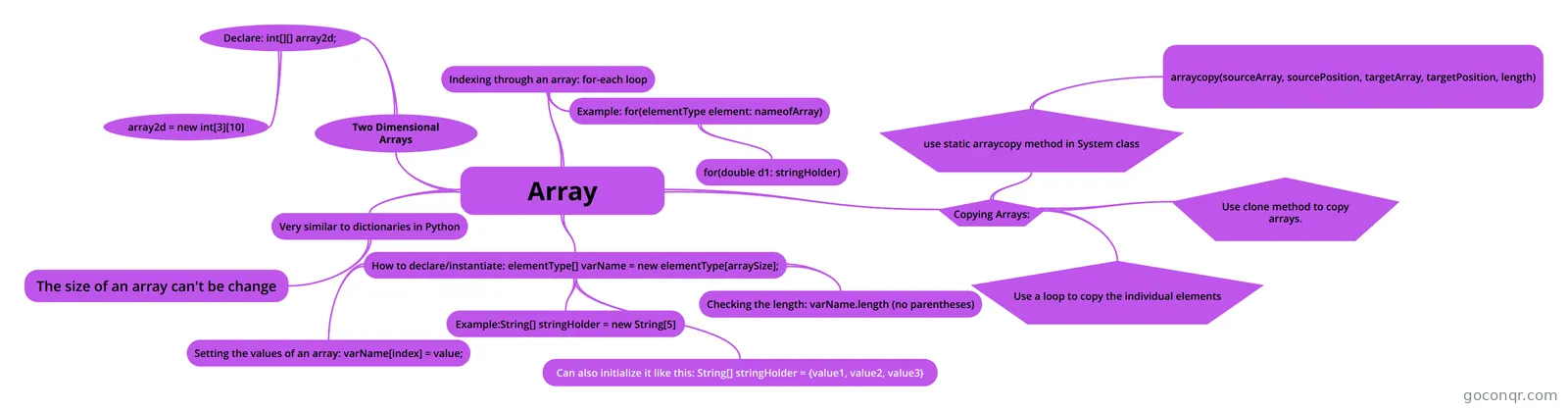
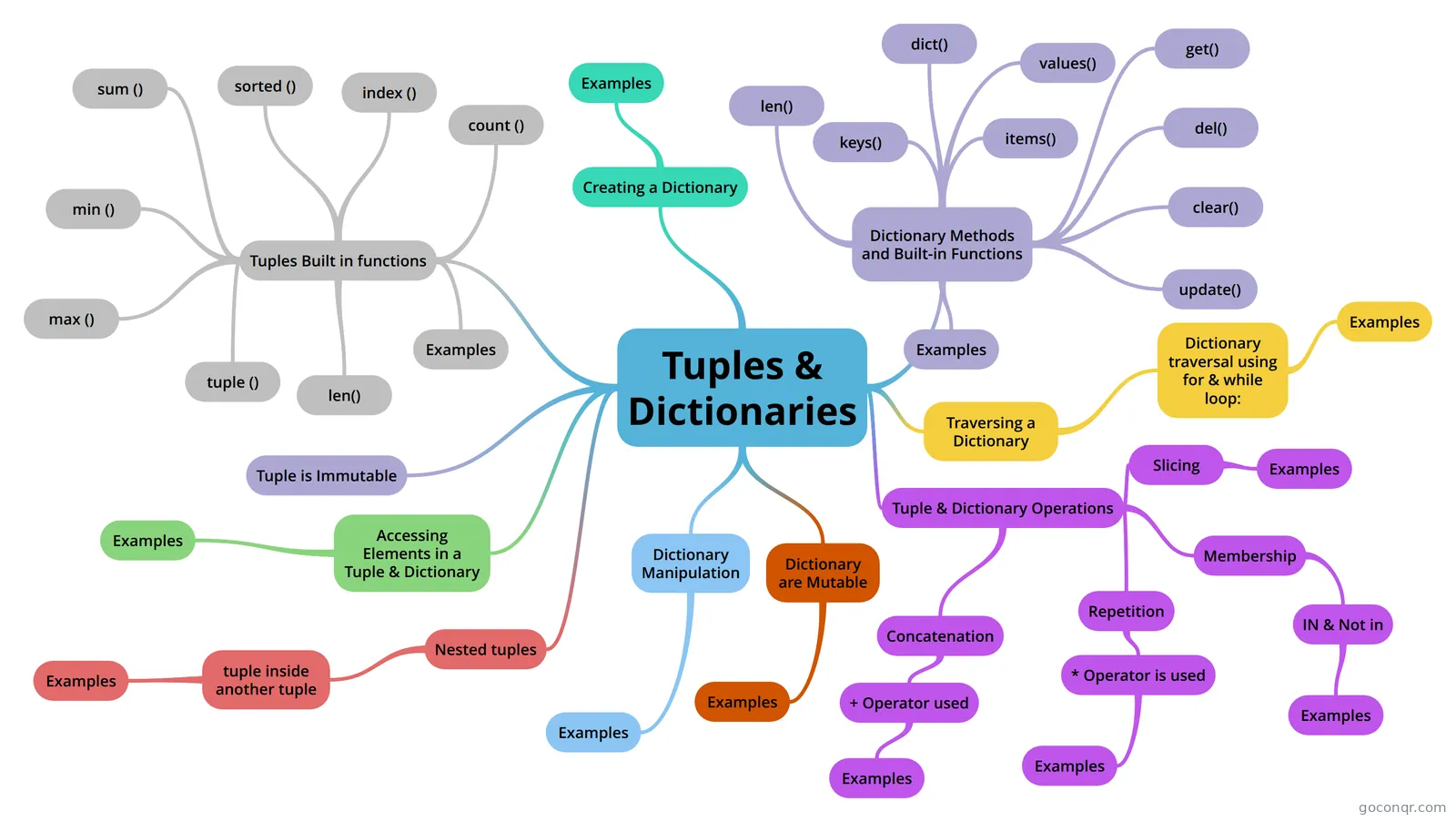
The page starts with the basics. The mind map Array shows how to declare and fill an array, while Tuples & Dictionaries covers accessing elements, mutability, concatenation, repetition, membership and slicing. The Data Structures - Abstract Data Types mind map lists the operations of a queue, a stack and a deque, with their O(1) and O(n) costs.
Further along you meet non-linear structures. The Binary Tree map links trees to file systems, databases, websites and inheritance, and explains parent, children and sibling relationships. The Hashing map defines a hash function and a hash value. There are also quizzes on splay trees, graph traversal and sets in Python.
Where to start
- Begin with a mind map such as Arrays or Linked Lists to see the shape of the topic.
- Move to flashcards for definitions, for example static and dynamic structures, LIFO and FIFO, in F453 Data Structures - Stacks and Queues.
- Then try a quiz, such as Graph Theory, which asks for the formal names of vertices and edges.
Using quizzes and maps together
Read a map first, then take the matching quiz without looking. Note which questions you missed and go back to that branch of the map. The quiz on Sets in Python asks you to predict output, so it pairs well with the Python sequences map.
Revision decks for A-level Computer Science, including OCR A-level material on lists, linked lists and graphs, sit alongside a GCSE Computer Science slide set. Many other resources follow university course weeks, lectures and practice exams.
Where this unit fits
Data Structures sits in the Programming strand of Computing and ICT. It connects naturally with the sorting, time complexity and algorithm resources listed here.
Choose one topic today, open a map or quiz, and see what you already know.
Frequently asked questions
Which resource should I open first?
Start with a mind map on the structure you are learning, such as Array, Binary Tree or Hashing. It gives you the outline quickly. Then try the Graph Theory quiz or a flashcard deck to test what stuck, and return to the map for anything you missed.
What do the mind maps cover?
They cover arrays, tuples and dictionaries, abstract data types such as stacks, queues and deques, binary trees, binary search trees, linked lists, graphs, sorting and hashing. Some include operation costs, and others link structures to real uses such as file systems and databases.
Are the resources free to use?
Yes. Every resource listed here is free to open, study and take, with no account needed. They were made by GoConqr users, not by GoConqr itself, so styles and depth vary from one resource to another.
Which levels and exams do they suit?
Most resources suit university students and professional candidates, with a smaller share for school students. Exam labels mentioned include GCSE Computer Science, A-level Computer Science, A-level Computing and the OCR versions of the A-level courses.
What if I cannot find my topic?
Look through the related mind maps and flashcards, since topics often appear inside broader resources like Data Structures & Algorithms. You can also make your own quiz, mind map, flashcards or notes with a free account, which also saves your quiz scores.