
Mindmap
Mechanical Assembly
Inhalt der Mindmap
Mechanical Assembly
Perbedaan mechanical assembly dengan metode penyambungan lain adalah kemampuan untuk disassembly dan jika metode lain menggunakan filler, metode ini menggunakan mechanical fastening
THREADED FASTENERS
- SCREWS, BOLTS, AND NUTS
- technical difference between a screw and a bolt : A screw is generally assembled into a blind threaded hole, whereas a bolt is assembled using a nut
- OTHER THREADED FASTENERS AND RELATED HARDWARE
- A stud (in the context of fasteners) is an externally threaded fastener, but without the usual head possessed by a bolt.
- Screw thread inserts are internally threaded plugs or wire coils made to be inserted into an unthreaded hole and to accept an externally threaded fastener.
- Captive threaded fasteners are threaded fasteners that have been permanently preassembled to one of the parts to be joined.
- A washer is a hardware component often used with threaded fasteners to ensure tightness of the mechanical joint; in its simplest form, it is a flat thin ring of sheet metal.
- Washers serve various functions
- distribute stresses that might otherwise be concentrated at the bolt or screw head and nut
- provide support for large clearance holes in the assembled parts
- Washers serve various functions
- STRESSES AND STRENGTHS IN BOLTED JOINTS
- Proof strength is roughly equivalent to yield strength; specifically, it is the maximum tensile stress to which an externally threaded fastener can be subjected without permanent deformation.
- failure can occur in one of the following ways
- external threads (e.g., bolt or screw) can strip
- internal threads (e.g., nut) can strip
- the bolt can break because of excessive tensile stresses on its cross-sectional area
- TOOLS AND METHODS FOR THREADED FASTENERS
- SCREWS, BOLTS, AND NUTS
RIVETS AND EYELETS
- A rivet is an unthreaded, headed pin used to join two (or more) parts by passing the pin through holes in the parts and then forming (upsetting) a second head in the pin on the opposite side
ASSEMBLY METHODS BASED ON INTERFERENCE FITS
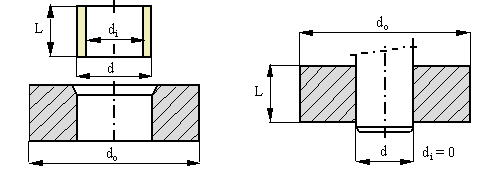
- An interference fit, also known as a press fit or friction fit is a fastening between two parts which is achieved by friction after the parts are pushed together, rather than by any other means of fastening.
- Shrink and Expansion Fits
- These terms refer to the assembly of two parts that have an interference fit at room temperature
- To assemble by shrink fitting, the external part is heated to enlarge it by thermal expansion, and the internal part either remains at roomtemperature or is cooled to contract its size
- The parts are then assembled and brought back to room temperature, so that the external part shrinks, and if previously cooled the internal part expands, to form a strong interference fit
- An expansion fit is when only the internal part is cooled
- once inserted into the mating component, it warms to room temperature, expanding to create the interference assembly
- Press fit is an interference fit between two parts in which one is forced under pressure into a slightly smaller hole in the other
- Snap Fits and Retaining Rings
- A snap fit involves joining two parts in which the mating elements possess a temporary interference while being pressed together, but once assembled they interlock to maintain the assembly
- Advantages of snap fit
- the parts can be designed with self aligning features
- no special tooling is required
- assembly can be accomplished very quickly
- Advantages of snap fit
- A snap fit involves joining two parts in which the mating elements possess a temporary interference while being pressed together, but once assembled they interlock to maintain the assembly
OTHER MECHANICAL FASTENING METHODS
- Stitching, Stapling, and Sewing
- Industrial stitching and stapling are similar operations involving the use of U-shaped metal fasteners
- Difference between industrial stitching and stapling : Stitching, U-shaped fasteners are formed during the assembly process. In stapling, fasteners are preformed
- Sewing(menjahit) is a common joining method for soft, flexible parts such as cloth and leather
- Industrial stitching and stapling are similar operations involving the use of U-shaped metal fasteners
- Stitching, Stapling, and Sewing
MOLDING INSERTS AND INTEGRAL FASTENERS
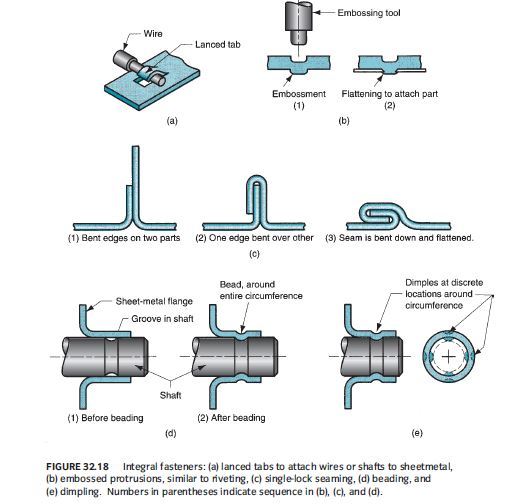
- INTEGRAL FASTENERS is involve deformation of component parts so they interlock and create a mechanically fastened joint
- This assembly method is most common for sheetmetal parts.
- lanced tabs to attach wires or shafts to sheet-metal parts
- embossed protrusions, in which bosses are formed in one part and flattened over the mating assembled part
- embossed protrusions, in which bosses are formed in one part and flattened over the mating assembled part;
- Seaming, where the edges of two separate sheet-metal parts or the opposite edges of the same part are bent over to form the fastening seam
- beading, in which a tube-shaped part is attached to a smaller shaft (or other round part) by deforming the outer diameter inward to cause an interference around the entire circumference
- dimpling—forming of simple round indentations in an outer part to retain an inner part
- INTEGRAL FASTENERS is involve deformation of component parts so they interlock and create a mechanically fastened joint
DESIGN FOR AUTOMATED ASSEMBLY
- Some of the general principles and guidelines in design for assembly include the following: (782 Mikell)
- (1) Use the fewest number of parts possible to reduce assembly required (2) Reduce the number of threaded fasteners; instead use snap fits, retaining rings, integral fasteners, and similar fastening mechanisms that can be accomplished more rapidly. Use threaded fasteners only where justified, e.g., where disassembly or adjustment is required (3) Standardize fasteners in order to reduce the number of sizes and styles in the product (4) Design parts to be symmetrical and minimize asymmetric features (5) Avoid parts that tangle.
- Some of the general principles and guidelines in design for assembly include the following: (782 Mikell)
Bilder und Dateien der Mindmap
Informationen
- Beschreibung
- PROSMAN II Mindmap am Mechanical Assembly, erstellt von Kalolo 34 am 06/08/2017.
- Erstellt von
- Kalolo 34
- Aufrufe
- 0
- Bewertung