
Mindmap
Ch.22: Musculoskeletal System (J)
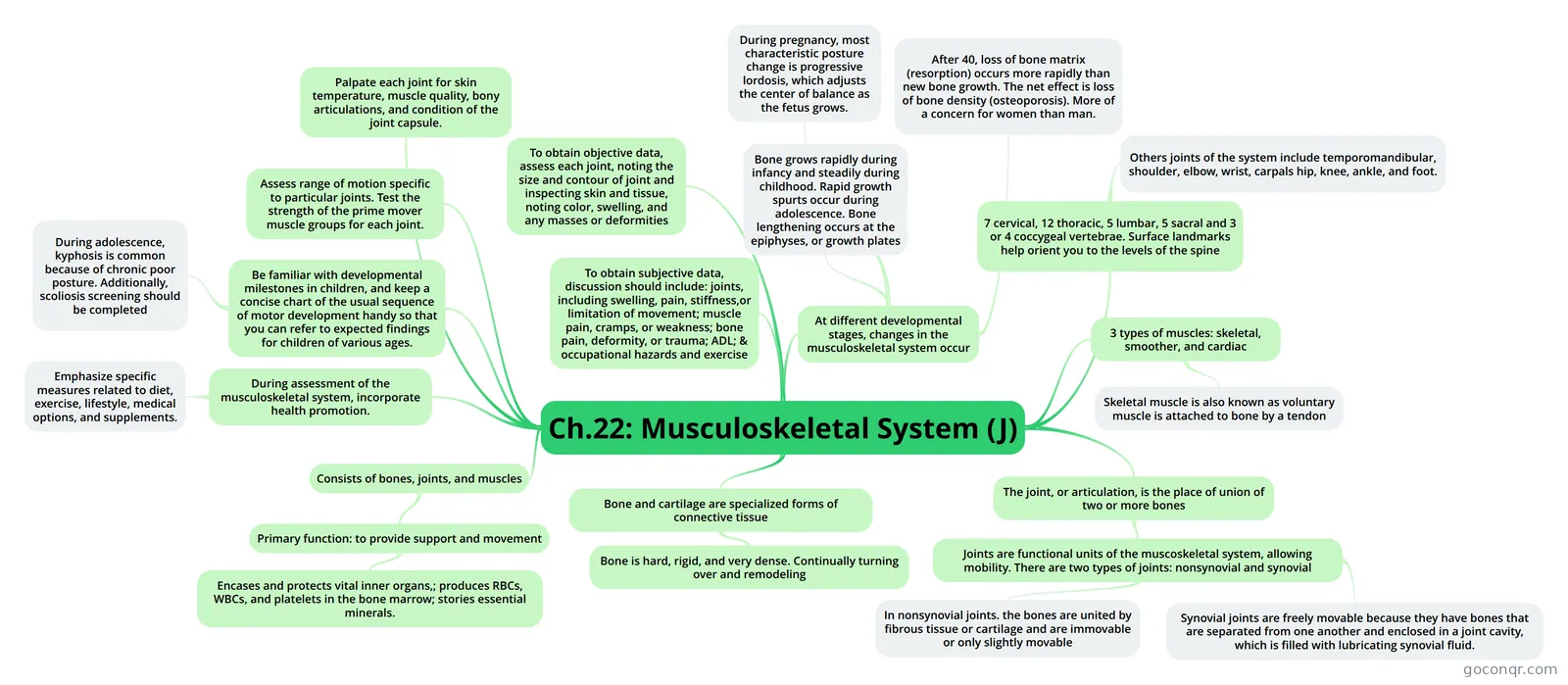
Mind map: Ch.22: Musculoskeletal System (J)
Inhalt der Mindmap
Ch.22: Musculoskeletal System (J)
Consists of bones, joints, and muscles
- Primary function: to provide support and movement
- Encases and protects vital inner organs,; produces RBCs, WBCs, and platelets in the bone marrow; stories essential minerals.
- Primary function: to provide support and movement
Bone and cartilage are specialized forms of connective tissue
- Bone is hard, rigid, and very dense. Continually turning over and remodeling
The joint, or articulation, is the place of union of two or more bones
- Joints are functional units of the muscoskeletal system, allowing mobility. There are two types of joints: nonsynovial and synovial
- In nonsynovial joints. the bones are united by fibrous tissue or cartilage and are immovable or only slightly movable
- Synovial joints are freely movable because they have bones that are separated from one another and enclosed in a joint cavity, which is filled with lubricating synovial fluid.
- Joints are functional units of the muscoskeletal system, allowing mobility. There are two types of joints: nonsynovial and synovial
3 types of muscles: skeletal, smoother, and cardiac
- Skeletal muscle is also known as voluntary muscle is attached to bone by a tendon
7 cervical, 12 thoracic, 5 lumbar, 5 sacral and 3 or 4 coccygeal vertebrae. Surface landmarks help orient you to the levels of the spine
- Others joints of the system include temporomandibular, shoulder, elbow, wrist, carpals hip, knee, ankle, and foot.
At different developmental stages, changes in the musculoskeletal system occur
- Bone grows rapidly during infancy and steadily during childhood. Rapid growth spurts occur during adolescence. Bone lengthening occurs at the epiphyses, or growth plates
- During pregnancy, most characteristic posture change is progressive lordosis, which adjusts the center of balance as the fetus grows.
- After 40, loss of bone matrix (resorption) occurs more rapidly than new bone growth. The net effect is loss of bone density (osteoporosis). More of a concern for women than man.
To obtain subjective data, discussion should include: joints, including swelling, pain, stiffness,or limitation of movement; muscle pain, cramps, or weakness; bone pain, deformity, or trauma; ADL; & occupational hazards and exercise
To obtain objective data, assess each joint, noting the size and contour of joint and inspecting skin and tissue, noting color, swelling, and any masses or deformities
Palpate each joint for skin temperature, muscle quality, bony articulations, and condition of the joint capsule.
Assess range of motion specific to particular joints. Test the strength of the prime mover muscle groups for each joint.
Be familiar with developmental milestones in children, and keep a concise chart of the usual sequence of motor development handy so that you can refer to expected findings for children of various ages.
- During adolescence, kyphosis is common because of chronic poor posture. Additionally, scoliosis screening should be completed
During assessment of the musculoskeletal system, incorporate health promotion.
- Emphasize specific measures related to diet, exercise, lifestyle, medical options, and supplements.
Informationen
- Beschreibung
- Mindmap am Ch.22: Musculoskeletal System (J), erstellt von Amanjot Paneser am 22/09/2017.
- Erstellt von
- Amanjot Paneser
- Aufrufe
- 5
- Bewertung
Mehr zu Musculoskeletal and Neurological Assessment