
Mindmap
pH
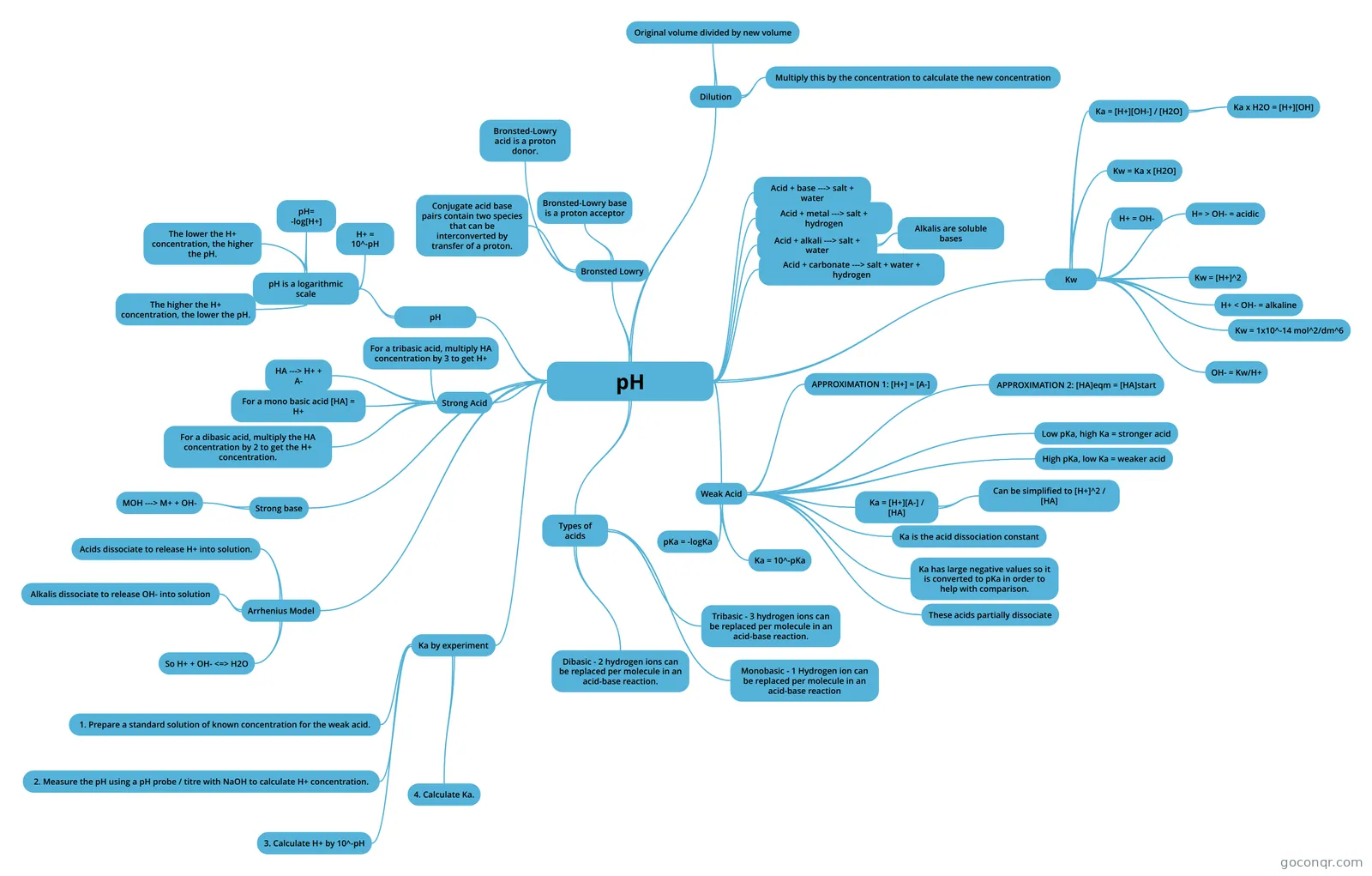
Mind map: pH and acids
Inhalt der Mindmap
pH
Bronsted Lowry
- Bronsted-Lowry acid is a proton donor.
- Bronsted-Lowry base is a proton acceptor
- Conjugate acid base pairs contain two species that can be interconverted by transfer of a proton.
pH
- pH is a logarithmic scale
- The lower the H+ concentration, the higher the pH.
- The higher the H+ concentration, the lower the pH.
- pH= -log[H+]
- H+ = 10^-pH
- pH is a logarithmic scale
Strong Acid
- For a mono basic acid [HA] = H+
- HA ---> H+ + A-
- For a dibasic acid, multiply the HA concentration by 2 to get the H+ concentration.
- For a tribasic acid, multiply HA concentration by 3 to get H+
Weak Acid
- Ka = [H+][A-] / [HA]
- Can be simplified to [H+]^2 / [HA]
- Ka is the acid dissociation constant
- Ka has large negative values so it is converted to pKa in order to help with comparison.
- pKa = -logKa
- Ka = 10^-pKa
- Low pKa, high Ka = stronger acid
- High pKa, low Ka = weaker acid
- These acids partially dissociate
- APPROXIMATION 1: [H+] = [A-]
- APPROXIMATION 2: [HA]eqm = [HA]start
- Ka = [H+][A-] / [HA]
Kw
- Ka = [H+][OH-] / [H2O]
- Ka x H2O = [H+][OH]
- Kw = Ka x [H2O]
- H+ = OH-
- Kw = [H+]^2
- H= > OH- = acidic
- H+ < OH- = alkaline
- Kw = 1x10^-14 mol^2/dm^6
- OH- = Kw/H+
- Ka = [H+][OH-] / [H2O]
Types of acids
- Monobasic - 1 Hydrogen ion can be replaced per molecule in an acid-base reaction
- Dibasic - 2 hydrogen ions can be replaced per molecule in an acid-base reaction.
- Tribasic - 3 hydrogen ions can be replaced per molecule in an acid-base reaction.
Acid + metal ---> salt + hydrogen
Acid + carbonate ---> salt + water + hydrogen
Acid + base ---> salt + water
Acid + alkali ---> salt + water
- Alkalis are soluble bases
Strong base
- MOH ---> M+ + OH-
Arrhenius Model
- Acids dissociate to release H+ into solution.
- Alkalis dissociate to release OH- into solution
- So H+ + OH- <=> H2O
Ka by experiment
- 1. Prepare a standard solution of known concentration for the weak acid.
- 2. Measure the pH using a pH probe / titre with NaOH to calculate H+ concentration.
- 3. Calculate H+ by 10^-pH
- 4. Calculate Ka.
Dilution
- Original volume divided by new volume
- Multiply this by the concentration to calculate the new concentration
Informationen
- Beschreibung
- A level Chemistry (Chapter 20 - Acids, Bases, and pH) Mindmap am pH, erstellt von Chloe Drewery am 18/10/2017.
- Erstellt von
- Chloe Drewery
- Aufrufe
- 0
- Bewertung