
Mindmap
MATRICES
Inhalt der Mindmap
MATRICES
- (补充)a concise way to store information, rectangular array of rows and columns of terms/elements/entries.
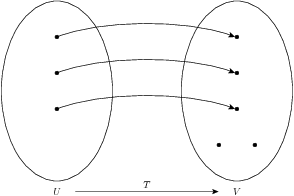
Matrix as a linear transformation(T): mapping basis to [image] T(U )-> V in analogy to linear function: f(x)=ax+b
- 1.linear transformation always maps 0 vector into 0 vector. 2.each linear transformation (T) has a unique matrix representing it, each matrix represent a linear transformation. [just like each mapping represent a linear function...]
- 思想方法: seeing how it maps over into matrix world in analytical way
- Dealing with a bounch of linear equations other than using Gauss-jordan ellimination(消元法): (...), binary, ternary......
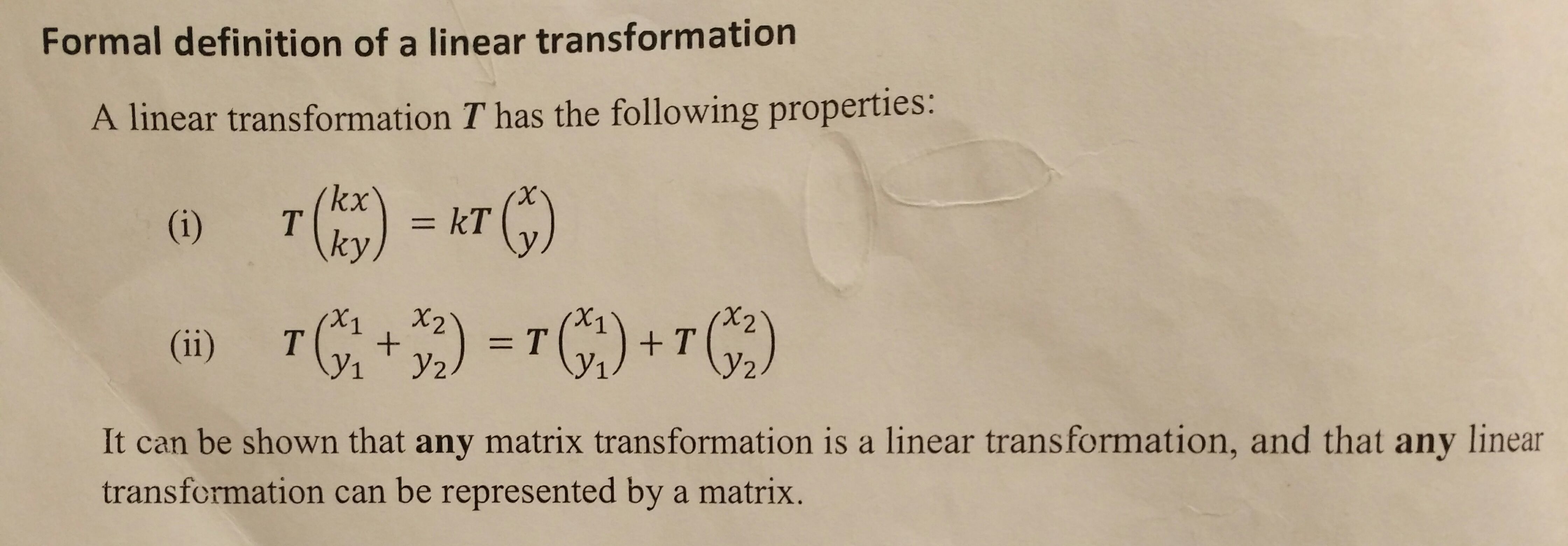
- Linear Transformation: in R^3 is a mapping satisfied following rules
- 反证: 若不符合任意一个rule,则非linear transformation. 如y=ax^2, 一个y对应俩x.
- Q: Find linear transformation matrix according to transformed matrix and changed basis
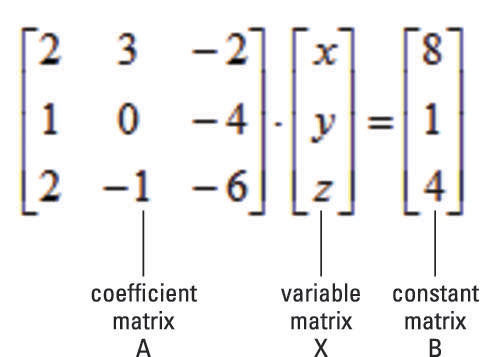
- normally we know: if transformation matrix is (...) then (...)[General Point]=transformed matrix. 1.find it by Gauss-jordan ellimination. 2.if matrix represented [general point] is nonsingular, then TAA^-1=A'A^-1, T=(A')(A^-1)
- By applying rules
- (easiest way:利用加减法组合) since it is linear transformation?, we could split it into three lines of basis:consider[General Point],T1(fist column of T) map (1 0 0) into T'1(first column of Ttransformed). T2...T3...
- Composite transformation: If T1,T2 are linear transformations and A1,A2 are corresponding matrices then:
- a. (T1+T2) will have (A1+A2)
- b. (T1·T2) will have (A1·A2)
- in other words, AB can be seen as two transformation: [General Point/Basis] be transformed by B then A.
- c. T^-1 will have A^-1
- Eigenvalues & Eigenvectors: Av=λv (λ∈R, v is nonzero vector)
- scale factor/number (λ) and changed basis (v) to represent any transformation (Av).
- (= =)beauty of it: Linear Transformation can be entirely determined by the combination of eigenvectors and eigenvalues.
- 特性: if v is an eigenvector, then so is (αv) (α∈R) with same λ
- αv: 可以理解为 multiple of basis--multiple of two linearly independent vectors. 就像direction vector一样,可以随意改变他的''倍数''.
- Unit/ Normalised Eigenvector: v/(|v|) for which has magnitude of 1
- e.g. 2x2, v/(|v|): Xv=a/√(a^2+b^2) Yv=b/√(a^2+b^2)
- Q: Find Eigenvalues by Characteristic equation: det(A-λI)=0
- Av=λv (v≠o vector) Av-λv=o vector (A-λI)v=o (λ multi I to proceed). Since v is nonzero vector, (A-λI) is a singular matrix: det(A-λI)=0, λ can be found easily by quatratic or cubic functions... (functions solve by long division... relevant: appli of △=b^2-4ac)
- Q2: Find Eigenvector according to corresponding Eigenvalues: Av1=(...)v1
- since it is a transformation, use the idea of [General Point/Basis] to represent v1: v1需满足的条件: linearly independent, as it is the things to represent a space/ basis vectors.
- (facts补充) 1. each eigenvalue have at least one linearly independent eigenvectors, while quantity of eogenvectors is less or equal to the directions of their space. 2. you can have infinite eigenvectors, but linearly independent eigenvectors depend on dimensions of space. 3.linearly independent is that one vector cannot be written as combinations of other two. we say: nonparallel in 2x2 space
- INVARIENT
- Invarient Point: is a point vector mapped onto itselft after transformation: A(v)=(1)(v)
- Invarient Line: is a Straight Line in which each points is mapped onto another point on the same line: A(v)=λ(v)
- Except the origin, the image point will always differ to original point as the Distance of that point from origin will be changed by a scale factor which is known as eigenvector (λ).
- Reducing a Symmetric matrix to Diagonal form
- Symmetric Matrix: A^t=A: a. all eigenvalues of symmertric matrix are real, b. eigenvectors corresponding to different eigenvalues will be orthogonal
- Columns of A are mutually orthonormal: 1. orthogonal is a fact, 2. unitary proved by AA^t=i
- AA^t=(...)(...)=I: consider first row x first column,... a^2+b^2+c^2=1 ??
- Columns of A are mutually orthonormal: 1. orthogonal is a fact, 2. unitary proved by AA^t=i
- Orthogonal/ Perpendicular
- two vectors are said to be if v1·v2=0
- Orthonormal: two vectors are orthogonal and unitary if v1·v2=0, |v1|=|v2|=1
- a linear transformation is said to be if it preserves dot product: v1·v2=Av1·Av2
- 特点: 1. it preserves distance and angle 2. (A)(A^t)=(A^t)(A)=I
- 2.=> for symmetrical orthogonal matrix A: A^2=I
- 特点: 1. it preserves distance and angle 2. (A)(A^t)=(A^t)(A)=I
- two vectors are said to be if v1·v2=0
- Steps: 1. find v with λ 2, normalised v, 3. let D=diagonal matrix of eigenvalues, P=matrix of normalised eigenvectors (in columns), 4. D=(P^t)(A)(P) OR (P^-1)(A)(P), or find A=(P)(D)(P^t) OR (P)(D)(P^-1)
- Symmetric Matrix: A^t=A: a. all eigenvalues of symmertric matrix are real, b. eigenvectors corresponding to different eigenvalues will be orthogonal
MATRIX ALGEBRA (involved in FP1)
- Order: matRiCes → R×C
- Addition & Multiplication
- Addition/ substraction works if matrices are of same order
- Matrix·Matrix: works if 1st c= 2nd r
- e.g. (2×3)(3×3)
- anticommutative property: AB≠BA
- (理解)is like A premultiple/ transform B. the other is B premultiple/ transform A.
- e.g. (A')(B')≠(B')(A')
- Q: 对于一些问题需要你证明他的不成立, 你要用 algebra 而非 words to show.
- (elimination) Division by inverse: (M-1)MA=(M-1)B, IA=(M-1)B, A=(M-1)B-->(in analogy to) ax=b, (1/a)(a)x=1/a(b)=a/b
- scalar·Matrix
- Inverse matrix: if (A)(B) OR (B)(A) = I, B is inverse of A
- 1. supported as (A)(A^-1)=I, and (A)(B)=I. hence B=A^-1. 2.A^-1 exist only when det(A)≠0, A is non-singular. and it is definitely a square matrix.
- Self-inverse: A^2 OR (A^-1)^2 = I ← A=A^-1
- if so, then it must be self-inverse: since if A=A^-1. A(A^-1)=(A^-1)(A-1)=I.
- (循环) Q: PM=M', QM'=M --> (PQ=I), Q=P'
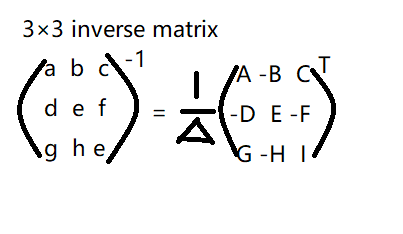
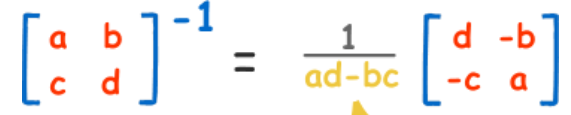
- Find inverse matrix
- 3×3: A^-1=C^t/(detA)
- 2×2:
- laws
- (AB)^-1=(B^-1)(A^-1)
- → (ABC)^-1 = (C^-1)(B^-1)(A^-1).
- (A^-1)^-1 = A
- (A^-1)' = (A')^-1
- (AB)^-1=(B^-1)(A^-1)
- Special Matrices
- column matrix
- row matrix
- square matrix
- → (detA OR △) Determinant
- rules
- det(AB)=(detA)(detB)=(detB)(detA)=det(BA)
- det(A)·det(A^-1)=1
- det(A)=det(At): if you find △ by row expansion, you just exchange the position of scalars (cofactors)
- det(AB)=(detA)(detB)=(detB)(detA)=det(BA)
- find determinant
- by row/column expansion
- 1.i,jth minor of a matrix is the determinant of Mi,j, where Mi,j is the matrix we have deleted i,jth columns. 2.cofactor matrix of i,jth is determinant by (sign)(minor). sign can be determined by following: + - + - + - - + - + - + + - + - + - 3.finally, to find determinant you can expand any row/column times corresponding cofactors.
- 2 2: △ = ad-bc
- 3 3: | |-| |+| |
- by row/column expansion
- Singular matrix: detA = 0 ←→ A^-1 dosen't exist
- 如何记忆: 理解为只有(A), singular(只有一种形式). →(A^-1) 不会存在(又多一种形式). →detA=0.
- rules
- Identity matrix (I): AI=IA=A, I=AA-1=A-1A, T: fixed point in positions
- it is a good property. e.g. appli. A^2=7A+2I, show that A^-1=1/2(A-2I). use (A^2)(A^-1)=(A)(A)(A^-1)= 7(A)(A^-1) + 2I(A^-1). therefore we found A^-1...
- → (detA OR △) Determinant
- 0 matrix: 0A=A0=0
- (general points) Geometrical interpretation: 1.draw a diagram. 2. consider locations of identity points' change (AI=B where A maps I into B OR T(I)-->B, AI=A=B).
- specials
- Translation
- Enlargement: centre: origin & scale factor
- (补充认识rule,using vectors) v1+v2=v T(v1)+T(v2)=T(v) n(v1)+n(v2)=n(v) T(nv1)+T(nv2)=T(nv)
- significance of 2x2 linear transformed matrices: area of images: At=|(Ao)(detMt)|
- area of transformed image= |area of origin image×determinant of transformation matrix|
- significance of 3x3 linear transformed matrices: volume: Vt=|(Vo)(detMt)|
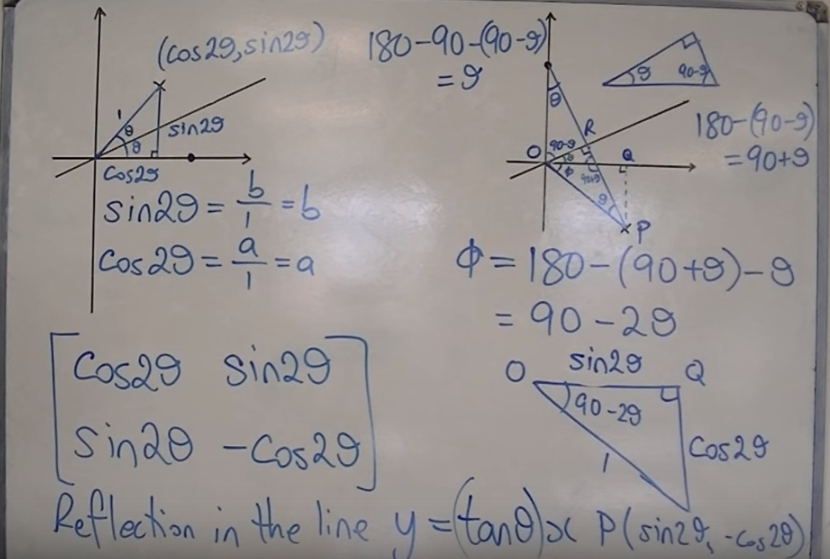
- Reflection: T: (........)<-->in y=(tanθ)x
- Rotation: about origin & 角度, Clockwise./ anticlockwise
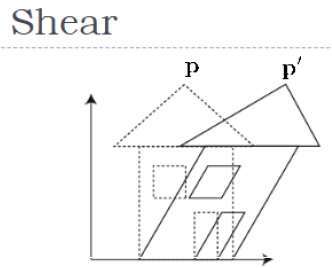
- Shears: as a translation in which only certain coordinates are shifted: 1.horizontal shear 2.vertical shear
- Stretches: 1.in x-direction by factor k; 2.y-direction by factor k
- specials
- Transpose of marix: A (mxn) → At (nxm) where r and c are swapped
- e.g. first row -> first column
- laws
- (AB)'=(B')(A')
- (A')'=A
- (A+B)'=(A')+(B')
- → Symmetric matrix: A=A^t
- e.g. prove (A^t)(A) is a symmetrc matrix: [if A=A^t then it is symmetrical] lets try [(A^t)(A)]^t=(A^t)(A) so it is.
- Symmetrical inverse matrix: A=A^-1
- transposed Area
Bilder und Dateien der Mindmap
Informationen
- Beschreibung
- MATHS (FP3) Mindmap am MATRICES, erstellt von C D am 19/11/2017.
- Erstellt von
- C D
- Aufrufe
- 7
- Bewertung