
Mindmap
God is One
Inhalt der Mindmap
God is One
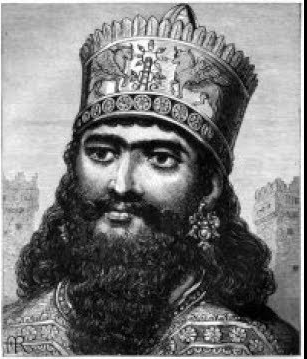
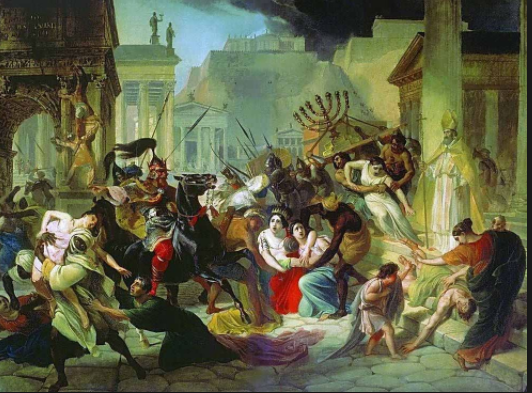
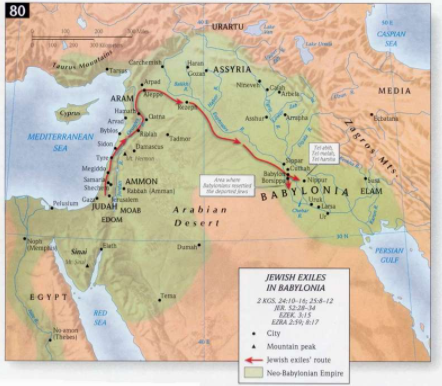
The kingdom of Israel is sacked by Nebuchadnezzar ll. The jewish people were sent to exile (586 B.C.E)
- By this time the kingdom was already fractured. The north being conquered in 722 BC by Sargon ll. The literati escaped to the south bringing oral traditions into judeah. Evidence of the influence of the Elohist tradition since the early days
- The Babylonians conquered Israel not in the name of Nebuchadnezzar, their king, but in the name of Marduk, their god.
- battles between the Israelites and their enemies, which take up so much of the early books of the Bible, were explicitly framed as a fight between Yahweh and foreign gods.
- When Yahweh helped the Israelites crush the Philistines, it proved that the Israelite god was more powerful than the Philistine god, Dagon.
- Dagon
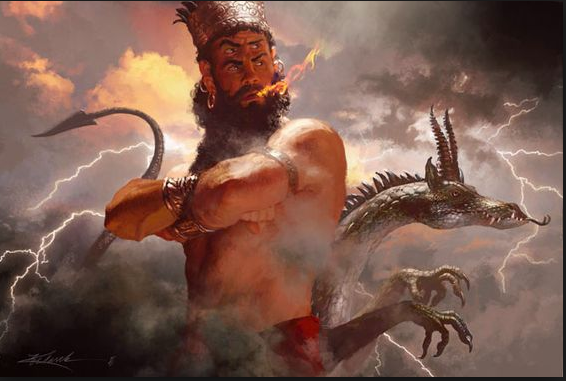
- But then Babylonians destroyed the israelites. So basically Marduk was more powerful than Yahweh
- Marduk
- Israelites adopted Babylonian names, studied Babylonian scriptures, and began worshiping Babylonian gods.
- Perhaps Yahweh was punishing the Israelites for believing in Marduk in the first place. Or Perhaps there was no Marduk. Just Yahweh
- “This is my name forever,” Yahweh tells the prophet Moses, “and this is how I will be remembered from generation to generation” (Exodus 3:15). (First Yahweh appereance)
- Moses’s name is Egyptian, and it contains the same root as the theophoric names Tuthmosis (“Thoth born; drawn out by Thoth”) and Rameses (“Ra born; drawn out by Ra”).
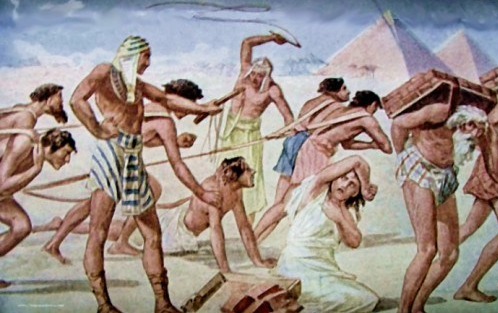
- Supposedly, the Israelites had grown so numerous and powerful in Egypt that they were stripped of their wealth and freedom and forced into slavery.
- The problem is that no archaeological evidence has ever been unearthed to indicate the presence of Israelites in ancient Egypt.
- Moses, who had married into a Midianite tribe, came across a Midianite deity (Yahweh) while under the employ of a Midianite priest (his father-in-law) in the land of Midian.
- the first task that this Midianite god gives to Moses is to return to Egypt, free the Israelite slaves from bondage, and shepherd them back to their home in the Land of Canaan
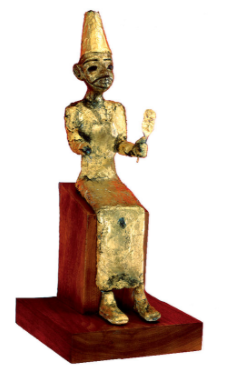
- The fact of the matter is that these biblical patriarchs did not worship a Midianite desert deity called Yahweh. They worshiped an altogether different god—a Canaanite deity they knew as El.
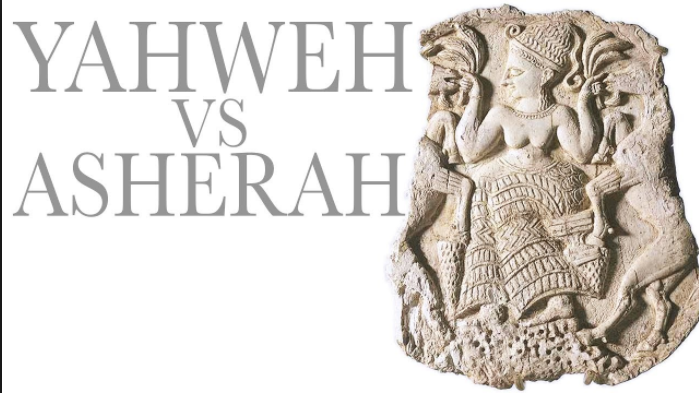
- Scholars have known for centuries that there were two distinct deities worshiped by the Israelites in the Bible,
- They have managed to identify at least four different written sources that make up the bulk of the early books in the Bible.
- Yahwist or J which dates to the tenth or ninth century B.C.E. and runs through large parts of Genesis, Exodus, and Numbers
- He creates the world through trial and error, forgetting to craft a mate for Adam
- More anthropomorphic
- Yahweh, usually rendered in English Bibles as the Lord, spelled with all capital letters: “The LORD [Yahweh] said, ‘Surely I have seen the misery of my people who are in Egypt’ .
- More anthropomorphic
- He creates the world through trial and error, forgetting to craft a mate for Adam
- Elohist, or E, source, which dates to the eighth or seventh century B.C.E. and is mostly confined to Genesis and parts of Exodus
- the Elohist material, which was probably written by a priest from northern Israel, refers to Mount Sinai as Mount Horeb (Exodus 3:1) and calls the Canaanites “
- Reveals Himself in Visions and dreams
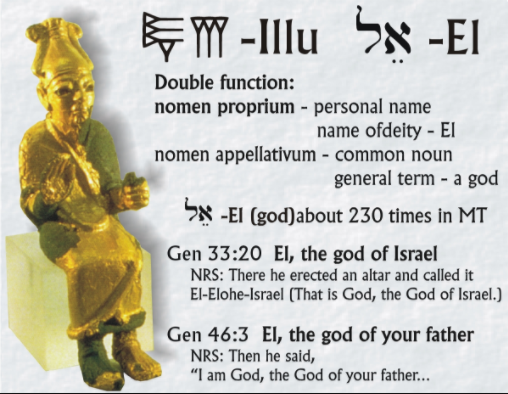
- God is called by a different name in each. The god of the Elohist is El or Elohim. Abbreviated capital G
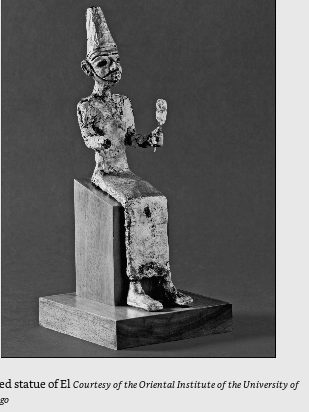
- El is one of the best-known and most well-documented deities in the Ancient Near East.
- "El" was also unquestionably the original god of Israel. Indeed, the very word Israel means “El perseveres.”
- The traditional view that israelites were strict monotheists is patently false.
- King Saul, the first king of Israel, even named two of his sons after the god Baal—Eshbaal and Meribbaal—alongside the son he named after Yahweh: Yehonatan, or Jonathan.
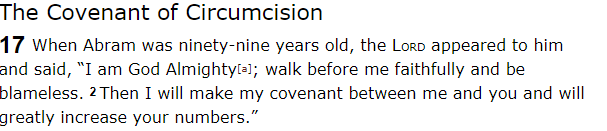
- Original Version read " I am El Shaddai" not "God Almighty"
- Indeed, the story of how monotheism—after centuries of failure and rejection—finally and permanently took root in human spirituality begins with the story of how the god of Abraham, El, and the god of Moses, Yahweh, gradually merged to become the sole, singular deity that we now know as God.
- the Israelites were unfamiliar. they continued to exhibit little loyalty to this unknown god.
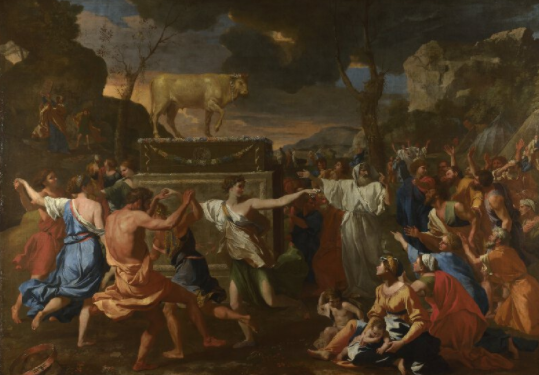
- After receiving the 10 commandments the Israelites down below had already reverted to the worship of Abraham’s god, fashioning for themselves an idol in the shape of a golden calf—the primary symbol of El.
- When Elyon gave the nations their inheritance, when he separated the sons of man, he fixed the borders of the people in accordance with the number of the gods; Yahweh’s own portion was his people. DEUTERONOMY 32:8–9 .
- This extraordinary passage not only affirms Israel’s recognition of other gods under El’s rule, it clearly casts Yahweh as one of those gods. It states that each deity received as a gift or “portion” from El its own nation, and that Yahweh’s gift was the nation of Israel.
- Israel became a kingdom And as happened in Babylon, Assyria, Egypt, and elsewhere, as the nature of the rule of men on earth changed, so, too, did the rule of the gods in heaven to match; in other words, politicomorphism.
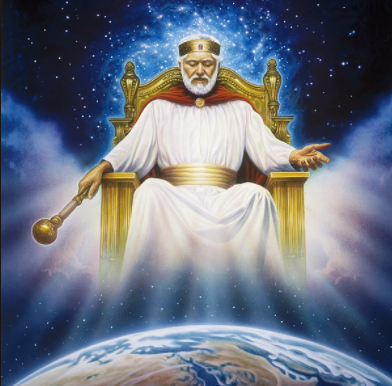
- A king in the sky was needed aswell. A king of gods, Yahweh filled that roll. Thus the desert deity worshiped by nomads in the Sinai was elevated to the top of the Israelite pantheon as king of heaven and ruler of all other gods.
- “Yahweh has established his throne in the heavens and his kingdom rules over all” (Psalms 103:19).
- So we see Yahweh in the Psalms—the chief form of kingly propaganda in the Bible—subsuming El’s role as the celestial king, enthroned and surrounded by a heavenly host in a divine council, just as El had been.
- Let the heavens praise your wonders, O Yahweh, and your faithfulness in the assembly of the holy ones. Who in the sky can be compared to Yahweh? Who among the sons of god is like Yahweh, a god feared in the council of the holy ones, greater and more fearful than any of those who surround him? PSALMS 89:5–7; SEE ALSO PSALMS 82
- They thought Yahweh was merely the best god in the universe. But not the only god.
- After the Babylonian conquest of Israel we start to see unambiguous monotheism in the entire Bible: “Thus says Yahweh, the King of Israel and its redeemer…‘I am the first and the last; besides me there are no gods’ ” (Isaiah 44:6).18
- The crisis of identity posed by the Babylonian Exile forced the Israelites to reexamine their sacred history and reinterpret their religious ideology. They needed to make sense of the experience
- it was better to devise a single vengeful god full of contradictions than to give up that god and thus their very identity as a people.
- people. And so all the historical arguments against belief in a single god were suddenly swept away by the overwhelming desire for this tiny, insignificant Semitic tribe to survive.
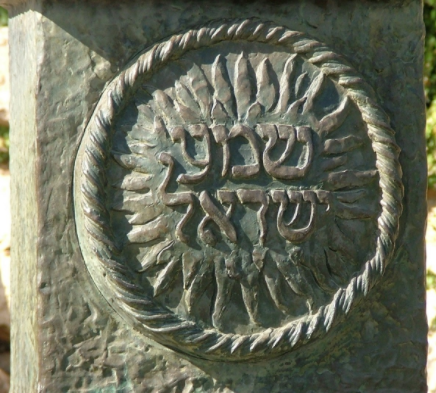
- The very testament of faith in Judaism, known as the Shema (“Hear O Israel, Yahweh is our god, Yahweh is one”), was composed after this transformational moment in Israelite history.
- Even the biblical material composed before the Exile—that is, the Yahwist and Elohist sources—was reworked and rewritten by the Priestly and Deuteronomistic writers after the Exile to reflect this newly found vision of One God.
- This was a new kind of God, both singular and personal. A solitary God with no human form who nevertheless made humans in his image. An eternal, indivisible God who exhibits the full range of human emotions and qualities, good and bad.
- It is an extraordinary development in the history of religions—one that took hundreds of thousands of years to evolve; one that would be overturned a mere five hundred years later by an upstart sect of apocalyptic Jews calling themselves Christians.
- This was a new kind of God, both singular and personal. A solitary God with no human form who nevertheless made humans in his image. An eternal, indivisible God who exhibits the full range of human emotions and qualities, good and bad.
- Even the biblical material composed before the Exile—that is, the Yahwist and Elohist sources—was reworked and rewritten by the Priestly and Deuteronomistic writers after the Exile to reflect this newly found vision of One God.
- The very testament of faith in Judaism, known as the Shema (“Hear O Israel, Yahweh is our god, Yahweh is one”), was composed after this transformational moment in Israelite history.
- people. And so all the historical arguments against belief in a single god were suddenly swept away by the overwhelming desire for this tiny, insignificant Semitic tribe to survive.
- it was better to devise a single vengeful god full of contradictions than to give up that god and thus their very identity as a people.
- The crisis of identity posed by the Babylonian Exile forced the Israelites to reexamine their sacred history and reinterpret their religious ideology. They needed to make sense of the experience
- After the Babylonian conquest of Israel we start to see unambiguous monotheism in the entire Bible: “Thus says Yahweh, the King of Israel and its redeemer…‘I am the first and the last; besides me there are no gods’ ” (Isaiah 44:6).18
- A king in the sky was needed aswell. A king of gods, Yahweh filled that roll. Thus the desert deity worshiped by nomads in the Sinai was elevated to the top of the Israelite pantheon as king of heaven and ruler of all other gods.
- Israel became a kingdom And as happened in Babylon, Assyria, Egypt, and elsewhere, as the nature of the rule of men on earth changed, so, too, did the rule of the gods in heaven to match; in other words, politicomorphism.
- This extraordinary passage not only affirms Israel’s recognition of other gods under El’s rule, it clearly casts Yahweh as one of those gods. It states that each deity received as a gift or “portion” from El its own nation, and that Yahweh’s gift was the nation of Israel.
- When Elyon gave the nations their inheritance, when he separated the sons of man, he fixed the borders of the people in accordance with the number of the gods; Yahweh’s own portion was his people. DEUTERONOMY 32:8–9 .
- After receiving the 10 commandments the Israelites down below had already reverted to the worship of Abraham’s god, fashioning for themselves an idol in the shape of a golden calf—the primary symbol of El.
- Every name Ending in "El" makes allusion to this great Canaanite god
- Gabri-EL = God is my strong man
- Rapha-EL = God has healed
- Gamali-EL = benefit of God
- Jo-EL = YAHWEH is God
- Micha-EL = who is like God
- Dani-EL =God is my judge
- Uri-El = God is my light
- Samu-EL = God has heard
- Uri-El = God is my light
- Dani-EL =God is my judge
- Micha-EL = who is like God
- Jo-EL = YAHWEH is God
- Gamali-EL = benefit of God
- Rapha-EL = God has healed
- Gabri-EL = God is my strong man
- the Israelites were unfamiliar. they continued to exhibit little loyalty to this unknown god.
- King Saul, the first king of Israel, even named two of his sons after the god Baal—Eshbaal and Meribbaal—alongside the son he named after Yahweh: Yehonatan, or Jonathan.
- The traditional view that israelites were strict monotheists is patently false.
- "El" was also unquestionably the original god of Israel. Indeed, the very word Israel means “El perseveres.”
- El is one of the best-known and most well-documented deities in the Ancient Near East.
- God is called by a different name in each. The god of the Elohist is El or Elohim. Abbreviated capital G
- Reveals Himself in Visions and dreams
- the Elohist material, which was probably written by a priest from northern Israel, refers to Mount Sinai as Mount Horeb (Exodus 3:1) and calls the Canaanites “
- Priestly, or P, source, which was written either during or immediately after the Babylonian Exile in 586 B.C.E. and is primarily a reworking of the J and E material
- The much later Priestly source tends to go back and forth between using the names Yahweh and Elohim in an obvious attempt to merge these two different gods into one.
- Deuteronomist, or D, source, which runs from the book of Deuteronomy through First and Second Kings and can be dated to somewhere between the seventh and fifth centuries B.C.E.
- Yahwist or J which dates to the tenth or ninth century B.C.E. and runs through large parts of Genesis, Exodus, and Numbers
- They have managed to identify at least four different written sources that make up the bulk of the early books in the Bible.
- the first task that this Midianite god gives to Moses is to return to Egypt, free the Israelite slaves from bondage, and shepherd them back to their home in the Land of Canaan
- “This is my name forever,” Yahweh tells the prophet Moses, “and this is how I will be remembered from generation to generation” (Exodus 3:15). (First Yahweh appereance)
- Perhaps Yahweh was punishing the Israelites for believing in Marduk in the first place. Or Perhaps there was no Marduk. Just Yahweh
- When Yahweh helped the Israelites crush the Philistines, it proved that the Israelite god was more powerful than the Philistine god, Dagon.
- battles between the Israelites and their enemies, which take up so much of the early books of the Bible, were explicitly framed as a fight between Yahweh and foreign gods.
Bilder und Dateien der Mindmap


Informationen
- Beschreibung
- Kindle (God-Reza Aslan) Mindmap am God is One, erstellt von Isaac Bolaños am 05/01/2018.
- Erstellt von
- Isaac Bolaños · Jan 2018
- Aktualisiert
- 5 Jan 2018
- Aufrufe
- 0
- Bewertung