
11993924
Beschreibung

Mindmap von Caitlin Ann, aktualisiert more than 1 year ago

|
Erstellt von Caitlin Ann
vor fast 8 Jahre
|
|
Thermodynamics
- Definitions of
terms
- Enthalpy change
- a heat change
at constant
pressure
- Enthalpy of formation - the
enthalpy change when one mole of
a compound is form d from its
elements in their standard states
under standard conditions
- Enthalpy of
combustion - the
enthalpy change when
one mole of substance
is completely burnt in
oxygen
- Enthalpy of atomisation - the
enthalpy change which accompanies
the formation of one mole of
gaseous atoms from the element in
its standard state under standard
conditions
- First ionisation energy - the
standard enthalpy change when
one mole of gaseous atoms is
converted into a mole of gaseous
ions each with a single positive
charge
- Second ionisation
energy - the loss of a
mole of electrons
from a mole of
singly positively
charged ions
- First electron affinity - the
standard enthalpy change when
a mole of gaseous atoms is
converted to a mole of gaseous
ions, each with a single negative
charge
- Second electron affinity -
the enthalpy change when
a mole of electrons is
added to a mole of gaseous
ions each with a single
negative charge to form
ions each with two
negative charges
- Lattice Enthalpy of formation -
the standard enthalpy change
when one mole of solid ionic
compound is formed from it's
gaseous ions
- Enthalpy of hydration - the
standard enthalpy change
when water molecules
surround one mole of
gaseous ions
- Enthalpy of solution - the
standard enthalpy change
when one mole of solute
dissolves completely in
sufficient solvent to form a
solution in which the
molecules or ions are far
enough apart not to interact
with each other
- Mean bond enthalpy - the
enthaloy change when one
mole of gaseous molecules
each breaks a covalent
bond to form two free
radicals, averaged over a
range of compounds
- Enthalpy change
- a heat change
at constant
pressure
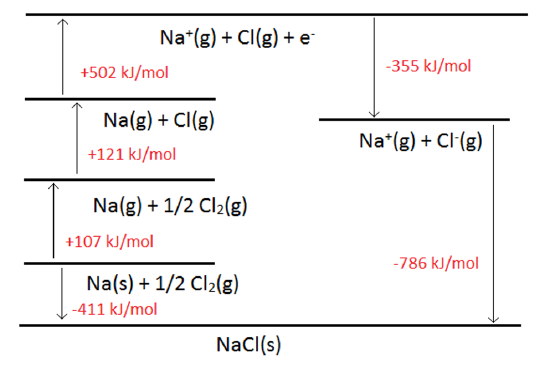
- Born-Haber cycles
- a thermochemical cycle
that includes all the
enthalpy changes
involved in the
formation of an ionic
compound
- the formation of an ionic
compound is an exothermic
process due to the large
amount of energy given out
when the lattice forms
- all elements in their standard
states have zero enthalpy
- a thermochemical cycle
that includes all the
enthalpy changes
involved in the
formation of an ionic
compound
- Trends in lattice
enthalpies
- larger ions lead to smaller lattice
enthalpies as the opposite charges do
not approach each other as closely
when the ions are larger
- the lattice enthalpy increases with the size
of the charge as ions with double the charge
give out roughly twice as much energy when
they come together
- down the group - larger positive ions
across the period - larger negative
ions
- larger ions lead to smaller lattice
enthalpies as the opposite charges do
not approach each other as closely
when the ions are larger
- Spontaneous or
feasible reactions
- entropy - the
measurement of
disorder in a system
- if the products are more disordered than the
reactants, the ∆S value will be positive
- gases are more disordered than liquids
which are more disordered than solids due
to the arrangement of particles
- entropy change = entropies of products - entropies of reactants
- ∆G = ∆H - T∆S
- if ∆G is negative, the
reaction is feasible
- spontaneous reaction - a reaction
that occurs without an outside
agency eg. heat energy
- a positive enthalpy
change is endothermic
(heat energy is
absorbed from the
surroundings)
- entropy - the
measurement of
disorder in a system
Medienanhänge
Möchten Sie kostenlos Ihre eigenen Mindmaps mit GoConqr erstellen? Mehr erfahren.