
Mindmap
Buoyancy
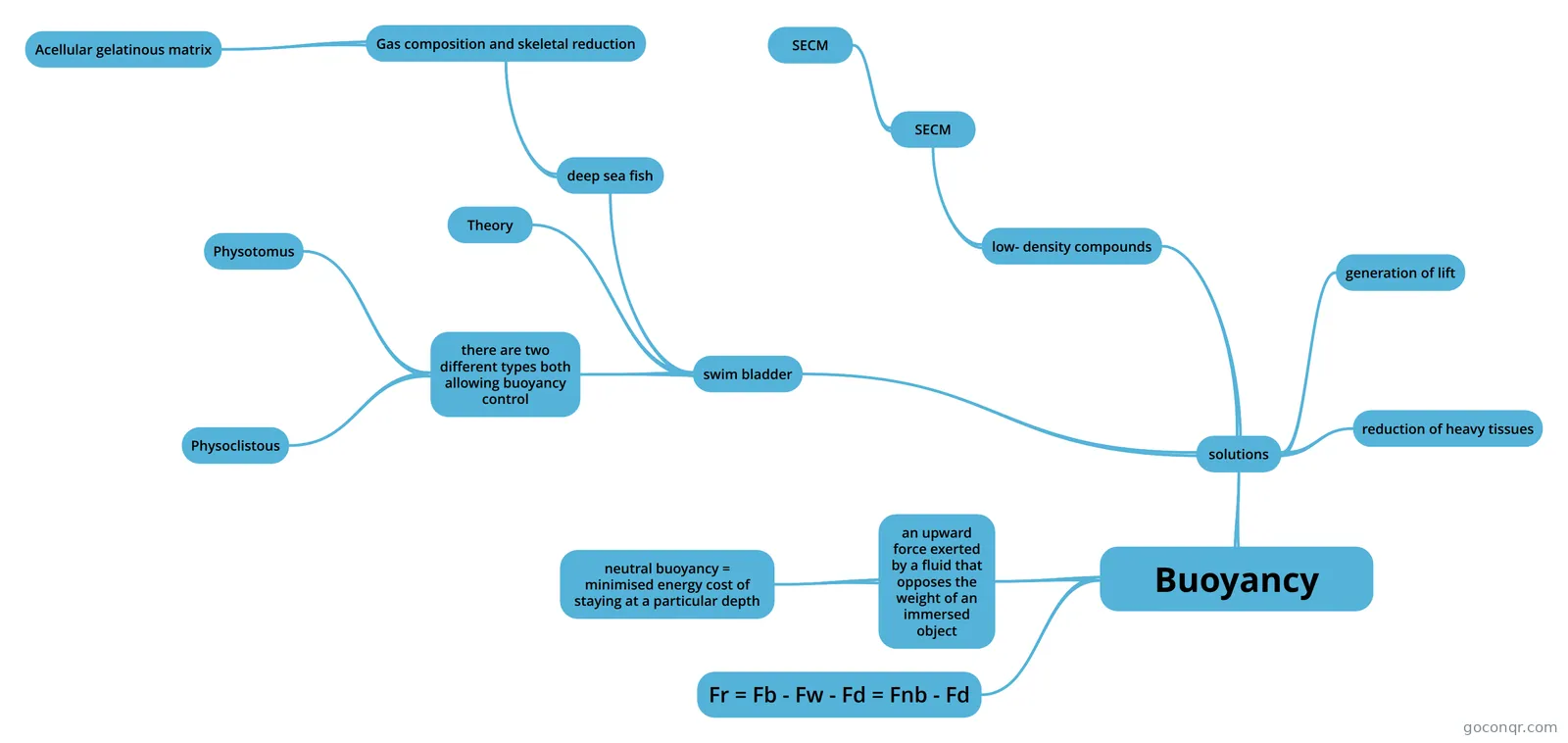
Mind map: Buoyancy and fluid forces
Inhalt der Mindmap
Buoyancy
an upward force exerted by a fluid that opposes the weight of an immersed object
- neutral buoyancy = minimised energy cost of staying at a particular depth
- fish can exert propulsion force > 25-50% of its body wieght for only a brief periods of time
- continuoes effort to support its body by muscular power alone would be energetically costly
- reducing the wieght of the body makes this easier - and less costly
- neutral buoyancy = minimised energy cost of staying at a particular depth
Fr = Fb - Fw - Fd = Fnb - Fd
- Fr = resulting force Fw = wet weight Fb = Buoyancy force Fd = drag force Fnd = Net buoyancy
solutions
- there are 4 main bouyancy adaptaions
- most species will adopt with a swim bladder of low-density compounds with either being combined with weight reduction measures and/or lift generation
- swim bladder
- the weight of seawater is 1.026 and the weight of a fish with no swim bladder is 1.07
- to achieve neutral buoyancy gas needs to occupy around 5% of body volume at any given depth - so the bigger you are the more you give up for a swim bladder
- fish remaining at one depth only need to maintain gas in swim bladder by topping up - nateral leaks
- the swim bladder wall - gas impermeable material fat or guanine crystals
- greater depth = greater potential rate of diffusive loss deeper living fishes have thicker layers crystals give swim bladder characteristics silver colour
- there are two different types both allowing buoyancy control
- fish swim bladders generally contain a mixture of gases including oxygen, nitrogen and carbon dioxide but in the deep sea they are predominantly filled with oxygen
- for fishes living near the surface, changes in the volume of the swim bladder with depth are a major difficulty
- this requires maximum vertical thrust from the fins in order to compensate for increased buoyancy
- Physotomus
- these fish have a connection to thier mouth - so have to stay near the surface and gulp in air - this is really easy and efficient however they are always linked to the surface
- Physoclistous
- these do not have a Pneumatic duct - between the swimbladder and the gut
- over two- thirds have these types
- other advantages are great efficiency at higher pressures disadvantages are they are slow to adjust
- retrieval of fish from depth often result in the rapid pressure equilibrium of the gas causing it to expand
- they add in gas by chemical reactions which produces gas which then inflates the swimbladder via gas diffusion
- then to deflate the gas bladder the air deflates gas into the blood stream
- Theory
- the density of oxygen at 0 degrees as a function of pressure calculated from boyles law, vander waals and amagats experimenal results
- this shows that the difference between the density of oxygen as a function of pressure calculated from amagats results and the density of seawater at the same pressure remains negative down to the maximum ocean depth of 11 km
- therefore an oxygen-filled swim bladder always provides positive buoyancy to fishes
- deep sea fish
- because of the relative incompressibility of gases at high pressure, ascent from 6000m to 5000m for an abyssal fish causes only a 14% increase in buoyancy
- it is probably that deep-sea fishes do not make major adjustments to their swim bladder buoyancy since minimal change in vertical thrust from the fins sufficient to maintain equilibrium
- great vertical excursion are trivial for these abyssal fishes
- an anomaly remains that it is not fully understood is how fish living at great depths can pump gas into their swim bladders.
- this suggests that deep sea fishes should have larger swim bladders
- however this isnt the case - due to lack of food and limited energy excursion they adapt other adaptations to assist the swim bladder
- Gas composition and skeletal reduction
- the deep water fishes lose all excess muscules and bones just the amin backbone
- Acellular gelatinous matrix
- structural support and transparency one possible role proposed for gelatinous larval fishes and some deep-sea invertebrates is to allow growth to large size at low metabolic cost
- fishes in the superorder elopomorpha have larvae called leptocephali in which most of the body consists of an acellular gelatinous matrix that provides structural support in the absence of a vertobral column and transparency for camouflage
- low- density compounds
- used by most sharks and some teleosts sharks use large quantities of lipids and hydrocarbon squalene in the liver to bring the body mass to bouyant
- shark bouyancy is further aided by heterocercal tail fins and pectoral find with a postiive angle of attack on the leading edges
- teleost use low density oil mainly in the bones
- SECM
- many deep - sea fish have gelatinous layer or subdermal extracellular matrix below the skin or around the spine
- gelatinous tissue are mostly extracellular fluid, which are inexpensive to grow. most of these secm tissues float in cold seawater - lower density than seawater and thus contribute to buoyancy in some speies
- gelatinous tissue can also increase swimming efficiency by fairing the transition from trunk to tAIL
- SECM
- the layer of gelatinous tissue is originally quit stable - but then when taken out an exposed to air it leaks out of the skin
- osmolarity of 350-400 mOsm kg-1. thus less dense then seawater
- these low density tissues and fluids would be adaptive under the high hydrostatic pressures of the deep sea, where the inflation of a swimbladder becomes increasingly difficult
- they have been noted in several species and mass of a fish
- gelatinous tissues could also act as fairing along the fishs tail, creating a better hydrofoil and improved swimming efficiency
- inexpensive bulking up and streamlining - gelatinous tissues are found in some species with gas-filled swim bladders indicating that bouyancy may not always be their primary adaptive role
- generation of lift
- reduction of heavy tissues
Informationen
- Beschreibung
- University Form, Function and adapatations of Marine Animals Mindmap am Buoyancy, erstellt von chloe allen am 22/02/2018.
- Erstellt von
- chloe allen
- Aufrufe
- 0
- Bewertung